AD Agencies
Harmanpreet Kaur on pressure, belief and cricket’s big reset
Goafest 2026 session traced women’s cricket rise from empty stands to glory


MUMBAI: When Harmanpreet Kaur talks about pressure, she does not sound like someone discussing a World Cup chase against Australia. She sounds like someone explaining how to survive life itself. “Breathe. Reset. Come back to the present moment.”
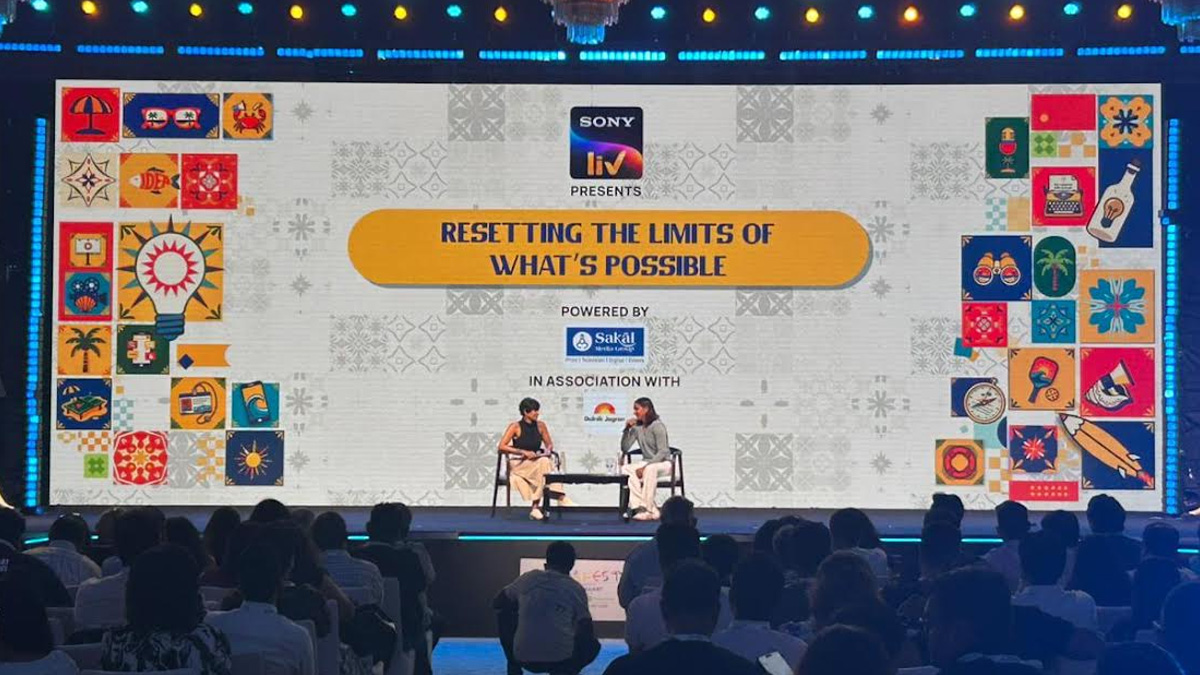
At Goafest 2026 at Taj Cidade de Goa Horizon, the Indian women’s cricket captain joined actor, anchor and fitness enthusiast Mandira Bedi for a deeply personal and surprisingly philosophical conversation titled “Resetting the Limits of What’s Possible”. What unfolded was far more than a celebrity fireside chat. It became part leadership masterclass, part locker-room confession, and part reflection on how women’s cricket in India rewrote its own destiny.
The session opened with the festival’s central theme, reset. Mandira Bedi asked Harmanpreet what “reset” means when a match is slipping away, the scoreboard is tightening and the pressure feels unbearable.
For Harmanpreet, the answer was not tactical. It was mental.
“Reset for me is coming back to the present moment,” she said, explaining how she consciously focuses on her breathing whenever pressure begins to cloud her thinking. “No matter how fast the game gets, just talking to yourself and focusing on breathing always helps.”
It was a striking insight from a player who has spent nearly two decades carrying the expectations of Indian women’s cricket on her shoulders. But perhaps that calmness did not come overnight. It was built over years that were far removed from the glamour, endorsements and sold-out stadiums now attached to the women’s game.
Long before the crowds and television lights arrived, there was a little girl in Punjab batting with a wooden plank because she did not have a proper cricket bat. Harmanpreet recalled how cricket was woven into everyday life in her family. Her father, brother and relatives constantly watched matches, and somewhere in between those living-room screenings, a dream quietly took shape.
“I don’t remember dreaming about anything except cricket,” she said. “I only remember asking my father for a bat and telling him one day I wanted to wear the India jersey.”
At the time, she did not even know women’s cricket existed professionally. She simply knew she wanted to play.
The turning point came after her Class 10 examinations, during the months she spent waiting for her results. A cricket coach noticed her talent while she was playing with boys and offered to open his academy to girls if she wanted to join. Until then, coaches had approached her for other sports never cricket.
“He was the first person who asked me if I wanted to seriously play cricket,” she recalled. “The next day I shifted to his school and joined the academy.”
The rest, as Mandira Bedi noted during the session, became history. Harmanpreet debuted for India in 2009 against Pakistan, beginning a journey that would eventually transform not only her career but the visibility of women’s cricket itself.
Naturally, the conversation gravitated towards the innings that changed everything her unbeaten 171 against Australia in the semi-final of the 2017 Women’s World Cup.
Even now, nearly a decade later, the knock continues to feel larger than sport. It was not merely an innings. It became a cultural moment that forced India to pay attention to women’s cricket in a way it never had before.
Yet Harmanpreet remembered it with remarkable simplicity.
“That day, I was just batting,” she said with a smile. “I was only trying to help my country win.”
Only later did she understand what that innings truly meant.
“When we came back from England, I saw little girls in cricket whites carrying kits in my city for the first time,” she said. “I had never seen girls going to play cricket before that. That’s when I realised the impact.”
The impact went beyond inspiration. It changed economics, visibility and ambition around the women’s game. Stadiums started filling up. Broadcasters started investing. Sponsors began paying attention. And eventually, the Women’s Premier League arrived.
Harmanpreet admitted she became emotional seeing the first WPL season unfold with packed crowds and large-scale production.
“We always dreamed of seeing stadiums full for women’s cricket,” she said. “After the 2017 World Cup, we knew if WPL happened, women’s cricket could change completely.”
For players who had spent years performing before sparse audiences and limited recognition, the WPL represented validation as much as opportunity. Harmanpreet credited the league and the trust shown by administrators and stakeholders — for accelerating the team’s confidence and eventually helping India secure a major ICC title.
“When somebody shows trust in you, you want to deliver,” she said. “That trust changed women’s cricket.”
The discussion also revisited India’s recent ICC triumph, particularly the nerve-shredding semi-final chase against Australia. Harmanpreet described how calmness became the team’s greatest weapon after losing early wickets.
She recalled conversations with teammates during the innings, emphasising how the focus remained only on the next few overs rather than the enormity of the target.
“We kept telling ourselves, just keep batting, don’t think too far ahead,” she said. “That calmness helped us.”
What emerged repeatedly through the session was Harmanpreet’s leadership style, one rooted less in authority and more in emotional freedom. Asked how she mentors younger players entering the dressing room, she spoke about removing fear rather than demanding perfection.
“Don’t be afraid of making mistakes,” she said. “Mistakes are normal. What matters is how quickly you learn from them.”
Her philosophy seemed especially relevant in a cricket culture where scrutiny can feel relentless. In India, every captain becomes a public debate. Every tactical decision is dissected across television panels, social media timelines and WhatsApp groups.
But Harmanpreet appeared remarkably unaffected by outside noise.
“There are always two sides,” she said. “Some people will appreciate you and some people won’t. But the important thing is are you honest in what you are doing for the team?”
Then came perhaps the sharpest line of the evening, delivered with effortless clarity.
“What people think doesn’t pay the bills and what people think doesn’t win matches.”
The audience erupted.
Mandira Bedi kept the mood light throughout, steering the conversation from intense sporting moments into humour-filled rapid-fire questions. Harmanpreet revealed her love for Punjabi music before matches, admitted she travels with a golf kit, named Harleen Deol and Shafali Verma as the funniest teammates, and confessed that chole bhature remains her ultimate cheat meal.
Asked what she might have become had cricket not worked out, Harmanpreet answered instantly: “Footballer.” Then, after a pause, she reconsidered. “Or golfer.”
But the evening’s most memorable answer arrived near the end.
Mandira asked her to complete one sentence, “A true champion is someone who…”
Harmanpreet did not overthink it.
“Someone who never gives up.”
It landed like the perfect final over. Simple, direct and impossible to argue with.
Because in many ways, Harmanpreet Kaur’s journey itself is proof of that idea. From batting with makeshift equipment in small-town Punjab to lifting India onto cricket’s biggest stages, her story mirrors the evolution of women’s cricket in the country overlooked for years, underestimated often, but never willing to stop fighting.
And at Goafest 2026, amid conversations about creativity, reinvention and change, Harmanpreet perhaps delivered the festival’s clearest message of all: sometimes resetting the limits of what’s possible begins with refusing to give up on the dream in the first place.