Connect with us

Regulators

WhatsApp agrees to follow CCI data safeguards after Supreme Court hearing

Company assures compliance by 16 March, ending long privacy row

Published

on

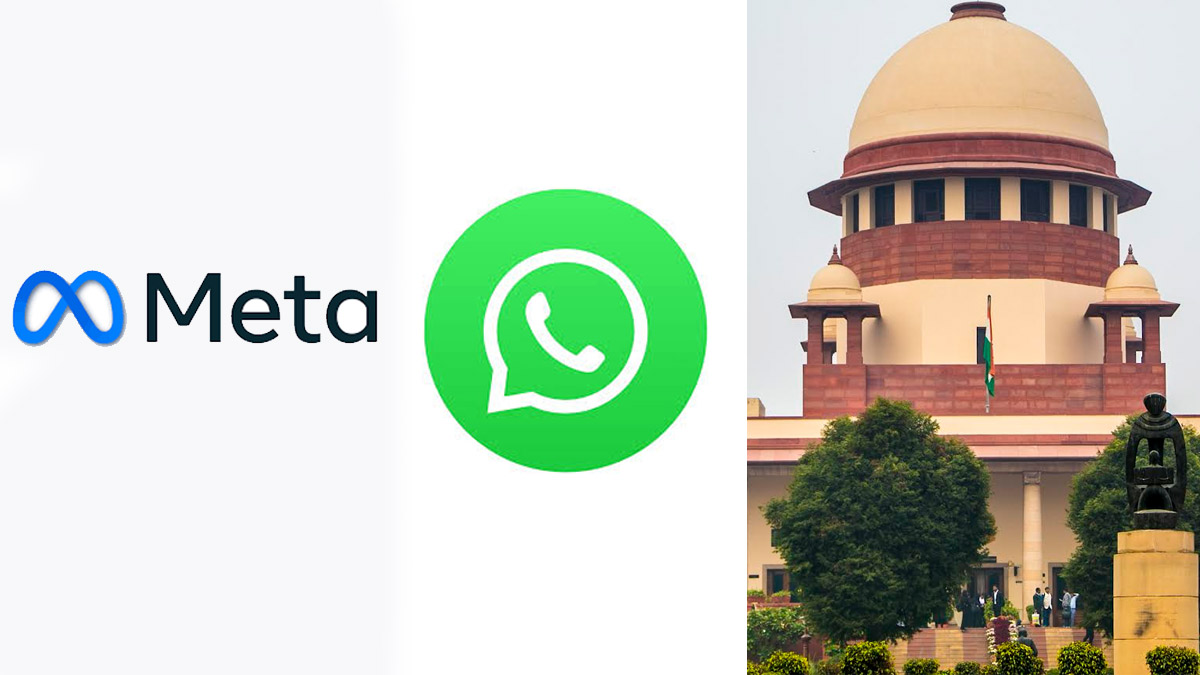
NEW DELHI: In a notable climbdown, WhatsApp and its parent company Meta have told the Supreme Court of India that they will comply with the data privacy safeguards ordered by the Competition Commission of India by 16 March 2026.

The assurance draws a curtain, at least for now, on the long-running dispute over WhatsApp’s 2021 privacy policy update that sparked outrage for its so-called take-it-or-leave-it approach to data sharing.

At the heart of the controversy was a simple question: should users be forced to share their data with other Meta platforms such as Facebook and Instagram in order to keep using WhatsApp? Regulators said no. WhatsApp has now agreed.

Advertisement

Under the revised framework, users will get meaningful consent options. They can opt in or opt out of sharing their data with Meta companies for purposes beyond running WhatsApp’s core services, including advertising. The company must also spell out, in plain terms, what data is being shared, with whom, and why.

Crucially, consent will not be a one-way street. Users will be able to withdraw it at any time. Access to WhatsApp cannot be tied to agreeing to share data for non-essential purposes. In short, no more bundled bargains.

The case has taken a winding legal route. In November 2024, the CCI fined Meta Rs 213.14 crore for abusing its market dominance and imposed a five-year ban on data sharing for advertising. A year later, the National Company Law Appellate Tribunal upheld the fine but replaced the blanket ban with a regime centred on user consent safeguards, later clarifying that these apply to both advertising and non-advertising data.

Advertisement

Earlier this month, the Supreme Court delivered a sharp rebuke, reportedly calling the mandatory data sharing a mockery of constitutionalism and likening it to a polite form of theft. Facing the risk of having their appeal dismissed, Meta and WhatsApp withdrew their plea for interim relief and agreed to implement the safeguards by mid-March.

For millions of Indian users, it is about control. The decision promises greater say over how personal data travels across the Meta ecosystem. For rivals in the digital advertising market, it is about fair play. The CCI had argued that WhatsApp’s vast user base gave Meta an edge that competitors could not match.

The broader backdrop is India’s Digital Personal Data Protection Act, still in the process of full implementation. This case sets an early benchmark for how global technology firms may be expected to handle user data in the country.

Advertisement

The main appeal challenging the legality of the 2021 policy and the Rs 213 crore fine is still pending before the Supreme Court. For now, however, WhatsApp has agreed to rewrite the rules of consent in India. Whether that marks a turning point or merely a pause in the battle remains to be seen.

Click to comment

Leave a Reply

Your email address will not be published. Required fields are marked *

Regulators

India’s telecom base crosses 1.314 billion mark in January 2026

Wireless adds 7.57m to hit 1.266bn, broadband surges past 1.052bn as Jio leads, MNP at 15.98m.

Published

on

MUMBAI: Ring the changes, India’s telecom sector is off the hook! While the rest of us were busy scrolling through reels, the nation quietly dialled up another blockbuster month of connections, pushing the total telephone subscriber base to a staggering 1.314 billion as of 31 January 2026. That’s a breezy net addition of 7.86 million in just 30 days enough to fill a small city with new SIMs overnight.

The real hero of the story? Wireless. It climbed to 1,266.34 million, adding a cool 7.57 million users at a steady 0.60 per cent monthly growth. Urban wireless jumped 0.77 pr cent to 725.67 million, while rural added 2.98 million to reach 540.67 million. Even after stripping out machine-to-machine (M2M) links, the active wireless (mobile) subscriber count on peak Visitor Location Register day stood at 1,172.10 million, a whopping 93.70 per cent of the 1,250.89 million total wireless mobile base. Bharti Airtel takes the crown here with a near-perfect 99.64 per cent VLR proportion, proving its customers are actually using their phones, not just hoarding them.

Broadband, meanwhile, is having its own glow-up. Total broadband subscribers crossed the magical 1,052.72 million mark, up 2.12 million (0.20 per cent) from December 2025. Break it down and the story gets even tastier: fixed wired access (DSL, FTTx, cable) grew a healthy 0.83% to 45.83 million, fixed wireless access (5G FWA, Wi-Fi, satellite) shot up a sizzling 5.77 per cent to 15.95 million, and mobile wireless (handset/dongle 3G/4G/5G/M2M) nudged 0.09 per cent higher to 990.95 million. In plain English, India is going wireless-first, and fast.

Advertisement

Reliance Jio Infocomm Ltd. continues to own the broadband throne with 517.56 million subscribers, that’s a commanding 49.16 per cent market share. Bharti Airtel follows at 359.29 million (34.13 per cent), Vodafone Idea at 128.97 million (12.25 per cent), BSNL at 29.64 million, and Atria Convergence Technologies at 2.38 million. Together, these top five command a dizzying 98.59 per cent of the entire broadband pie. On the fixed-wired side alone, Jio still leads with 13.99 million, followed by Airtel (10.38 million), BSNL (4.47 million), Atria (2.38 million) and Kerala Vision (1.46 million) together holding 71.30 per cent. In wireless broadband (FWA + mobile), Jio’s 503.57 million, Airtel’s 348.91 million and Vodafone Idea’s 128.97 million make the top three almost untouchable at 99.98 per cent combined.

Even the old-school wireline segment refused to be left on hold. It grew 0.61 per cent to 47.66 million, adding 0.29 million net subscribers. Urban wireline sits at 42.59 million (89.36 per cent share), rural at 5.07 million. Private players dominate with 80.60 per cent market share; PSUs (BSNL, MTNL, APSFL) hold the remaining 19.40 per cent. Bharti Airtel and Reliance Jio led net additions here too, adding 209,890 and 179,166 lines respectively, while MTNL and BSNL saw small declines.

The numbers that really make you pause? Tele-density figures. Overall, India now boasts 92.22 per cent tele-density (including M2M). Urban areas are practically saturated at 149.84 per cent, while rural has climbed to 59.83 per cent, proof that the digital divide is shrinking, one village tower at a time. Delhi LSA leads the pack at a jaw-dropping 359.98 per cent, Bihar trails at 62.49 per cent. Without M2M, the national figure dips to 84.26 per cent, but the message stays loud and clear, India is more connected than ever.

Advertisement

Fixed Wireless Access (FWA) deserves its own spotlight. 5G FWA subscribers jumped to 11.53 million (urban 5.83 million, rural 5.70 million), while UBR FWA stood at 3.92 million. M2M cellular connections, the silent workhorses powering smart meters and IoT grew to 113.46 million, with Bharti Airtel holding a massive 70.18 million (61.85 per cent share), followed by Jio (20.60 million), Vodafone Idea (18.8 million) and BSNL (3.88 million).

Mobile Number Portability (MNP) requests hit 15.98 million in January 8.97 million from Zone-I and 7.02 million from Zone-II. UP (East) led with 2.33 million, followed by UP (West) at 1.59 million in the north and Madhya Pradesh (1.52 million) plus Bihar (1.44 million) in the south/east. People are clearly shopping around for better deals.

Circle-wise, every category (A, B, C and Metro) posted positive net additions in both wireline and wireless segments. Circle A added 2.79 million wireless and 88,736 wireline, Circle B added 2.69 million wireless and 151,789 wireline. Yearly growth remains impressive too: wireless up 6.92 per cent nationally, wireline up 36.06 per cent. Only Kolkata LSA saw a tiny wireless dip; everywhere else, the green arrows were glowing.

Advertisement

So what does all this mean for the average Indian? More choices, faster 5G FWA rollouts in rural homes, cheaper data plans thanks to fierce competition, and a nation where your phone is no longer a luxury, it’s the default way to live, work, learn and stay connected. The lines are busier, the signals stronger, and India’s telecom story is far from over. In fact, it’s just getting started and the next billion connections are already dialling in.

Continue Reading

Advertisement News18
Advertisement All three Media
Advertisement Whtasapp
Advertisement Year Enders

Indian Television Dot Com Pvt Ltd

Signup for news and special offers!

Copyright © 2026 Indian Television Dot Com PVT LTD