Budget
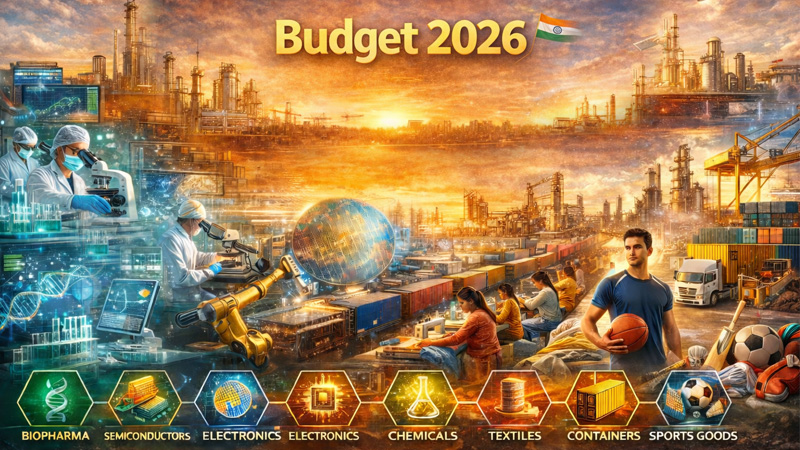
Union Budget 2026 targets 7 strategic sectors to scale manufacturing and global competitiveness
NEW DELHI: Union Budget 2026-27 lays out an ambitious plan to scale up manufacturing across seven strategic and frontier sectors, finance minister Nirmala Sitharaman said in Parliament, forming part of the six areas under the ‘First Kartavya’ framework.
Biopharma SHAKTI aims to develop India as a global biopharma hub, with ₹10,000 crore over five years. The initiative will expand domestic production of biologics and biosimilars, establish a biopharma-focused network with three new NIPER institutes, upgrade seven existing ones, and create over 1,000 accredited India Clinical Trial sites. The Central Drugs Standard Control Organisation will be strengthened with a dedicated scientific review cadre to meet global standards.
The semiconductor sector gets a boost with India Semiconductor Mission 2.0, focused on producing equipment and materials, designing full-stack Indian IP, fortifying supply chains, and developing industry-led R&D and training centres to upskill the workforce. The Electronics Components Manufacturing Scheme, launched in 2025 with ₹22,919 crore, will now see an outlay of ₹40,000 crore.
To tap mineral-rich states, the Budget proposes Rare Earth Corridors in Odisha, Kerala, Andhra Pradesh and Tamil Nadu, supporting mining, processing, research and manufacturing of rare earth permanent magnets.
For chemicals, three dedicated Chemical Parks will be set up on a cluster-based, plug-and-play model via challenge route to enhance domestic production and reduce import dependence.
Capital goods and construction equipment will get a fillip through Hi-Tech Tool Rooms in two locations, digitally-enabled for design, testing and manufacturing of high-precision components. A Construction and Infrastructure Equipment (CIE) Scheme will strengthen domestic production of lifts, fire-fighting gear, tunnel-boring machines and other high-value equipment. A Container Manufacturing Scheme with ₹10,000 crore over five years will create a globally competitive ecosystem.
The textile sector will see an Integrated Programme with five sub-components:
1. National Fibre Scheme – self-reliance in natural fibres (silk, wool, jute), man-made and new-age fibres.
2. Textile Expansion and Employment Scheme – modernisation of clusters with machinery, technology upgrades and common testing/certification centres.
3. National Handloom and Handicraft Programme – targeted support for weavers, artisans and rural industries.
4. Tex-Eco Initiative – promote globally competitive and sustainable textiles and apparels.
5. Samarth 2.0 – modernise textile skilling ecosystem via industry-academia collaboration.
Mega Textile Parks will be set up in challenge mode. The Mahatma Gandhi Gram Swaraj initiative will strengthen khadi, handloom and handicrafts, supporting training, skilling, quality processes and global market linkages.
Finally, the Budget backs sports goods manufacturing, promoting research, innovation in equipment design and material sciences, positioning India as a hub for high-quality, affordable sporting equipment.
From Biopharma to semiconductors, electronics, chemicals, textiles, containers and sports goods, Budget 2026-27 lays a comprehensive, integrated roadmap to make India a global manufacturing powerhouse, blending technology, infrastructure, skills and innovation to boost productivity, jobs and competitiveness.
Industry reactions:
Senthil Kumar Hariram, MD and Founder, FTA Global:
“For the advertising and marketing industry, Budget 2026–27 signals a clear recognition of the services sector as a key growth engine, particularly through its focus on AI and emerging technologies. While there could have been more targeted measures for smaller service-led companies, the intent to simplify compliance, expand MSME financing, and invest in Tier-2 and Tier-3 infrastructure is a positive step. Evaluating the impact of AI on jobs and the services sector is timely for marketing and communications, as AI is already redefining how insights are generated, content is created, media is optimised, and campaigns are measured. The next step is ensuring AI adoption goes hand in hand with upskilling, enabling long-term, sustainable growth.”
Rajiv Chilaka, Founder & CEO, Green Gold Animation:
“The Finance Minister’s renewed focus on the AVGC sector and structured content creation at school and college levels is a transformative step for India’s creative economy. By establishing Animation, VFX, Gaming and Comics Content Creator Labs across thousands of educational institutions, the government is building a deep, sustainable talent pipeline aligned with the industry’s projected requirement of nearly 2 million professionals by 2030. The strong push for regional content creators, access to world-class tools, training and production ecosystems, will accelerate original IP creation in local languages, expand employment opportunities, and fuel India’s cultural exports globally. These measures strengthen skill development and lay the foundation for India to emerge as a global hub for high-value digital content, gaming, and animation production.”
Vishal Goenka, Co-Founder, IndiaBonds.com:
“Small policy moves for the bond market, with the market-making framework, will enhance liquidity in the secondary market, and introduction of bond indices will bring more transparency for pricing and hedging credit risk. Big boost for municipal bond issuance with incentives up to ₹100 crore. Streamlining 15G/15H TDS exemption forms for inpiduals will ease retail bond investment. Although fiscal prudence is shown with 4.4 per cent fiscal deficit for FY26 and 4.3 per cent projected for FY27, the larger-than-expected gross borrowing plan of ₹17.2 lakh crore may worry markets, despite net borrowing of ₹11.7 lakh crore being in line. All eyes now on RBI policy to address bond market concerns.”
Karan Agarwal, Director, Cox & Kings:
“What stood out for me is that the Budget doesn’t treat travel as a one-sided story. Cutting TCS on foreign tour packages to 2 per cent corrects friction in outbound travel. On inbound travel, the focus on cultural and experiential tourism—archaeological sites, Buddhist circuits, skilled local guides—shifts India from crowded and transactional to curated and experience-led tourism. If executed well, this could transform Indian tourism and create long-term value for travellers, local communities and businesses.”

Budget
Decoding Budget 2026’s impact with CNBC-Awaaz’s Anuj Singhal
MUMBAI: Anuj Singhal, managing editor at CNBC- AWAAZ and CNBC BAJAR, operates at the sharp end of India’s business news ecosystem. With over two decades in business journalism, he has earned credibility for decoding policy, markets and macro trends for millions of Hindi-speaking investors. Equal parts newsroom leader and market analyst, he shapes editorial direction while anchoring flagship shows that break down the economy, politics and corporate India in real time.
Known for cutting through jargon and hype, Singhal blends data, discipline and clarity — a mix that has made him one of the most trusted voices in Hindi business news.
In this interaction, he discusses the Union Budget, trade deals, newsroom strategy and what truly moves markets and ratings.
• What was the single most market-moving announcement in this Budget, and why?
The most market-moving element was the clear commitment to fiscal consolidation without compromising capex. The glide path on fiscal deficit reassured bond markets and foreign investors, while sustained public investment kept growth expectations intact. That balance removed a big overhang for both equities and debt.
• Do you see this Budget as growth-oriented, fiscally cautious, or politically calibrated?
This Budget is growth-led but fiscally disciplined. It avoids overt populism, stays within macro guardrails, and prioritises medium-term competitiveness over short-term optics. Politically, it is restrained; economically, it is deliberate. The message is clear: stability over spectacle.
• How is CNBC-AWAAZ programming different, especially in decoding trade deal impact?
CNBC-AWAAZ goes beyond headline reaction. We translate policy into portfolio impact — sector by sector, stock by stock.
On trade agreements, our focus is on:
-Earnings visibility
-Export competitiveness
-Currency implications
-Margin sustainability
We don’t treat trade deals as political milestones. We decode them as profit-and-loss events for corporate India and map them to FY earnings trajectories.
• Which sectors look like clear winners and laggards over the next 12–18 months?
The next 12–18 months favour sectors aligned with structural spending and supply-side strengthening.
– Clear beneficiaries:
Capital goods and infrastructure
Manufacturing linked to export chains and PLI ecosystems
Power, defence, and logistics
– Relative laggards:
Consumption segments dependent on immediate demand revival
Businesses facing margin pressure from global volatility or pricing power erosion
This is not a momentum-driven market environment. It is execution-driven. Balance-sheet strength and order visibility will matter more than narrative.
• One headline to sum up this Budget 2026 for India Inc?
“Steady Hands, Long-Term Vision: A Budget That Rewards Discipline Over Drama”.
• What editorial filters do you apply before calling something ‘market-positive’ or ‘negative’?
We apply three structured filters:
– First: Earnings translation — does this materially change earnings visibility or cash flow outlook?
– Second: Time horizon — is the impact immediate, cyclical, or structural?
– Third: Valuation context — good news priced in or not.
If a policy doesn’t move earnings or risk perception, we don’t oversell it.
• How has business news consumption changed around big policy events?**
There has been a clear behavioural shift. They’re less interested in what was said, more in what it means for their money. There’s also a clear shift toward second-screen consumption, with digital platforms complementing live TV. The audience seeks sharper accountability. Viewers no longer accept broad optimism or pessimism — they want frameworks, numbers, and sector mapping.
• CNBC-AWAAZ decisively outperformed on Budget Day. What editorial and distribution choices mattered most?
Three deliberate strategic choices:
– Preparation depth:
We build scenarios months in advance — deficit ranges, sectoral incentives, tax calibrations — so we’re ready with analysis the moment numbers are announced.
– Language of impact:
We translate macro policy into investor-friendly Hindi without diluting complexity. That bridges accessibility and sophistication.
– Integrated distribution:
Television, YouTube, and digital platforms operate as one editorial grid, not parallel silos. This ensures continuity of narrative.We stayed analytical while others stayed reactive.
• How different is your YouTube audience from your TV audience?
The behavioural differences are subtle but important. TV audiences prioritise authority, structured debate, and context. YouTube audiences want speed, clarity, and actionable insights — often sharper, sometimes more opinionated. However, both share one expectation: accuracy. The format evolves; the trust benchmark does not.
• How do you retain viewers after the budget speech ends?
By shifting from announcements to implications.Retention comes from shifting the narrative from announcement to implication. We break down sectoral breakouts, stock-level impact, and what to do next. The speech is just the trigger; analysis is the destination.
• Is Budget Day your biggest traffic day?
It is one of the biggest — but more importantly, it is among the deepest in engagement. Viewers spend longer durations, revisit segments, and seek follow-up programming. That indicates behavioural trust, not just traffic.
• What’s the first thing you personally track on Budget Day — the speech or the markets?
The markets. They’re the fastest truth-teller. The speech explains intent; markets reveal interpretation.
• Your personal Budget-day ritual?
Early morning prep, minimal distractions, and once the speech begins, complete immersion. For me, Budget Day is less about reaction and more about reading between the lines.
• What drove your Budget-day ratings dominance, and how are Budget and trade deals shaping markets now?
Our dominance came from credibility, consistency, and clarity.
As for markets, both the Budget and recent trade deals are reinforcing a narrative of policy stability and global integration, which supports valuations even amid global volatility.
For Singhal, the market is the final judge. Policies can promise and speeches can persuade, but prices reveal what investors truly believe. As India’s investor class grows more informed and more demanding, business journalism is shifting from commentary to calibration. The premium is on clarity, context and credibility. In a landscape flooded with noise, the real edge lies in interpretation. In the end, the markets listen to numbers, not narratives , and Singhal’s craft is helping viewers tell the difference.