MAM
Bingo! brings the fun to Zepto’s great Indian fake shaadi bash
MUMBAI: It had all the trimmings of a big, fat Delhi wedding glittering lehengas, baraatis doing bhangra like their lives depended on it, fairy lights dripping off trees, and dhol beats echoing into the night. But here’s the catch no one was actually getting married. Welcome to The Great Indian Fake Shaadi powered by Zepto, where the pheras were fake, but the fun was frighteningly real.
Held on 31 October at Chhatarpur Farms, the event looked straight out of a Bollywood wedding blockbuster mehndi corners, sangeet lights, selfie-ready dulha-dulhan setups, and food stalls that could put a five-star buffet to shame. Except this wasn’t your typical shaadi. This was India’s newest social trend, the Fake Shaadi, a Gen Z-fuelled, ticketed celebration where friends, creators, and influencers come together for a no-strings-attached wedding experience.
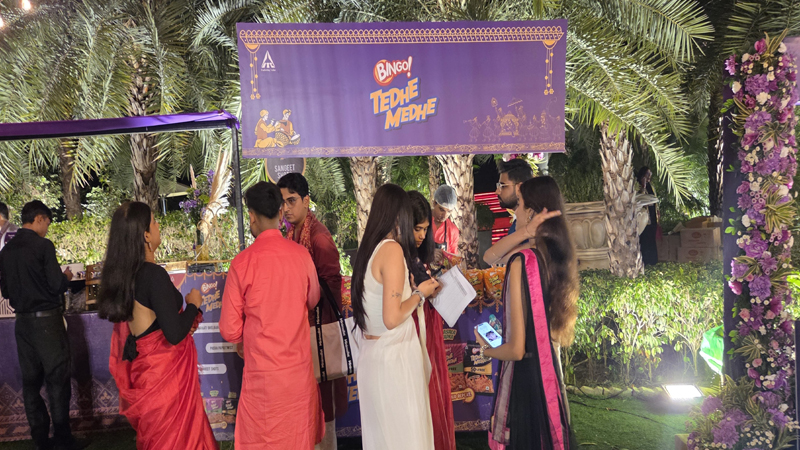
And if you thought the baraatis were the stars of the night, think again. Bingo! Tedhe Medhe gate-crashed the fake wedding and instantly became its life and soul. Staying true to its Tedha DNA, the brand rolled out the Tedhe Medhe Chaat Stall, a desi snacking fantasia that had guests queuing up for quirky creations like Baraati Bhelbarood, Phera Papri Twist, and Sangeet Shots. It was the kind of “wedding menu” Delhi didn’t know it needed.
When the dhols dropped and the night heated up, the viral Tedhe Medhe anthem sparked a full-blown dance-off. Creators, influencers, and snack lovers joined in spontaneous baraat flash mobs, turning the event into a content carnival of twirls, reels, and hashtags.
“The Zepto Great Indian Fake Shaadi brought together brands, creators, and communities in a truly engaging format,” said Zepto chief brand officer Chandan Mendiratta. “Our collaboration with Bingo! Tedhe Medhe added a playful, flavourful twist to the celebration, a perfect example of how brands can creatively connect with audiences through culture-driven experiences.”
ITC Ltd., VP & head of marketing (snacks, noodles & pasta) for foods division Suresh Chand added, “At Bingo! we’ve always believed that snacking is more than just food, it’s an emotion. Partnering with Zepto’s Fake Shaadi allowed us to bring that emotion to life in the most entertaining way possible. It perfectly captured our brand’s quirky, spontaneous spirit.”
The Fake Shaadi trend has been sweeping social media, fuelled by India’s young audience who crave collective joy over conventional celebrations. It’s weddings without the stress, baraats without the budget, and full-blown chaos without the commitment. And Bingo! Tedhe Medhe couldn’t have found a more fitting dance floor for its offbeat brand personality, spontaneous, funny, and gloriously unpredictable.
With dhol beats replaced by DJ drops and pheras swapped for photo booths, Delhi’s “wedding of the year” proved that the shaadi scene has officially gone Tedha. From #SabkaJawaabTedheMedhe to the Fake Shaadi Baraat, Bingo! continues to show that it doesn’t just follow trends, it snacks on them.
Because when life gets Tedha, you don’t wait for the pheras, you just dance, munch, and say, “Sorry Shaktimaan… I mean, Shaadi Shaktimaan!”
After all, in this wedding that wasn’t, the only real thing was the fun and the Tedhe Medhe crunch.

Digital
Content India 2026 opens with a copro pitch, a spice evangelist and a £10,000 prize for Indian storytelling
Dish TV and C21Media’s three-day summit puts seven ambitious projects before an international jury, and two walk away with serious development money
MUMBAI: India’s content industry gathered in Mumbai this March for Content India 2026, a three-day summit organised by Dish TV in partnership with C21Media, and it wasted no time making a statement. The event opened with a Copro Pitch that put seven scripted and unscripted television concepts before an international panel of judges, and by the end of it, two projects had walked away with £10,000 each in marketing prize money from C21Media to support development and international promotion.
The jury, comprising Frank Spotnitz, Fiona Campbell, Rashmi Bajpai, Bal Samra and Rachel Glaister, evaluated a shortlist that ranged from a dark Mumbai comedy-drama about mental health (Dirty Minds, created by Sundar Aaron) to a Delhi coming-of-age mystery (Djinn Patrol, by Neha Sharma and Kilian Irwin), a techno-thriller about a teenage gaming prodigy (Kanpur X Satori, by Suchita Bhatia), an investigative crime drama blending mythology and modern thriller (The Age of Kali, by Shivani Bhatija), a documentary on India’s spice heritage (The Masala Quest, hosted by Sarina Kamini), a documentary on competitive gaming (Respawn: India’s Esports Revolution, by George Mangala Thomas and Sangram Mawari), and a reality-horror competition merging gaming and immersive fear (Scary Goose, by Samar Iqbal).
The session was hosted by Mayank Shekhar.
The two winners were Djinn Patrol, backed by Miura Kite, formerly of Participant Media and known for Chinatown and Keep Sweet: Pray & Obey, with Jaya Entertainment, producers of Real Kashmir Football Club, also attached; and The Masala Quest, created and hosted by Sarina Kamini, an Indian-Australian cook, author and self-described “spice evangelist.”
The summit also unveiled the Content India Trends Report, whose findings made for bracing reading. Daoud Jackson, senior analyst at OMDIA, set the tone: “By 2030, online video in India will nearly double the revenue of traditional TV, becoming the main driver of growth.” He noted that in 2025, India produced a quarter of all YouTube videos globally, overtaking the United States, while Indians collectively spend 117 years daily on YouTube and 72 years on Instagram. Traditional subscription TV is declining as free TV and connected TV gain ground, forcing broadcasters to innovate. “AI-generated content is just 2 per cent of engagement,” Jackson added, “highlighting the dominance of high-quality human content. The key for Indian media companies is scaling while monetising effectively from day one.”
Hannah Walsh, principal analyst at Ampere Analysis, added hard numbers to the picture. India produced over 24,000 titles in January 2026 alone, with 19,000 available internationally. The country now accounts for 12 per cent of Asia-Pacific content spend, up from 8 per cent in 2021, outpacing both Japan and China. Key exporters include JioStar, Zee Entertainment, Sony India, Amazon and Netflix, delivering over 7,500 Indian-produced titles abroad each year. The top importing markets are Saudi Arabia, the UAE, Egypt, the United States and the Philippines. Scripted content dominates globally at 88 per cent, with crime dramas and children’s and family titles performing particularly strongly.
Manoj Dobhal, chief executive and executive director of Dish TV India, framed the summit’s ambition squarely. “Stories don’t need translation. They need a platform, discovery, and reach, local or global,” he said. “India produces more movies than any country, our streaming platforms compete globally, and our tech and creators win international awards. Yet fragmentation slows growth. Producers, platforms, and tech move in different lanes. We need shared spaces, collaboration, and an ecosystem where ideas, technology, and people meet. That is why we built Content India.”
The data, the pitches and the prize money all pointed to the same conclusion: India is not waiting for the world to discover its stories. It is building the infrastructure to sell them.