News Headline
India’s media industry went to regulatory war with itself in 2025

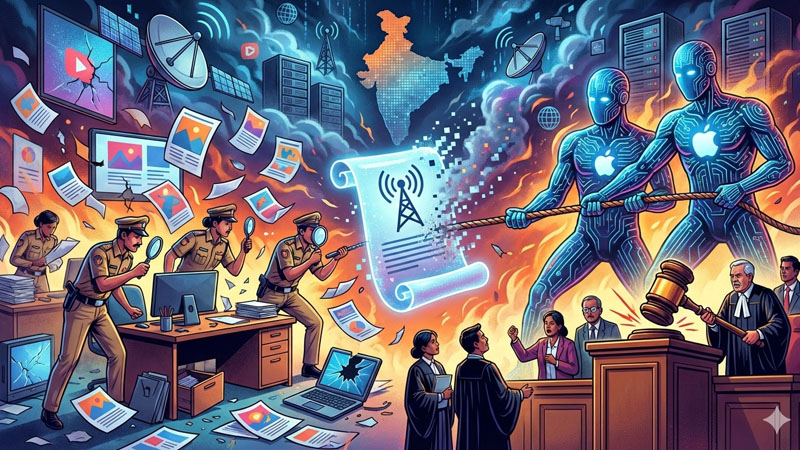
MUMBAI: If 2024 was the year India’s media regulators sharpened their knives, 2025 was when they started swinging. Broadcasters, streaming platforms, social-media giants, advertising agencies and even individual YouTubers found themselves caught in a regulatory maelstrom that would have made Kafka proud. By year’s end, the industry looked less like a marketplace and more like a battlefieldÑcomplete with raid squads, courtroom showdowns and one spectacularly withdrawn piece of legislation that tried to regulate everything from Star Plus to your cousin’s food vlog.
The chaos began with good intentions, naturally. The government wanted to tame fake news, curb obscene content and bring order to India’s digital wild west. What it delivered instead was a year-long game of regulatory whack-a-mole that left companies scrambling, lawyers grinning and freedom-of-speech advocates apoplectic.
March 2025 brought the advertising industry’s worst nightmare. Just as cricket’s Indian Premier League was about to beginÑthe annual bonanza when advertisers throw billions at TV screensÑthe Competition Commission of India stormed into the offices of GroupM, Dentsu, Publicis, Interpublic Group, Havas and Madison. The CCI accused them of the oldest trick in the cartel book: price-fixing and collusion on ad rates.
The raids, which also hit the Indian Broadcasting and Digital Foundation, the Advertising Agencies Association of India and the Indian Society of Advertisers, sent tremors through the industry. WhatsApp groups that once buzzed with bonhomie went silent. The cosy club had been busted. If convicted, penalties could reach 10 per cent of annual turnover or three times the profits earned during collusionÑwhichever hurts more. Executives face personal fines of 10 per cent of their average annual income. Several are now banned from holding senior positions.
The timing was exquisiteÑor vindictive, depending on your perspective. The CCI clearly wanted to prevent any funny business with IPL ad rates, which had long been whispered about in hushed tones at industry gatherings. By year’s end, the case remained open, leaving agency heads nervously checking their emails for summons.
If advertising agencies had a rough year, Elon Musk’s X had a worse one. In March, the platform filed a petition in Karnataka high court challenging the government’s Sahyog portalÑa system that allows everyone from federal ministries to district-level police to demand content takedowns from social-media platforms. X called it a “censorship portal”. The government called it essential for tackling harmful content.
The fight centred on whether the government could use Section 79 of the Information Technology Act to issue blocking orders, or whether only Section 69AÑwith its judicial oversightÑapplied. X argued that Sahyog bypassed due process, violated constitutional rights to equality and free speech, and created “an impermissible parallel mechanism” for unrestrained censorship. Since its October 2024 launch, officials had submitted nearly 300 demands targeting 3,465 URLs through Sahyog.
In September, the Karnataka high court ruled against X, dismissing its petition. The platform promptly announced it would appeal to the supreme court. The irony was delicious: Musk, who had cultivated a seemingly robust relationship with prime minister Narendra Modi and refrained from criticising India’s censorship powers, now found himself in a legal quagmireÑeven as he tried to launch Tesla and Starlink in the country. His political role in America’s Trump administration complicated matters further, raising questions about what he valued more: his various business interests or his government position.
X wasn’t alone in courtroom dramatics. In February, the platform added NestlŽ, Abbott Laboratories, Colgate-Palmolive, Lego, Pinterest, Tyson Foods and Shell International to a separate lawsuit alleging that advertisers had unlawfully pressured social-media platforms to adopt brand-safety standards. Since Musk’s acquisition, X’s relationship with advertisers had remained strainedÑa problem not helped by his vision of an “unmoderated social-media landscape”.
While X battled bureaucrats, OpenAI found itself fighting a different war: copyright infringement. In November 2024, Asian News International, an Indian news agency, sued OpenAI in Delhi high court, accusing the ChatGPT creator of using its content to train AI models without permission. ANI wanted to know whether storing copyrighted data for training constituted infringement, whether generating responses using such data violated copyright, and whether any of this fell under “fair use”.
The case snowballed. In January 2025, the Federation of Indian PublishersÑrepresenting Bloomsbury, Penguin Random House and RupaÑfiled to join as co-plaintiffs. By late January, Indian billionaires Mukesh Ambani and Gautam Adani jumped in, along with the Indian Express, Hindustan Times and others under the Digital News Publishers Association banner. OpenAI’s portfolio of accusers now included everyone from NDTV to Network18.
In February, Bollywood entered the fray. Saregama, T-Series, Sony Music and the Indian Music Industry told the court that OpenAI had used their lyrics, compositions and sound recordings without permission. Unlike text-based content, music brought complications: rhythm, melody, harmony, performance rights. Delhi high court appointed two amici curiae to help navigate this mess. By year’s end, the case remained unresolved but had already set a precedent as India’s most comprehensive challenge to AI’s use of copyrighted material.
OpenAI’s response? It blacklisted ANI’s domain in October 2024 and argued that Indian courts lacked jurisdiction since its servers sat in America. The court wasn’t convinced. Hearings continue in 2026, with global implications for how AI companies compensateÑor don’t compensateÑcontent creators.
No regulatory fiasco better captured 2025’s spirit than the Broadcasting Services Bill saga. Released in November 2023 to replace the 30-year-old Cable Television Networks Act, the bill aimed to create a unified framework for cable TV, DTH, IPTV, OTT platforms and digital news. Noble enough.
Then in July 2024, the ministry of information and broadcasting secretly circulated a watermarked revised draft to select stakeholders. This version dramatically expanded the bill’s scope to include YouTubers, Instagram influencers and podcasters who monetised content or covered news. Digital creators crossing certain subscriber thresholds would be classified as “Digital News Broadcasters” or “OTT Broadcasters,Ó requiring government registration, grievance officers, content evaluation committees and compliance with programme and advertisement codes.
The reaction was volcanic. Over 750 digital creators signed an open letter demanding transparency. The Internet Freedom Foundation, IAMAI, DigiPub and Content Creators Association of India warned about threats to press freedom. The Network of Women in Media said the bill could “irreparably damage free press and creative freedom”. Broadcasting stakeholders worried about equipment seizure provisions and criminal penalties.
On 12 August 2024, facing intense backlash, the ministry withdrew the draft and asked stakeholders to return physical copiesÑwithout providing feedback. It promised a fresh draft after “detailed consultations”, extending the comment deadline to 15 October. Then…nothing. By October 2024, industry sources confirmed the bill had been suspended. No consultations. No fresh draft. No timeline for reintroduction. As 2025 ended, the Broadcasting Bill remained in regulatory purgatory, a testament to what happens when governments try to regulate the internet without consulting the people who actually use it.
The bill’s ghost haunted the year, though. Uncertainty about its revival kept OTT platforms nervous, digital creators anxious and lawyers employed.
Meanwhile, the government’s attempt to establish a Fact Check Unit under the Press Information Bureau sparked its own legal circus. Notified in March 2024 under amended IT Rules, the FCU was empowered to identify “fake, false or misleading” content about government business. Platforms failing to remove such content risked losing safe-harbour protectionsÑpotentially exposing them to liability for third-party posts.
Comedian Kunal Kamra, the Editors Guild of India, the Association of Indian Magazines and the News Broadcasters and Digital Association immediately sued. They argued the amendment violated free speech, lacked constitutional authority and would have a “chilling effect” on media.
Bombay high court delivered a split verdict in January 2024. Justice G.S. Patel struck down the amendment for vagueness and lack of procedural safeguards. justice Neela Gokhale upheld it. In September 2024, justice Atul Chandurkar sided with justice Patel, finding the amendment violated free speech, business freedom and equality principles. Critically, the court noted that the parent IT Act 2000 provided no power to establish such a unit.
The Supreme Court in March 2024 stayed the notification, recognising “serious constitutional questions”. Despite these judicial setbacks, the PIB Fact Check Unit continued operating throughout 2025, responding to approximately 37,000 queries. In December, a parliamentary committee recommended statutory backing for the unit, legal definitions of fake news, mandatory fact-checking units in all media organisations and AI-generated content labelling. The battle continues.
Critics point out the obvious: letting the government decide what’s “fake news” about government business is like letting the fox guard the henhouse. The government insists it’s protecting citizens from misinformation whilst respecting free speech. Both can’t be entirely right.
Amidst the chaos, the Advertising Standards Council of India (Asci) proved that self-regulation can actually workÑsometimes. In April 2025, ASCI updated its influencer guidelines to require specific qualifications before making claims about health, nutrition or finance. The rules mandate disclosure labels like “advertisement”, “sponsored” or “partnership” on promotional content. ASCI flagged 318 influencers in 2024-25 for promoting illegal offshore betting without proper disclosures.
The body also introduced clause 1.8, requiring media companies to label sponsored content on their social-media handlesÑdistinguishing it from editorial content. Following a supreme court mandate in June 2024, the government made self-declaration certificates mandatory for all advertisements starting June 18th. Advertisers must certify their ads contain no misleading claims.
AsciÕs limitation remains its voluntary status. Court judgments confirm it cannot restrict non-members’ advertisements. However, collaboration with the Central Consumer Protection Authority, which refers non-compliant ads for statutory action, gives Asci’s code more teeth. It’s not enforcement, exactly, but it’s something.
Traditional broadcasting continued its slow-motion collapse. Cable TV subscribers dropped from 98.5 million in 2018 to 64 million by 2023, with the trend accelerating in 2025 as consumers migrated to OTT platforms. India now has 918 permitted private satellite TV channels serving approximately 230 million households through cable, DTH and IPTV. But more than half of licensed channels aren’t part of any self-regulatory bodyÑprompting the government to make such membership mandatory for uplinking and downlinking permissions.
The All India Digital Cable Federation advocated for regulatory support, but the government’s attention was elsewhere. Print media fared little better. The Press and Registration of Periodicals Act 2023 took effect in March 2024, modernising registration requirements but offering no solution to collapsing revenues. Telangana’s new Media Accreditation Rules introduced provisions for digital media but capped accreditation at just 10 cards for digital news statewideÑdown from 23,000 cards previously issued to all journalists. Access to government information just became a luxury good.
Other competition cases added to the mayhem. In May, the CCI fined Planetcast Media Services (formerly Essel Shyam Communication) Rs 223.6m for bid-rigging in tenders for IPL 2012 broadcasting services. The company and Globecast had formed a cartel, exchanging information and quoting bid prices by arrangement. In another case, Kerala high court affirmed CCI’s jurisdiction over competition issues in broadcasting, dismissing challenges from Star India, Asianet and Disney Broadcasting India. The court ruled that whilst regulatory overlap exists with the Telecom Regulatory Authority of India, competition matters remain CCI’s domain.
Meta, meanwhile, told the National Company Law Appellate Tribunal it was being punished for offering superior services in its WhatsApp privacy policy case. The company insisted that integrating WhatsApp data enhances advertiser value and market leadership, adding that CCI failed to prove abuse. The tribunal wasn’t persuaded.
And in a blow to cinema operators, CCI launched a probe into PVR Inox after producers alleged it still charged a digital fee originally meant only for technology upgrades. The commission is investigating whether the multiplex giant abused its dominant position. Bollywood, it seems, isn’t just fighting AIÑit’s fighting ticket prices too.
Throughout 2025, OTT platforms operated under the three-tier self-regulatory structure established by IT Rules 2021: self-classification by platforms, industry self-regulatory bodies for grievance redressal and government oversight through an inter-ministerial committee. Platforms must maintain content evaluation committees, classify programming using age-based ratings and implement parental locks for restricted content.
By December, the government had disabled public access to 43 OTT platforms for displaying obscene content. The message was clear: comply or disappear. The $8.5bn merger between Walt Disney and Reliance’s India media assetsÑcreating a behemoth with an estimated 40 per cent share of TV and streaming ad marketsÑadded another layer of complexity. Regulators now face the challenge of monitoring a consolidated industry whilst preventing anti-competitive behaviour.
As 2025 ended, several battles remained unresolved. The Broadcasting Bill lurks in regulatory limbo with no timeline for reintroduction. X’s Supreme Court appeal against Sahyog awaits hearing. OpenAI’s copyright cases grind through Delhi high court. CCI’s advertising cartel investigation continues. The PIB Fact Check Unit operates despite judicial rejection. And in October, the ministry of electronics and information technology released draft amendments addressing AI-generated content and deepfakes, requiring platforms to label synthetic information. Public consultations closed in November, but implementation timelines remain unclear.
Industry observers expect any revised Broadcasting Bill to exclude social media platforms and narrow its scope on individual creators. Platform compliance will evolve as companies navigate contradictory requirements across jurisdictions. ASCI will likely expand into virtual influencers and metaverse advertising. And the partnership with CCPA may give its voluntary code statutory backingÑfinally putting some enforcement muscle behind the guidelines.
The year revealed the central tension in India’s media regulation: how to protect consumers and prevent misinformation whilst preserving freedom of expression. Vague provisions in IT Rules and proposed legislation create chilling effects. Terms like “business of government”, “fake news”, “misleading content” and “national security” lack precise definitions, enabling subjective interpretation and potential abuse. Digital-rights organisations warn that expansive government powers pressure intermediaries toward over-censorship.
Yet the government has legitimate concerns. Deepfakes proliferate. Misinformation spreads faster than fact-checkers can debunk it. Obscene content circulates freely. Offshore betting apps target Indians through influencer endorsements. The advertising industry appeared to operate a cosy cartel. Someone needs to set standards.
The question is whether heavy-handed regulation is the answer. The Broadcasting Bill’s secret circulation, closed-door consultations and abrupt withdrawal suggest not. Sahyog’s extension of censorship powers to district-level officials without due process suggests not. The Fact Check Unit’s attempt to make government the arbiter of truth about government suggests definitely not.
As India’s digital economy grows and media consumption patterns evolve, finding the right balance between regulation and freedom will remain a persistent challenge. Self-regulatory bodies like Asci demonstrate that industry-led standards can complement statutory frameworks when properly supported. But the shift toward mandatory participation and enhanced government oversight suggests a movement away from voluntary mechanisms toward hybrid governanceÑor perhaps just surveillance by another name.
The regulatory choices made in coming years will significantly impact India’s media ecosystem, digital economy and democratic values for decades. Stakeholders across government, industry and civil society must engage in transparent dialogue to develop frameworks that protect legitimate public interests whilst preserving constitutional freedoms.
For now, one thing is certain: 2025 was the year India’s media industry discovered that the only thing worse than no regulation is regulation written by people who don’t understand the internet. The bills may be suspended, the court cases ongoing and the raids concluded, but the fundamental questions remain unanswered. Who decides what’s fake news? How much censorship is too much? Can innovation thrive under surveillance? And most importantly, who’s actually in charge?
The courts, bureaucrats, politicians and tech giants are all still fighting over the answer. Stay tuned for 2026Ñit promises to be just as messy.






