MAM
Amagi Media Labs IPO opens 13 January at Rs 343 to Rs 361 Band
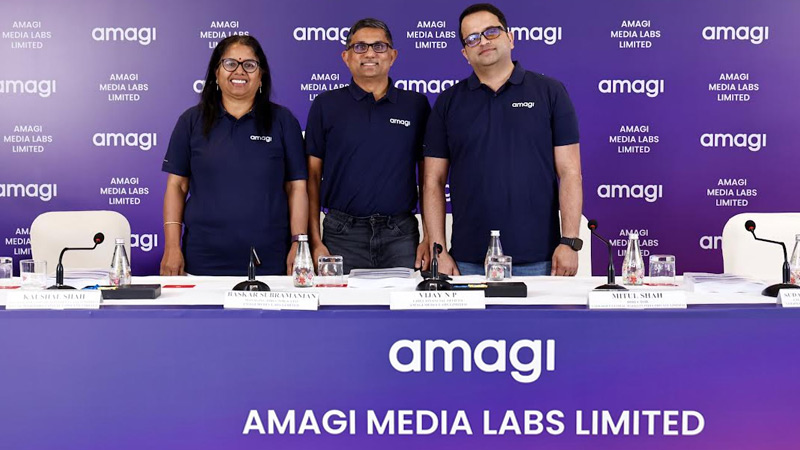
MUMBAI: India’s fast-growing ad-tech star Amagi Media Labs Limited is ready to make its stock market debut, opening its initial public offering on Tuesday, 13 January 2026.
The IPO, which blends fresh capital raising with partial exits for early backers, will remain open until Friday, January 16. Anchor investors get first dibs a day earlier, on Monday, 12 January.
Amagi has set its price band between Rs 343 and Rs 361 per share, with each equity share carrying a face value of Rs 5. Investors can bid for a minimum of 41 shares and then in multiples of 41, making the entry ticket clear and simple.
At the heart of the offer is a fresh issue worth up to Rs 8,160 million, aimed at fuelling the company’s next phase of growth. Alongside this, existing shareholders will sell up to 26.94 million shares through an offer for sale.
Some of India’s most recognisable venture capital names are trimming their holdings, including PI Opportunities Fund I and II, Accel India VI, Trudy Holdings and Norwest Venture Partners. A small number of shares will also be sold by individual shareholders, including founders and early executives.
Once the dust settles, Amagi’s shares are set to be listed on both the BSE and the National Stock Exchange, putting the company firmly in the public spotlight.
The IPO is being steered by a heavyweight syndicate of bankers, with Kotak Mahindra Capital, Citigroup, Goldman Sachs India, IIFL Capital Services and Avendus Capital acting as book running lead managers.
For market watchers and casual investors alike, Amagi’s listing adds another lively chapter to India’s buzzing startup to stock market story.

AD Agencies
Fevicol releases its last ad campaign by the late Piyush Pandey
The adhesive brand’s last campaign by the late advertising legend Piyush Pandey turns an everyday Indian obsession into a quietly powerful metaphor
MUMBAI: Fevicol has never needed much of a plot. A sticky bond, a wry observation, a truth that every Indian instantly recognises — that has always been enough. “Kursi Pe Nazar,” the brand’s latest television commercial, is no different. And yet it carries a weight that no previous Fevicol film has had to bear: it is the last one its creator, the advertising legend Piyush Pandey, will ever make.
The film, released on Tuesday by Pidilite Industries, fixes its gaze on the kursi — the chair — and what it means in Indian life. Not just as a piece of furniture, but as a currency of ambition, a vessel of authority, and a source of quiet social drama that plays out in every home, office and institution across the country. Who sits in the chair, who waits for it, and who eyes it hungrily from across the room: the film transforms this sharply observed cultural truth into a narrative that is, in the best Fevicol tradition, funny, warm and instantly familiar.
The campaign was Pandey’s idea. He discussed it in detail with the team before his death, but did not live to see it shot. Prasoon Pandey, director at Corcoise Films who helmed the commercial, said the team needed five months to find its footing before they felt ready to shoot. “This was the toughest film ever for all of us,” he said. “It was Piyush’s idea, magical as always.”
The emotional weight of that responsibility was not lost on the team at Ogilvy India, which created the campaign. Kainaz Karmakar and Harshad Rajadhyaksha, group chief creative officers at Ogilvy India, described the process as “a pilgrimage of sorts, on the path that Piyush created not just for Ogilvy, but for our entire profession.”
Sudhanshu Vats, managing director of Pidilite Industries, said the film was rooted in a distinctly Indian insight. “The ‘kursi’ symbolises aspiration, transition, and ambition,” he said. “Piyush Pandey had an extraordinary ability to elevate such everyday observations into iconic storytelling for Fevicol. This film carries that legacy forward.”
That legacy is considerable. Over several decades, Pandey’s partnership with Fevicol produced some of the most beloved advertising in Indian history, building the brand into something rare: a household name that people actively enjoy watching sell to them.
“Kursi Pe Nazar” does not try to be a tribute. It simply tries to be a great Fevicol film. By most measures, it succeeds — which is, in the end, the most fitting send-off of all.