MAM
September bliss Ipsos survey finds consistent happiness levels!


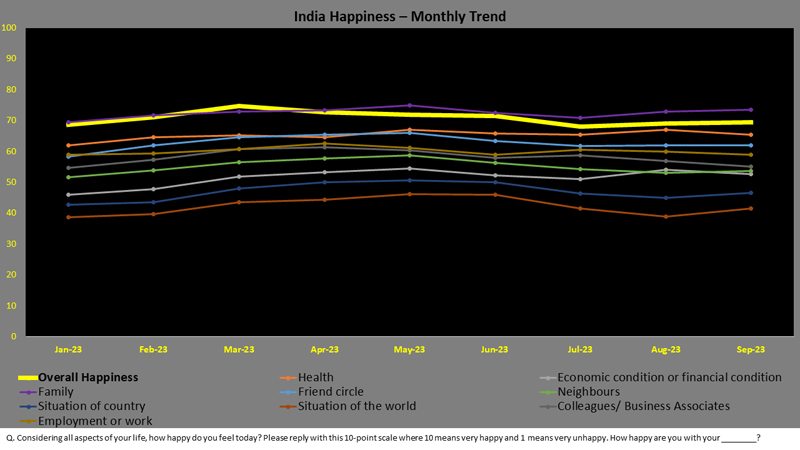
Mumbai: The September wave of Ipsos IndiaBus happiness monitor shows happiness has stayed steady in September with no change in happiness levels. However, 69 per cent of urban Indians claim to be happy.
A graph showing different colored lines
Description automatically generated

Interestingly, the cohorts that emerged happiest were full-time students (74 per cent), homemakers (73 per cent), women (71 per cent) and those with higher education (70 per cent).
94 per cent of urban Indians living in tier-one towns claimed to be happy. Urban Indians in the west and north were happier than those in the South and East. 87 per cent of urban Indians living in the west zone were happy and similarly, 77 per cent of those living in the north zone claimed to be happy. Only 54 per cent of those living in the South Zone were seen to be happy. And only one in two (50 per cent) in the east per cent one were happy. The trend was seen across demographics.

Overall, happiness has surged for family (+1 per cent), situation of the world (+3 per cent), situation of the country (+2 per cent), and neighbours (+1 per cent); and decreased for health (-2 per cent), economic/ financial conditions (-1 per cent), colleagues/ business associates (-2 per cent), employment or work (-1 per cent) and with no change around friends’ circle, in September, over the previous month.
Looking at the pecking order of happiness contributors for urban Indians, it was led by family (74 per cent), health (65 per cent), friends’ circle (62 per cent), employment or work (59 per cent), colleagues/ business associates (55 per cent), neighbours (54 per cent), economic/ financial conditions (53 per cent), situation of the country (47 per cent) and situation of the world (42 per cent).
Commenting on the findings of the survey, ESG & CSR group service line leader, public affairs, and corporate reputation, Parijat Chakraborty said, “Happiness Levels have held steady and family continues to be the biggest driving force in infusing happiness. The happiness monitor also shows happiness is defined by different aspects of our daily life. It is about close family ties, social framework and societal engagement, work environment and colleagues, financial conditions, how the country is being run and how the global scenario looks. The G20 Summit has rubbed off on the perception of India and the world and is being positively manifested in the happiness monitor in September. Likewise, work and colleagues and increasing work pressures have slightly dented happiness levels. Women and homemakers seem happier with their “me” time.”
“West and North zones have seen a maximum boom in terms of jobs, access to the best of facilities and overall development. Tier one towns are the emerging centres of consumerism. Seeing a major boost in quality of life and happiness,” added Chakraborty.
Methodology
Ipsos IndiaBus is a monthly pan-India omnibus (which also runs multiple client surveys), that uses a structured questionnaire and is conducted by Ipsos India on diverse topics among 2200+ respondents from SEC A, B and C households, covering adults of both genders from all four zones in the country. The survey is conducted in metros, Tier 1, Tier 2 and Tier 3 towns, providing a more robust and representative view of urban Indians. The respondents were polled face-to-face and online. We have a city-level quota for each demographic segment that ensures the waves are identical and no additional sampling error. The data is weighted by demographics and city-class population to arrive at the national average. Data collection is done every month and the results are calculated on a two-month rolling sample.








Many drivers assume basic coverage is just a formality until an accident involving someone else brings legal notices, compensation claims, and unexpected financial pressure. At that point, the real importance of car insurance becomes clear. A single road incident can quickly create obligations that are difficult to manage alone.
In this blog, you will learn how third-party online cover supports legal safety, what it includes, and why securing it online is a smart first step.
Why Third-Party Insurance is Legally Mandatory
Indian motor law requires vehicles used on public roads to carry third-party liability cover. The intent is to protect the public by ensuring there is a recognised route for compensation when a vehicle causes harm to others.
If a vehicle is driven without this cover, penalties can apply, and the owner may have to pay the compensation amount personally if legal liability is decided against them. This helps ensure that people who suffer loss are not left without support.
How Third-Party Online Insurance Works
When third party car insurance is purchased online, the proposer shares vehicle and personal details, pays the premium, and receives the policy document in digital form. The cover applies during the policy period and provides legal liability protection for others arising from the use of the insured vehicle.
If an incident leads to a claim, the process usually involves reporting, submitting required papers, and following the steps set by the authority handling the matter.
What is Covered Under Third-Party Insurance?
This cover is designed to pay for losses suffered by others when legal liability is established. The response depends on the policy terms, the evidence, and the decision made during the claim proceedings.
Bodily Injury to Third Party
If someone else is injured in an accident involving the insured vehicle, the policy can cover the insured person’s legal liability. Compensation is assessed using medical records and other supporting documents, along with findings on responsibility. Payment is made based on the final compensation amount decided in the case, as per the policy terms.
Property Damage
If another person’s property is damaged, the policy can respond to the insured person’s liability for that loss, within the limit mentioned in the policy. The amount is generally based on documents that support ownership and the assessed repair or replacement cost. Timely reporting and clear paperwork can reduce delays in assessment.
Legal Support During Claim Proceedings
Third-party claims can involve notices, hearings, and filings because they focus on legal liability. Under the policy terms, the insurer may assist in organising documents and managing parts of the defence process through appointed representatives. This can support orderly communication and reduce missed deadlines.
What is Not Covered
Third-party cover is narrow, so some common expenses are excluded. These exclusions are common, but the exact details depend on the policy terms.
● Damage to the insured vehicle is not covered, including repair costs.
● Loss or damage to the insured person’s belongings is not covered.
● Injury cover for the owner-driver or passengers is typically separate.
● Claims linked to use that breaches policy terms may not be payable.
● Contractual promises beyond legal liability are generally not included unless stated.
Why Buying Online Strengthens Legal Safety
Buying online does not change legal duties, but it can make compliance easier to maintain and easier to prove. Digital records also support clarity if cover dates are questioned after an incident.
● Digital issuance can reduce the risk of an accidental gap in cover.
● A stored e-policy can be retrieved quickly when proof is requested.
● Receipts and time stamps help confirm when the policy was active.
● Online renewals can support timely payment and avoid lapsed cover.
● Clear documents make limits and required steps easier to understand.
Conclusion
Third-party liability cover is a direct step towards legal protection because it covers losses suffered by others when a vehicle causes harm. It supports compliance and reduces the risk of penalties for uninsured driving. Buying online can help keep policy documents, dates, and receipts easy to retrieve during checks and claim proceedings. When the cover’s scope and exclusions are understood in advance, it becomes easier to stay compliant, prepared, and confident on the road.