MAM
Toonz Animation to use 2D, 3D animation for Hanuman

MUMBAI: The three and a half year old Trivandrum based animation firm Toonz is looking to expand its content scope. With this in mind, it is using both 2D and 3D animation for its next series The Adventures of Hanuman. The show is expected to hit Indian airwaves next year.
Speaking to Indiantelevision.com on the venture, Toonz Animation India president and CEO Bill Dennis said, ” Toonz has recently opened its own 3D department Digital Fantasy. They have landed a couple of substantial jobs and you are going to hear a lot about them in the near future. Also, our next series Adventures of Hanuman, is being done in 2D and 3D. It’ll be a great look. I think 3D will become very, very big in India. Already it is growing by leaps and bounds.”
As far as the distribution of Tenali Raman overseas is concerned Dennis pointed out that the series is being distributed for Toonz by Indigo Kids (United Kingdom). Since Toonz has just wrapped the final episode Indigo Kids has not yet had the entire series to market. However they are expecting two substantial contracts within the next couple of months, Dennis revealed.

Asked if Toonz gets a lot of outsourcing work to do from firms in the US, UK, Dennis said, “Toonz tries to balance its work content. We’re currently doing a lot of work in building our library (Tenali,Hanuman, Brady’s). However, we also take on jobs on a work for hire basis. In September, we begin production on an Australian project, which is strictly work for hire. Our studio in Mumbai concentrates on ad films and commercials. Naturally all of that work is work for hire.”
Meanwhile, in a bid to augment its revenue stream Toonz is looking to come out with a string of merchandise based on its series Tenali Raman. Dennis said, ” Toonz is working with two merchandise distributors on the Tenali Raman line. One is in London and the other in Singapore. We expect the line to include print in the form of comics, colouring books, activity books, clothing (tee shirts, hats, jeans) toys (plush and vinyl), video and DVD, CD’s of the music track. Some of this merchandise has already been developed. We plan to make them available across India beginning in October/November.”
Asked whether the company was satisfied with the response that Tenali Raman had received on Cartoon Network so far, Dennis said, ” The response to Tenali Raman has been exceptional. Cartoon Network has done a great job in promoting Tenali. They’re portraying him as one of their regular characters, alongside Popeye, Powerpuff Girls, Dexter etc. And, it seems to be working. We are getting letters and reports that Tenali is quickly becoming a favourite around the country.
“Tenali has been dubbed in Hindi, Malayalam, and the Tamil version is underway. In addition to Cartoon Network, it is now airing on Asianet. We plan to take Tenali to every state in every language.” Dennis said.
In addition, Toonz is developing a 52-episode animation series Brady’s Beasts. The series is expected to hit Indian airwaves sometime next year. Dennis had these remarks to make about the project. “Brady’s Beasts is very different from Tenali or Hanuman. Brady’s Beasts was not conceived at Toonz. We are a co-production partner in charge of the actual production of the series (52 episodes). Once it’s finished, we’ll own the series in Asia and India.”
On the events side Dennis said that Toonz was the primary backer of Week with the Masters Animation Celebration. The event brings top industry professionals from around the world to Trivandrum to show their films and hold discussions with Indian Animators and filmmakers. “This year it happens in the first week of November and we are expecting a slate of ten ‘masters’ ” Dennis said.
” We also sponsor the Children’s Animation Workshop. This is a great event in which we encourage children from around the country to submit their story ideas and character designs for consideration in making a cartoon. Last year we had several thousand entries and selected seven to produce their films. The seven came to our studio and worked alongside our artists in finalising the script, choosing the style, colour designs, character designs and music.
” In some cases they actually were the narrators for their film. Toonz then has a tie up with Cartoon Network to broadcast the films. We also send the films to compete around the world to film festivals. For last year’s films, we have already won six major awards from Europe and the United States.”
MUMBAI: The three and a half year old Trivandrum based animation firm Toonz is looking to expand its content scope. With this in mind, it is using both 2D and 3D animation for its next series The Adventures of Hanuman. The show is expected to hit Indian airwaves next year.
Speaking to Indiantelevision.com on the venture, Toonz Animation India president and CEO Bill Dennis said, ” Toonz has recently opened its own 3D department Digital Fantasy. They have landed a couple of substantial jobs and you are going to hear a lot about them in the near future. Also, our next series Adventures of Hanuman, is being done in 2D and 3D. It’ll be a great look. I think 3D will become very, very big in India. Already it is growing by leaps and bounds.”
As far as the distribution of Tenali Raman overseas is concerned Dennis pointed out that the series is being distributed for Toonz by Indigo Kids (United Kingdom). Since Toonz has just wrapped the final episode Indigo Kids has not yet had the entire series to market. However they are expecting two substantial contracts within the next couple of months, Dennis revealed.
Asked if Toonz gets a lot of outsourcing work to do from firms in the US, UK, Dennis said, “Toonz tries to balance its work content. We’re currently doing a lot of work in building our library (Tenali,Hanuman, Brady’s). However, we also take on jobs on a work for hire basis. In September, we begin production on an Australian project, which is strictly work for hire. Our studio in Mumbai concentrates on ad films and commercials. Naturally all of that work is work for hire.”
Meanwhile, in a bid to augment its revenue stream Toonz is looking to come out with a string of merchandise based on its series Tenali Raman. Dennis said, ” Toonz is working with two merchandise distributors on the Tenali Raman line. One is in London and the other in Singapore. We expect the line to include print in the form of comics, colouring books, activity books, clothing (tee shirts, hats, jeans) toys (plush and vinyl), video and DVD, CD’s of the music track. Some of this merchandise has already been developed. We plan to make them available across India beginning in October/November.”
Asked whether the company was satisfied with the response that Tenali Raman had received on Cartoon Network so far, Dennis said, ” The response to Tenali Raman has been exceptional. Cartoon Network has done a great job in promoting Tenali. They’re portraying him as one of their regular characters, alongside Popeye, Powerpuff Girls, Dexter etc. And, it seems to be working. We are getting letters and reports that Tenali is quickly becoming a favourite around the country.
“Tenali has been dubbed in Hindi, Malayalam, and the Tamil version is underway. In addition to Cartoon Network, it is now airing on Asianet. We plan to take Tenali to every state in every language.” Dennis said.
In addition, Toonz is developing a 52-episode animation series Brady’s Beasts. The series is expected to hit Indian airwaves sometime next year. Dennis had these remarks to make about the project. “Brady’s Beasts is very different from Tenali or Hanuman. Brady’s Beasts was not conceived at Toonz. We are a co-production partner in charge of the actual production of the series (52 episodes). Once it’s finished, we’ll own the series in Asia and India.”
On the events side Dennis said that Toonz was the primary backer of Week with the Masters Animation Celebration. The event brings top industry professionals from around the world to Trivandrum to show their films and hold discussions with Indian Animators and filmmakers. “This year it happens in the first week of November and we are expecting a slate of ten ‘masters’ ” Dennis said.
” We also sponsor the Children’s Animation Workshop. This is a great event in which we encourage children from around the country to submit their story ideas and character designs for consideration in making a cartoon. Last year we had several thousand entries and selected seven to produce their films. The seven came to our studio and worked alongside our artists in finalising the script, choosing the style, colour designs, character designs and music.
” In some cases they actually were the narrators for their film. Toonz then has a tie up with Cartoon Network to broadcast the films. We also send the films to compete around the world to film festivals. For last year’s films, we have already won six major awards from Europe and the United States.”




MAM
Lego brings Messi, Ronaldo, Mbappé, Vinicius together
Campaign clocks 314 million views ahead of FIFA World Cup 2026 buzz.
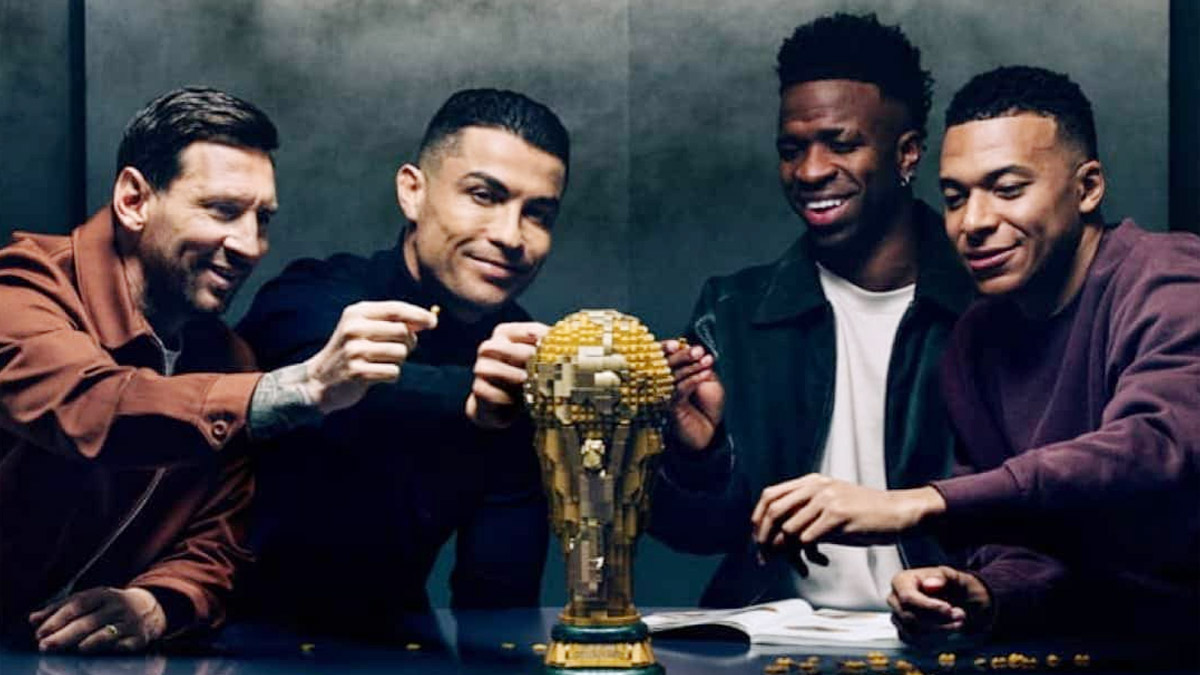
MUMBAI: Four legends, one frame and not a single tackle in sight. Lego has pulled off a crossover few thought possible, uniting Lionel Messi, Cristiano Ronaldo, Kylian Mbappé and Vinícius Júnior in a single campaign ahead of the FIFA World Cup 2026 only this time, they’re building dreams brick by brick.
Titled “Everyone wants a piece”, the campaign features the quartet assembling a Lego version of the World Cup trophy, before placing miniature versions of themselves atop it, a playful nod to football’s ultimate prize. Shared widely across social media, the ad carries a pointed disclaimer: it is not AI-generated, a subtle but telling signal in an era where even reality is often questioned.
The numbers tell their own story. The campaign has already crossed 314 million views on Instagram across the players’ accounts, with fans hailing it as a rare, almost nostalgic moment particularly for the reunion of Messi and Ronaldo, whose last shared campaign ahead of the 2022 World Cup became one of the platform’s most-liked posts.
Beyond the film, Lego is extending the play with exclusive, player-themed sets tied to each of the four stars, part of a broader football-led programme designed to ride the global momentum building towards 2026. The idea, as echoed by the players themselves, leans into the parallels between football and play experimentation, creativity, failure, and triumph.
Messi described the sets as a way to bring on-pitch moments into an imaginative, hands-on world, while Ronaldo called the transformation into a Lego figure a rare honour, blending sport with storytelling. Vinícius, meanwhile, struck a more personal note, recalling childhood moments of building with Lego and framing creativity as a universal language that transcends borders.
The timing is no accident. With the 2026 World Cup set to run from June 11 to July 19 across the United States, Canada and Mexico, and featuring an expanded 48-team format, global anticipation is already building. Argentina, led by Messi, will enter as defending champions, adding another layer of intrigue.
For Lego, the campaign does more than celebrate football, it taps into its mythology. Because when icons become figurines and rivalries turn into play, the beautiful game finds a new kind of pitch. one built, quite literally, by hand.






