News Broadcasting
Broadcasters thrilled, cable frat incensed by Trai order

NEW DELHI/MUMBAI: The Telecom Regulatory Authority of India (Trai) today said that new channels may be launched but the price cannot be out of sync with the prices of similar channels that were existing on or before 26 December, the cut off date for freezing of cable prices.
It also indicated that there is no ceiling on cable operators or service providers but any decrease or increase in number of channels should be calculated on a pro rata basis and that the price freeze order is effective in CAS and non-CAS areas.
After announcement of the Telecommunication (Broadcasting and Cable) Services Tariff Order 2004, a number of questions had been raised in regard to the underlying import of the provisions of the order by the industry. Through today’s directive, the regulator attempts to clarify certain contentious issues.

Pointing out that Trai has not put any sort of a ceiling or bar on new launches, the clarifications issued by the regulator said, “In such cases, the Tariff Order does not provide any specific ceiling. However, in specifying the relevant charges (cost of a new channel for the subscriber too), the charges that the broadcaster/multi system operator/cable operator might have in place in the contiguous areas/similar channels as on 26 December 2003 should be kept in mind.”
Explaining the rationale behind this, Trai chairman Pradip Baijal told indiantelevision.com in the evening that the clarifications issued by the regulator is more aimed at bringing about a semblance of orderliness in an unorganised industry.
On the pricing of new channels, if launched now, Baijal said, “the basic aim is to see that the consumer does not get affected by industry’s own games. If new channels are to be launched, then the industry needs to absorb a major portion of the cost because the burden of the extra cost or service cannot be passed on to the customer.” Similar calculations would have to be done if the consumer base is sought to be increased by the broadcaster for increased subscription revenue.
For the pay broadcasters, the Trai order came as welcome news but not so for the cable fraternity, who made no bones about their displeasure with the latest directive from the regulator.
“If there is a price freeze, then there is a price freeze. Why should there be calculations done on a pro rata basis?” an executive of Zee Telefilms’ cable arm Siti Cable said.
National Cable & Telecom Association’s Vikki Chowdhry said, “How can Trai think of keeping the consumer immune from any price hike, if the broadcaster raises its subscriber base or pushes for that? It is evident that the government of India is bent on favoring the pay TV channel broadcasters for the sake of their utility in the coming general elections whereby this NDA Government will solely utilize the broadcasting media to their advantage now after giving this sop to the broadcasters.”
“The previous order of Trai dated 15th Jan 04, of freezing the cable subscription was welcomed by cable service providers as well the consumers at large, but after today’s clarification the previous order passed in the consumers’ interest has no meaning left,” an NCTA statement said.
Star India COO Sameer Nair was in a far more positive frame of mind (to put it mildly). “This is very good news,” Nair said. “In any case, we had dropped our price from Rs 30 to Rs 27 so the Trai order serves to underscore an issue that we have constantly been trying to get across. Which is that there has been massive underdeclaration and increasing the subscriber base is a legitimate option that will only improve transparency in the business,” Nair said.
K Jayaraman, CEO of the Rajan Raheja promoted MSO Hathway Datacom (in which Star has a 26 per cent stake) refuses to buy this argument. “If more declaration is demanded, prices have to go up. If Trai implements this then it should also decide the subscription margins that the broadcaster, MSO and cable operator should take home. Otherwise it will just not work.”
SET India CEO Kunal Dasgupta was also happy with the latest developments. “It is good that Trai has clarified the matter,” he said.
HTMT group director and CTO KV Seshasayee had this to say: “We believe that Trai probably is not fully informed about the implications of saying the subscriber base numbers can change. This will be used by the broadcasters to force declarations far beyond what the MSOs are getting paid for. It will finally hit the consumer because we will be forced to pass on these extra costs which MSOs cannot bear since we are already incurring huge losses.”
The latest Trai directive has completely taken the wind out of the Cable fraternity’s sails. It remains to be seen how they respond to this setback.






News Broadcasting
Induction cooktop demand spikes 30× amid LPG supply concerns
Supply worries linked to West Asia tensions push households and restaurants to turn to electric cooking alternatives
MUMBAI: As geopolitical tensions in West Asia ripple through global energy supply chains, the familiar blue flame in Indian kitchens is facing an unexpected challenger: electricity.
What began as concerns over the availability of liquefied petroleum gas (LPG) has quickly evolved into a technology-driven shift in cooking habits. Households across India are increasingly turning to induction cooktops and other electric appliances, initially as a backup but now, for many, a necessity.
A sudden surge in demand
Recent data from quick-commerce and grocery platform BigBasket highlights the scale of the shift. According to Seshu Kumar Tirumala, the company’s chief buying and merchandising officer, demand for induction cooktops has risen dramatically.
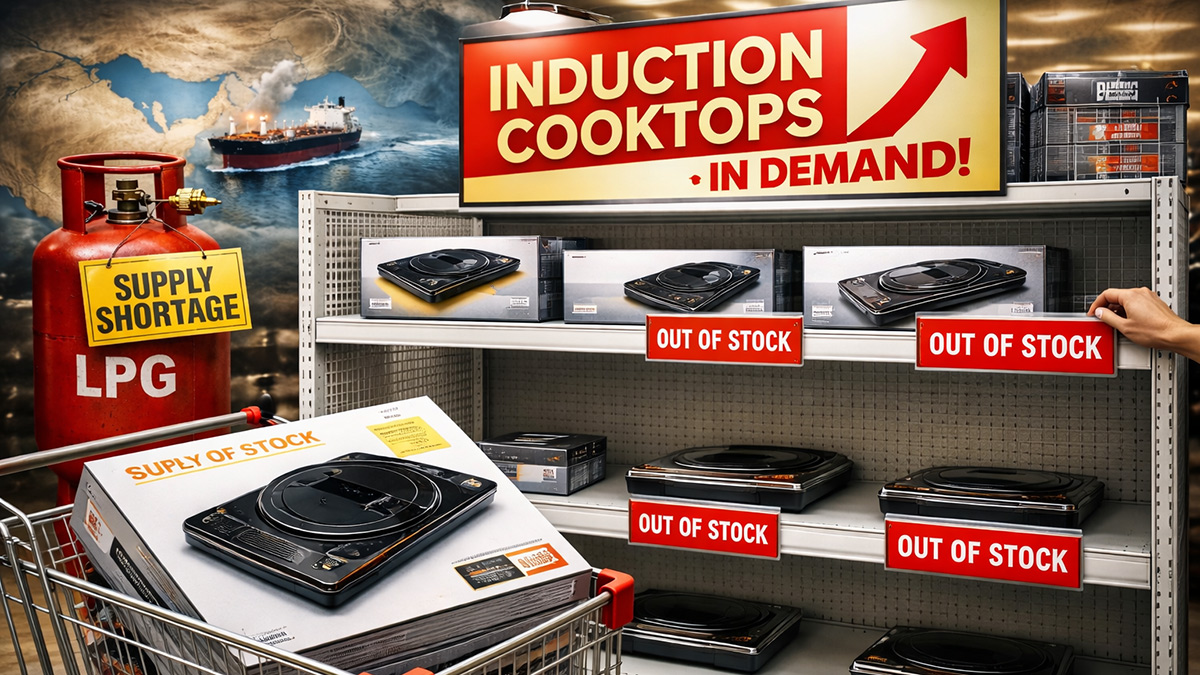
“Induction cooktops have seen a significant surge in demand, recording a fivefold jump on 10 March and a thirtyfold spike on 11 March,” Tirumala said.
The increase stands out sharply when compared with broader kitchen appliance trends. Most appliance categories are growing within 10 per cent of their typical demand levels, while induction cooktops have witnessed explosive growth as households rush to secure an alternative cooking option.
Major e-commerce platforms including Amazon and Flipkart have reported rising searches and orders for induction stoves. Quick-commerce apps such as Blinkit and Zepto have also witnessed stock shortages in major metropolitan areas including Delhi, Mumbai and Bengaluru.
What was once considered a convenient appliance for hostels, small kitchens or occasional use has suddenly become an essential addition in many homes.
A crisis thousands of miles away
The trigger for this shift lies far beyond India’s kitchens.
Escalating conflict in the Middle East has disrupted shipping routes through the Strait of Hormuz, one of the world’s most critical energy corridors. Nearly 85 to 90 per cent of India’s LPG imports pass through this narrow waterway, making the country particularly vulnerable to supply disruptions.
The ripple effects have been swift.
India currently meets roughly 60 per cent of its LPG demand through imports, and tightening global supply has already begun to affect domestic availability and prices.
Earlier this month, the price of domestic LPG cylinders increased by Rs 60, while commercial cylinders rose by more than Rs 114.
To discourage panic buying and hoarding, the government has also extended the mandatory waiting period between domestic refill bookings from 21 days to 25 days.
Restaurants feel the pressure
The strain is not limited to households. Restaurants, hotels and roadside eateries are also grappling with supply constraints as commercial LPG availability tightens under restrictions imposed through the Essential Commodities Act.
In cities such as Bengaluru and Chennai, restaurant associations report that commercial LPG availability has dropped by as much as 75 per cent, forcing many establishments to rethink their kitchen operations.
Some restaurants have reduced menu offerings, while others are rapidly installing high-efficiency induction systems, creating hybrid kitchens where electricity now shares the workload with gas.
For smaller eateries and roadside dhabas, the shift is less about sustainability and more about survival.
A potential structural shift
The government has maintained that there is no nationwide LPG crisis and has directed refineries to increase production to stabilise supply.
Nevertheless, the developments of March 2026 may already be triggering a longer-term behavioural shift.
For decades, LPG has been the backbone of cooking in Indian households. However, recent disruptions have highlighted the risks of relying on a single fuel source.
Increasingly, households appear to be hedging against uncertainty by adopting electric cooking options to guard against price volatility and delivery delays.
If the current trend continues, the induction cooktop, once viewed as a niche appliance, could emerge as a quiet symbol of India’s evolving kitchen economy.