MAM
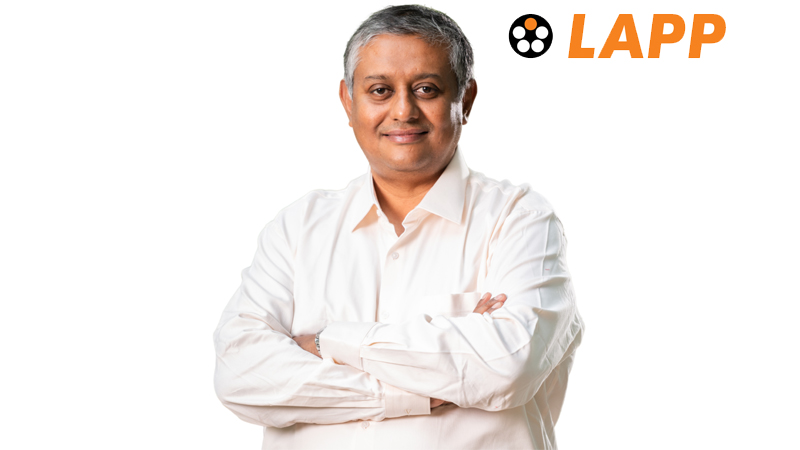
Lapp India appoints Sumit Mitra as MD
Mumbai: Lapp India has appointed Sumit Mitra as managing director, effective 1 November 2024. With over three decades of experience in the industrial sector, Sumit’s leadership will drive Lapp India’s growth and market expansion. Based in Bangalore, he will report to the CEO of Lapp Asia Pacific.
Sumit joins Lapp from SKF Group, where he contributed to operational excellence and market growth in both Indian and multinational companies. His strategic skills and focus on talent development make him a key addition to Lapp’s leadership team.
“We are thrilled to welcome Sumit to Lapp India,” said Lapp Asia Pacific CEO Richard Lee. “India is our largest market outside Germany, with immense growth potential across industries. Sumit’s strategic vision and expertise will be instrumental in accelerating our expansion and deepening our commitment to delivering cutting-edge solutions that meet the evolving needs of our Indian customers.”
In his new role, Sumit will focus on transforming Lapp India into a leading player in cable and connectivity solutions, with a commitment to tackling complex customer challenges across diverse industries. He aims to strengthen the company’s operational base, scale product offerings, and bring industry-first technologies to India’s growing market.
“Joining Lapp India is both an honour and a tremendous opportunity,” stated Mitra. “The strong growth in the Indian economy provides Lapp tremendous opportunities for our existing business as well as in many new segments. I look forward to harnessing these opportunities to drive profitable growth at Lapp India.”
A graduate in Electronics and Telecommunications Engineering from Pune University and an MBA from IIM-Calcutta, Sumit’s strong people-centric approach, combined with his technical and strategic background, underscores his vision for Lapp India’s future.

Brands
TV bills on the rise: JioStar, Sony, and Zee crank up prices by 10 per cent
Broadcasters tune into higher tariffs as JioStar, Sony, and Zee reveal new prices
MUMBAI: If you were hoping for a cheaper night in front of the telly next year, you might want to look away from the remote. India’s broadcasting giants are flipping the script on pricing, with JioStar, Sony, and Zee all tuning into a new frequency of higher tariffs. Ahead of the 2026 financial year, the Big Three have released their updated Reference Interconnect Offers (RIOs), signalling a collective push that will see most monthly bills rise by roughly 10 per cent.
The synchronised move suggests that broadcasters are testing the price elasticity of their audience. In simpler terms, they are betting that your love for daily soaps and live sports is stronger than your annoyance at a slightly lighter wallet.
Sony is making a particularly bold play in the High Definition space. If you enjoy the crispness of Sony Entertainment Television HD or Sony SAB HD, your monthly bill for those channels will jump from 25 rupees to 30 rupees. The same 30-rupee price tag now applies to their sports heavyweights, including Sony Sports Ten 1, Sony Sports Ten 2, Sony Sports Ten 3 Hindi, and Sony Sports Ten 5.
However, Sony is also expanding its horizons. Fans of regional content have new arrivals to look forward to, provided they are patient. Sony Sports Ten 4 Kannada is slated for an April 2026 debut, while Sony Vizha and Sony Vizha HD are expected by June. By August, Sony Telugu and Sony Telugu HD should be live. To keep customers sweet until then, Sony is offering “proportionate discounts.” For instance, the Happy India 2026 Smart Tamil bouquet, normally 42 rupees, will cost just 29.91 rupees until the new Vizha channel officially joins the party.
On the standard definition front, Sony is keeping its “strategic mass price” at 19 rupees for big hitters like Sony Max, Sony Marathi, and Sony Aath. Smaller channels see minor tweaks: Sony Max 2 is nudging up from 2 rupees to 3 rupees, while Sony Yay! sits at 6 rupees and Sony Max 1 remains at 5 rupees.
Zee Entertainment is also getting in on the act with a comprehensive 10 percent hike. Their flagship Standard Definition channels, such as Zee TV, Zee Cinema, Zee Marathi, Zee Bangla, Zee Sarthak, Zee Kannada, and Zee Tamil, are all locked in at 19 rupees. Interestingly, they have matched this 19-rupee price point for many of their HD versions too, including &TV and &Pictures.
For those who prefer the all-you-can-eat bouquet approach, Zee’s All-in-One Hindi SD pack has risen to 58 rupees. Their Marathi and Bangla packs are now 64 rupees, while the Southern trio of Tamil, Kannada, and Telugu SD packs will set you back 85 rupees. If you want those same Southern packs in glorious HD, the price climbs to a steeper 131 rupees. Zee is also shuffling its deck by exiting English entertainment but entering the sports arena, with Zee Cafe and &flix seeing price adjustments to 7 and 8 rupees respectively.
JioStar is perhaps the most aggressive of the bunch when it comes to regional favourites. While they have kept core Hindi staples like Star Plus, Colors, and Star Gold at 19 rupees, they have pushed premium regional channels like Asianet, Colors Kannada, Vijay TV, and Maa TV up to 30 rupees. This move is significant because any channel priced over 19 rupees cannot be included in a discounted bouquet, meaning fans of these channels will have to buy them separately, potentially driving up the total cost of a monthly subscription.
Even the youngsters aren’t spared, with kids’ favourites like Nick SD and Nick HD+ now priced at 19 rupees. As we head towards April 2026, the ball is now in the court of the cable and dish operators. They must decide how much of these increases they can swallow and how much they will pass on to the person holding the remote. For the average viewer, the message is clear: premium content is getting a premium price tag.