MAM
AI to transform marketing strategies, not its core – Vikram Sakhuja
MUMBAI: Artificial intelligence (AI) has gone from being a buzzword to an indispensable tool, revolutionising industries across the globe.
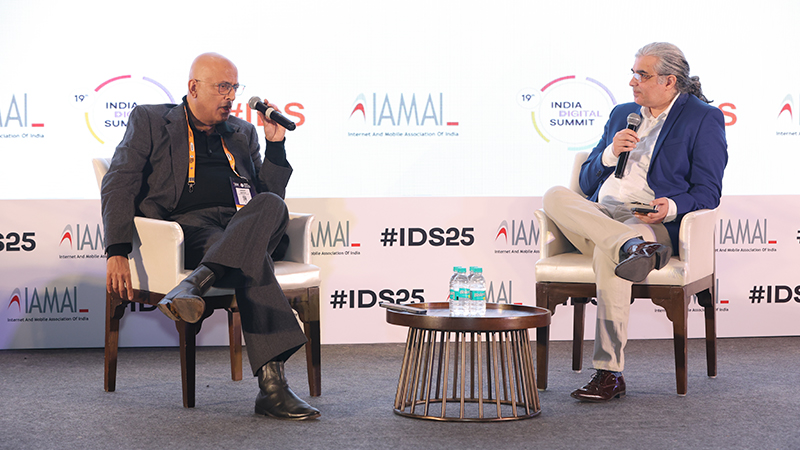
At the 19 India Digital Summit, Madison Media & OOH at Madison World group CEO Vikram Sakhuja shared his views on how AI is transforming marketing strategies without disrupting its core principles. Spoiler alert: marketing fundamentals are safe, but the methods? They’re getting an AI upgrade!
Sakhuja made it clear that while AI is rewriting the “how” of marketing, the “why” and “what” remain rooted in human understanding. “The core principles of marketing will largely remain unchanged. What will evolve and transform are the methods of marketing,” he said during a thought-provoking session hosted by India Today Group consumer revenue group CMO & COO, Vivek Malhotra.
Malhotra posed the billion-dollar question: Can publishers leverage AI-driven algorithms to help the ad industry scale to $1 trillion? Sakhuja’s reply was simple: AI’s learning thrives on data. “You can’t just write an algorithm; it’s the data fed into the system that enables learning and improvement over time,” he noted, adding that companies like Google are refining AI engines to optimise media spends through better data.
Can AI foster human connection? The answer is a surprising yes.
Are algorithms too mechanical to form meaningful consumer bonds? Not according to Sakhuja. “AI can create a deep connection. For instance, when Meta launches a trailer, the number of shares it gets is a real-time pulse check,” he explained. AI helps broadcasters and advertisers bypass traditional targeting and focus on consumers who actually engage.
And the examples don’t stop there. Think about Cadbury’s Diwali campaign, where Shah Rukh Khan’s virtual presence personalised messages for neighbourhood stores. That’s AI delivering local charm on a national scale.
Sakhuja dismissed the notion that AI is the sole domain of new-age brands. “Of course, legacy brands can embrace AI,” he said. He highlighted how even routine tasks like food delivery via Swiggy or Zomato rely on AI, demonstrating its seamless integration into daily life.
The takeaway? Age doesn’t matter if you’re willing to innovate.
But wait, what about data validation? With great data comes great responsibility.
Sakhuja cautioned about the dangers of bad data—what he called the “garbage in, garbage out” problem. Feeding unvalidated data into AI can lead to “hallucinations” (no, not the psychedelic kind) where outputs are wildly off-mark.
The solution? “Validation checks are crucial to ensure accuracy and prevent biases. The key is balancing AI’s capabilities with human oversight,” Sakhuja advised, adding that ethical use and privacy concerns need to stay top of mind.
Three ways AI supercharges marketing:
1 Precision targeting: AI identifies who’s engaging and how, skipping old-school guesswork.
2 Customised experiences: From localised campaigns to dynamic messaging, AI personalises at scale.
3 Smart scaling: Brands like Cadbury use AI to connect with millions while keeping it personal.
Final thought: Will AI replace humans? Not likely. Sakhuja pointed out that AI is a tool, not a replacement. “Human judgment remains critical. Over-reliance on AI could erode the creativity and ethics that define good marketing,” he concluded.
So how will your brand embrace the AI wave without losing its human touch?

Digital
Content India 2026 opens with a copro pitch, a spice evangelist and a £10,000 prize for Indian storytelling
Dish TV and C21Media’s three-day summit puts seven ambitious projects before an international jury, and two walk away with serious development money
MUMBAI: India’s content industry gathered in Mumbai this March for Content India 2026, a three-day summit organised by Dish TV in partnership with C21Media, and it wasted no time making a statement. The event opened with a Copro Pitch that put seven scripted and unscripted television concepts before an international panel of judges, and by the end of it, two projects had walked away with £10,000 each in marketing prize money from C21Media to support development and international promotion.
The jury, comprising Frank Spotnitz, Fiona Campbell, Rashmi Bajpai, Bal Samra and Rachel Glaister, evaluated a shortlist that ranged from a dark Mumbai comedy-drama about mental health (Dirty Minds, created by Sundar Aaron) to a Delhi coming-of-age mystery (Djinn Patrol, by Neha Sharma and Kilian Irwin), a techno-thriller about a teenage gaming prodigy (Kanpur X Satori, by Suchita Bhatia), an investigative crime drama blending mythology and modern thriller (The Age of Kali, by Shivani Bhatija), a documentary on India’s spice heritage (The Masala Quest, hosted by Sarina Kamini), a documentary on competitive gaming (Respawn: India’s Esports Revolution, by George Mangala Thomas and Sangram Mawari), and a reality-horror competition merging gaming and immersive fear (Scary Goose, by Samar Iqbal).
The session was hosted by Mayank Shekhar.
The two winners were Djinn Patrol, backed by Miura Kite, formerly of Participant Media and known for Chinatown and Keep Sweet: Pray & Obey, with Jaya Entertainment, producers of Real Kashmir Football Club, also attached; and The Masala Quest, created and hosted by Sarina Kamini, an Indian-Australian cook, author and self-described “spice evangelist.”
The summit also unveiled the Content India Trends Report, whose findings made for bracing reading. Daoud Jackson, senior analyst at OMDIA, set the tone: “By 2030, online video in India will nearly double the revenue of traditional TV, becoming the main driver of growth.” He noted that in 2025, India produced a quarter of all YouTube videos globally, overtaking the United States, while Indians collectively spend 117 years daily on YouTube and 72 years on Instagram. Traditional subscription TV is declining as free TV and connected TV gain ground, forcing broadcasters to innovate. “AI-generated content is just 2 per cent of engagement,” Jackson added, “highlighting the dominance of high-quality human content. The key for Indian media companies is scaling while monetising effectively from day one.”
Hannah Walsh, principal analyst at Ampere Analysis, added hard numbers to the picture. India produced over 24,000 titles in January 2026 alone, with 19,000 available internationally. The country now accounts for 12 per cent of Asia-Pacific content spend, up from 8 per cent in 2021, outpacing both Japan and China. Key exporters include JioStar, Zee Entertainment, Sony India, Amazon and Netflix, delivering over 7,500 Indian-produced titles abroad each year. The top importing markets are Saudi Arabia, the UAE, Egypt, the United States and the Philippines. Scripted content dominates globally at 88 per cent, with crime dramas and children’s and family titles performing particularly strongly.
Manoj Dobhal, chief executive and executive director of Dish TV India, framed the summit’s ambition squarely. “Stories don’t need translation. They need a platform, discovery, and reach, local or global,” he said. “India produces more movies than any country, our streaming platforms compete globally, and our tech and creators win international awards. Yet fragmentation slows growth. Producers, platforms, and tech move in different lanes. We need shared spaces, collaboration, and an ecosystem where ideas, technology, and people meet. That is why we built Content India.”
The data, the pitches and the prize money all pointed to the same conclusion: India is not waiting for the world to discover its stories. It is building the infrastructure to sell them.