News Broadcasting
Prof Michael Spence: India’s growing economic strength poised to reshape global role

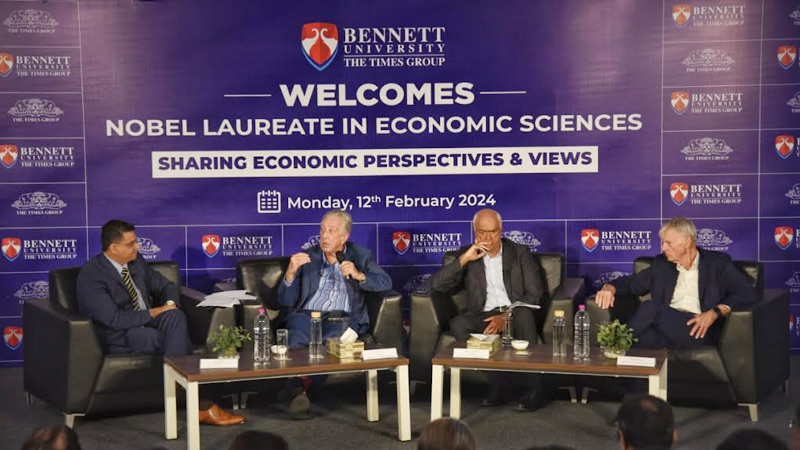
Mumbai: India is poised to boost its economic and geopolitical role in the coming decades, helped by an evolving demographic dividend, rapidly expanding digital economy and GDP growth rates that top the world’s major economies, leading global economists, including Nobel Laureate Michael Spence, said in an exclusive panel discussion with ET NOW at Bennett University.
“As somebody who has spent the last 25 years thinking about growth in one form or another in virtually every corner of the world, let me just say that the major economy with the highest potential growth rate is India,” Prof Spence said in a discussion with ET NOW Sr editor Ajaya Sharma. “India has successfully developed, by far, the best digital economy and financial architecture in the world. It is a transformational architecture.”
India’s leap on the technology front will be a key catalyst for the economic expansion of the nation, currently the world’s fifth biggest economy and its pivotal position in international affairs, he added.

Responding to a question from a student on crypto assets, including bitcoin, Prof Spence said, “Crypto currency is not a currency, because a currency is a store of value and a medium of exchange. If its value changes by a factor of 20 or 30 per cent in a week, it is hard to believe it is a store of value. It is only a currency for those people who want to hide in the darknet.”
He added, “What we will have, are central bank digital currencies. They are like regular currencies because the central banks control that. They are going to solve extreme data security challenges. Whole economies and financial systems are going digital and so do currencies. The notion that we will have an economy running on a currency that’s entirely decentralized– is not going to happen.”
Remarks by other panelists outlined in depth how India would play a bigger role on the global stage. “India is at the cutting edge of transformation in technology, which I think is a basis for optimism,” Rob Johnson, president of the Institute for New Economic Thinking (INET), said in the discussion. The country’s rising international role comes amid evolving geopolitics in the backdrop of conflicts in Ukraine and the Middle East, and mounting trade and military tensions between China and the United States.
“The relatively open global economic system that has been in place for over 70 years, but it is breaking down under the pressure of enormous array of shocks, pandemics, geopolitical tensions involving U.S. and China and others, climate shocks are very frequent and severe,” Prof Spence said.
The world is undergoing a turbulent phase, which he likened to a “regime change in global economy.”
“This is the world that has characteristics and experiences that we haven’t felt for the last three decades. That’s what I mean by regime change and disruption,” he said.
In such a juncture, India is exporting a vision “at the cutting edge of this new frightened world,” Johnson said. “India in the realm of technology is a visionary and an ambassador to transformation.”
Prof Rohinton Medhora, chair of governing board of INET, said a significant part of global wealth are in intangibles and intellectual property.
“The source of wealth is locked up in intangibles. Most governments haven’t fully caught on to govern an economy, where so much wealth resides in intangibles, where fixed costs are high and marginal costs of production are practically zero.”
“If it is existential, firms will get it. But often existential is still 10, 20, 30 years down the horizon. Very few firms have that horizon because they don’t have that capital or staying power. So, we need capital markets that encourage that kind of horizon,” said Prof Medhora.
Mr Johnson summed up India’s current role citing French author and aviator Antoine de Saint-Exupéry’s famous novel The Little Prince, “Its only with the heart, one can truly see.” India sees that with more clarity than almost any other country, he said.
The discussion was held at Bennett University (BU), which is the higher education initiative from The Times Group and comprises six schools with undergraduate, postgraduate, and doctoral programs across Engineering, Management, Law, Media, and Liberal Arts. Set up in 2016, BU has focused on making students employment and industry ready in the shortest possible time.
The discussion with Prof Spence and INET is an ET NOW presentation and will air on Friday (7.30pm) and Saturday (8.30pm). ET NOW is India’s leading English business news channel and leads with its focus on both markets and finance as well as content around development, economy, government and policy issues. ET NOW engages with viewers in 16 countries across the globe.






News Broadcasting
News18 India to air Sabse Bada Dangal on 4 May counting day
Channel promises fastest results, live trends and analysis across five states.

MUMBAI: Ballots will do the talking and screens will do the shouting. As counting day approaches for high-stakes Assembly elections across West Bengal, Tamil Nadu, Kerala, Assam and Puducherry, News18 India is gearing up for an all-day broadcast of its flagship election show, Sabse Bada Dangal, on 4 May from 6 am onwards. The Hindi news channel plans to deliver continuous, real-time updates as votes are tallied, combining live counting data with on-ground reporting and studio analysis. With political fortunes set to shift through the day, the coverage will track every swing, surge and surprise as trends turn into results.
The broadcast will feature a mix of senior political leaders, analysts and experts, offering instant reactions and decoding the evolving electoral picture. Expect heated debates, quick takes and detailed breakdowns as the numbers settle across all five states.
For News18 India, counting day has long been a high-visibility moment. The network is banking on its reporting reach, editorial bandwidth and technology-driven coverage to stay ahead in what is often a fiercely competitive news cycle.
With multiple battlegrounds and shifting narratives, the day promises both drama and data in equal measure. And if all goes to plan, Sabse Bada Dangal will once again turn the counting of votes into prime-time spectacle.