News Broadcasting
Content distribution revisited

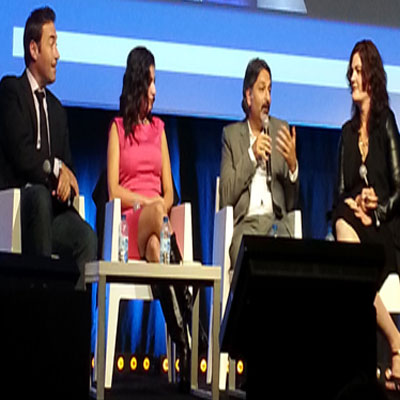
CANNES: “In India, we produce so much content and it is up on the web in the next three and a half minutes,” began IndiaCast Group CEO Anuj Gandhi. He was speaking at a panel on ‘Access is the new ownership: A new look at content distribution’, on day two of MIPCOM.
Moderated by Superhuman founder Louisa Heinrich, the session focussed on changing audience expectations and how consumers ought to get what they want to watch, where they want to watch, instead of what content distributors want to show.
“We need to ensure that quality content is produced and is also made available cross country,” Gandhi reinforced.
Describing India’s internet story as ‘spinning faster than the globe’ Gandhi substantiated his statement with statistics. “India has 150 million internet users and ranks number three worldwide. 75 per cent of the population using internet is below the age of 15. Almost 86 per cent of Indian web users visit a social networking site, of which 80 million are on Facebook.”
“That apart, there are 220 million mobile devices sold every year. There are 700 million mobile phone users and 40 million are 3G subscribers. India boasts of seven million tablets and 0.5 million are sold per month. Also, there are 50 million smart phones and three million sold every month,” he said.
India is the second most important market for internet giants, Gandhi said, adding: “Consumption of video has shot up in India, with more and more people hooking on to YouTube to watch videos.”
Gandhi further informed the audience that the rollout of the national telecom policy would target 175 million broadband users by 2017, up from the current 15 million. “100 hours of content is being uploaded to YouTube every minute. Also, the good news is that the data access charges will come down by 70 per cent.”
Coming to IndiaCast, he said it is looking at ways to handle traditional media. “We are getting shackled by the traditional platform. We are losing out on opportunities. The traditional platforms have ring-fenced content rights. There are longer contracts and limited flexibility.
So while the traditional platform is growing, it is also getting expensive and has capacity constraint. Content needs to travel. We need to exploit our rights to ensure that the content is made available everywhere,” said he.
Gandhi foresees a five-fold increase in data consumption in the switch from 2G to 3G and another five times with that to 4G. “There will be a three times growth in the YouTube revenue in the next two years and two million paying mobile TV subscribers in the next two years. The number of people watching YouTube has already crossed 50 million and the channel is now looking at ways to monetize it,” he said.
Asked about the role of the broadcaster in social media, Gandhi said: “Well, the key issue is to have a 360 degree marketing campaign and social media is one such platform. As a content distribution company, we need to analyse what people are saying about available content. We need to be innovative, be aware of what is happening in the markets, and also keep experimenting with windowing and stop playing safe.”