Connect with us

News Broadcasting

Parents should stop treating young minds as ‘Project Children’: Prof Vijender Singh Chauhan at ‘Ideas of India’ Summit 3.0


Published

on

Mumbai: Highlighting the importance of listening to the aspirations of young minds and their idea of India, in a session titled ‘Yearning to Learn: What Young People are Telling Us’ at the ‘Ideas of India’ Summit 3.0 in Mumbai, on 23 Feb, eminent academicians Zakir Husain Delhi College, University of Delhi associate professor Prof Vijender Singh Chauhan and KD Campus & KD Live founder Neetu Singh elaborated on the need for creating career opportunities, the role of parents in supporting their dreams, and the impact of social media algorithms and AI disruption on their future.

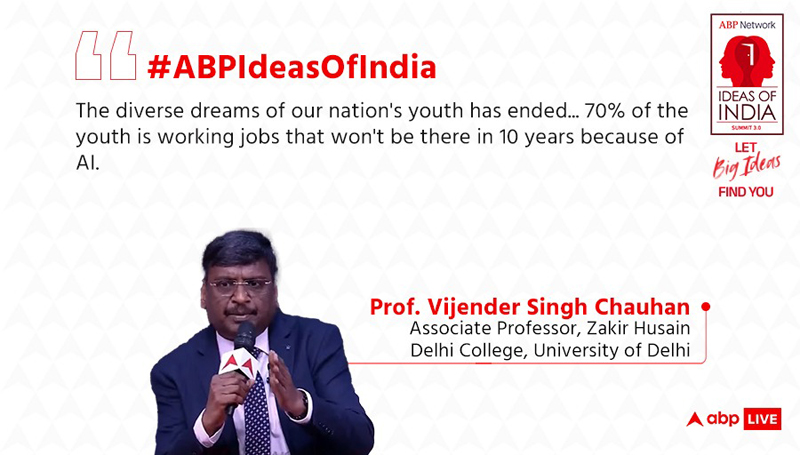
Known as the man who helps civil service aspirants crack interviews, Prof Vijender Singh Chauhan said, “We need to understand that 25-year-olds are the most populous demographic in India globally. And we need to ask ourselves whether, as a society, we are preparing to sustain them when this population turns 50. Today, we are witnessing a decline in the diversification of dreams among young minds. There are only 800 jobs available in UPSC, yet 8 lakh people are applying for them. This clearly indicates that young people are not getting their desired career choices. Parents should stop treating their children as mere projects, pushing them towards preparing for IITs, then sending them to IIMs, and finally aiming for a UPSC clearance. Getting a government job should not be the sole aspiration of young minds.”
Sharing her thoughts on the importance of parents’ role in shaping the future of children, Neetu Singh, widely renowned for having developed her own style and method for English coaching, added, “We need to understand that there are still values in our society, and many students go through hardships only to fulfil the dreams of their parents. Students come from the lower economic sections of society, and the job opportunities are fewer for them. So, parents should not burden children with the weight of their expectations and dreams, so they get shattered. It is essential for students to know what is essential for them and they need to engage in grooming and self-improvement, giving their heart and soul properly.”

Advertisement

Elaborating on the risks of AI disruption and algorithms, Prof Chauhan added, “Engineers doing basic coding jobs will soon find AI taking over these roles. Are we preparing them for the jobs that will emerge 10 years down the line? Also, we need to be aware of how social media algorithms and persuasive technology are making us believe in collective dreams or choices that are not our own. Algorithms are influencing career choices, personal, social, and most importantly, our political choices, which is dangerous.”

The ABP Network’s ‘Ideas of India’ Summit 3.0, spotlighting ‘The People’s Agenda,’ brought a confluence of ideas and ideators to a common platform celebrating the country’s people and its plurality. The two-day summit hosted policymakers, cultural ambassadors, industry experts, celebrities, business leaders, economists, and leading luminaries to delve into the fundamental ideas of liberty, justice, equality, and diversity that define India, its society, culture, and politics. The meaningful deliberations on diverse topics had the brightest minds across sectors providing insights into the nation’s trajectory and its journey to becoming Viksit Bharat.


Advertisement
Click to comment

Leave a Reply

Your email address will not be published. Required fields are marked *

News Broadcasting

Induction cooktop demand spikes 30× amid LPG supply concerns

Supply worries linked to West Asia tensions push households and restaurants to turn to electric cooking alternatives

Published

on

MUMBAI: As geopolitical tensions in West Asia ripple through global energy supply chains, the familiar blue flame in Indian kitchens is facing an unexpected challenger: electricity.

What began as concerns over the availability of liquefied petroleum gas (LPG) has quickly evolved into a technology-driven shift in cooking habits. Households across India are increasingly turning to induction cooktops and other electric appliances, initially as a backup but now, for many, a necessity.

A sudden surge in demand

Recent data from quick-commerce and grocery platform BigBasket highlights the scale of the shift. According to Seshu Kumar Tirumala, the company’s chief buying and merchandising officer, demand for induction cooktops has risen dramatically.

Advertisement

“Induction cooktops have seen a significant surge in demand, recording a fivefold jump on 10 March and a thirtyfold spike on 11 March,” Tirumala said.

The increase stands out sharply when compared with broader kitchen appliance trends. Most appliance categories are growing within 10 per cent of their typical demand levels, while induction cooktops have witnessed explosive growth as households rush to secure an alternative cooking option.

Major e-commerce platforms including Amazon and Flipkart have reported rising searches and orders for induction stoves. Quick-commerce apps such as Blinkit and Zepto have also witnessed stock shortages in major metropolitan areas including Delhi, Mumbai and Bengaluru.

Advertisement

What was once considered a convenient appliance for hostels, small kitchens or occasional use has suddenly become an essential addition in many homes.

A crisis thousands of miles away

The trigger for this shift lies far beyond India’s kitchens.

Escalating conflict in the Middle East has disrupted shipping routes through the Strait of Hormuz, one of the world’s most critical energy corridors. Nearly 85 to 90 per cent of India’s LPG imports pass through this narrow waterway, making the country particularly vulnerable to supply disruptions.

Advertisement

The ripple effects have been swift.

India currently meets roughly 60 per cent of its LPG demand through imports, and tightening global supply has already begun to affect domestic availability and prices.

Earlier this month, the price of domestic LPG cylinders increased by Rs 60, while commercial cylinders rose by more than Rs 114.

Advertisement

To discourage panic buying and hoarding, the government has also extended the mandatory waiting period between domestic refill bookings from 21 days to 25 days.

Restaurants feel the pressure

The strain is not limited to households. Restaurants, hotels and roadside eateries are also grappling with supply constraints as commercial LPG availability tightens under restrictions imposed through the Essential Commodities Act.

In cities such as Bengaluru and Chennai, restaurant associations report that commercial LPG availability has dropped by as much as 75 per cent, forcing many establishments to rethink their kitchen operations.

Advertisement

Some restaurants have reduced menu offerings, while others are rapidly installing high-efficiency induction systems, creating hybrid kitchens where electricity now shares the workload with gas.

For smaller eateries and roadside dhabas, the shift is less about sustainability and more about survival.

A potential structural shift

The government has maintained that there is no nationwide LPG crisis and has directed refineries to increase production to stabilise supply.

Advertisement

Nevertheless, the developments of March 2026 may already be triggering a longer-term behavioural shift.

For decades, LPG has been the backbone of cooking in Indian households. However, recent disruptions have highlighted the risks of relying on a single fuel source.

Increasingly, households appear to be hedging against uncertainty by adopting electric cooking options to guard against price volatility and delivery delays.

Advertisement

If the current trend continues, the induction cooktop, once viewed as a niche appliance, could emerge as a quiet symbol of India’s evolving kitchen economy.

Continue Reading

Advertisement News18
Advertisement All three Media
Advertisement Whtasapp
Advertisement Year Enders

Copyright © 2026 Indian Television Dot Com PVT LTD

This will close in 10 seconds

×