Brands
Life in the digital era: food, shelter, clothing and Internet

MUMBAI: As the lines blur between the real and virtual, many brands are making an effort to create a virtually real world to reach out to the audiences/consumers. Especially, when technology allows them a two-way communication with their target audience unlike before when they were left doing only the talking.
Not only do consumers respond in real time on the digital platform, it is a faster, more measurable and result-driven medium that helps brands understand their user base, increase revenue and reward loyalty.
Says Priti Nair of Curry Nation: “A good digital campaign can reach out far and wide as compared to any other medium and that too at a throwaway price. Also, the longevity of a good campaign is far more on the digital platform than any other medium. All these make digital a medium worth checking out.”
Recently, the agency created a digital campaign for Nirlep – Khaate peete desh ka rakhwala – which revolves round Indians’ love for food, sending out a tongue-in-cheek message that healthy eating is still possible with Nirlep non-stick cookware.
“The best part about a viral video is it gives you a lot of space to play around. Interesting characters, situations can be explored. Using the slogan of ‘Yes We can’ with food was both, entertaining enough as well as informative,” says Nair about the campaign.
Says NeoNiche Integrated Solutions MD and CEO Prateek N Kumar: “With digital and technology, the sky’s the limit. If you can dream it, you can build around platforms to really make those elements come to life in real time. A well thought of digital plan also has the capacity of creating WOM and going viral, the ROI is literally exponential compared to traditional media.”
While digital and social media is constantly evolving and is still uncharted territory for most marketers, the basic principles of communication remain the same: Who are you trying to reach, where are they and what excites them?
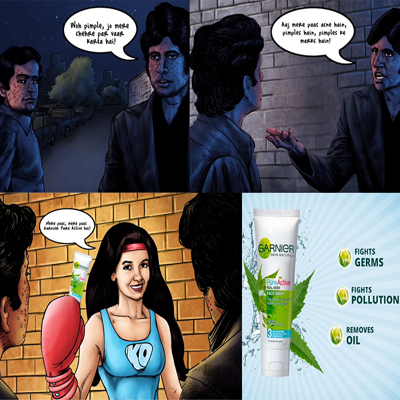
Not so long ago, FoxyMoron launched a digital campaign – No Pimples, No Marks – for Garnier Pure Active. A fun take on popular movies, posters were released titled Rowdy Pimple, The Dirty Pimple, Pimple Tum Kab Jaaogey and I Hate Pimple Storys which conveyed how pimples haven’t spared Bollywood either.
FoxyMoron co-founder and online strategist Harshil Karia believes one should use a medium which requires you to ‘only’ spend to achieve success. “This is a slightly touchy topic as social media increasingly spawns ideas from scaling organically. For instance, on YouTube, the organic percentage of video views or on Facebook, the organic percentage of fans has considerably reduced. Since both these are dominant mediums, it’s a challenge but try to find holes within the mediums where organic percentages are high and capitalize on them. For example, on Facebook, there was a time when video organic views were extremely high because Facebook was pushing a video agenda. Similarly, as Google pushes a social agenda, its propensity to help brands scale organically will be higher,” he explains.
The brand must know its audience even better than itself. Otherwise, whatever be the strategy, it will never be seen or heard by the right people who matter.
Karia gives the example of HUL’s Lifebuoy campaign, ‘Help a child reach 5’, which tells the story of how a father celebrates his son completing five years of age and has a heart-warming and thought-provoking concept at its core. The YouTube video went viral and garnered over 10 million views.
Digital gurus believe that in the era of smart devices and social handles, the basic necessities of mankind have changed from “Food, Shelter and Clothing” to “Food, Shelter, Clothing and Internet”. With brands latching onto this trend, it will only help them garner user intelligence in real time – something the traditional marketing mix can’t help them achieve.