Hindi
I am scared of not living up to the audiences’ expectations: Amitabh Bachchan

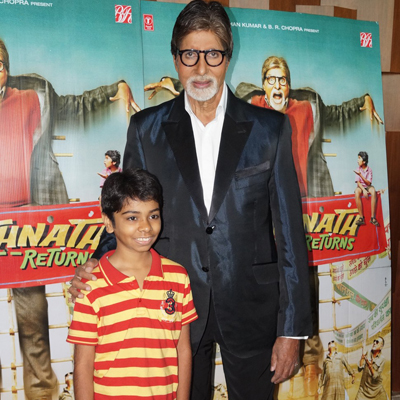
NEW DELHI: Megastar Amitabh Bachchan has one fear: “I am still scared of not living up to the expectations of the people,” he says.
Now in his early seventies, the star says box office figures do not affect him so much as what people say about a film in which he has enacted a role since the expectations from him have grown over the years.
Bachchan also denied that he overawes other stars on a film set and he has confidence in his fellow stars. However, he admitted that he does help them feel comfortable, even as he denied ever giving tips to directors or interfering with their vision of a film. He said he liked working with children as he found them very ‘uninhibited’. “It is a wrong premise that I direct other directors or stars,” he reiterated.
The star was speaking at a press meet about his latest film, ‘Bhootnath Returns’ directed by Nitesh Tiwari and produced by Bhushan Kumar and Krishan Kumar of T-Series and Abhay Chopra, Kapil Chopra, and Renu Ravi Chopra of BR Films.
Being released on 11 April, the film has been presented in the name of the late B R Chopra and the late Gulshan Kumar. Others in the film are Boman Irani, child actor Parth Bhalerao, and Usha Jadhav, though there are guest appearances by Ranbir Kapoor and Shah Rukh Khan.
Although the story to a large extent deals with elections, Bachchan denied that it was in any way made to capitalize on the poll season, adding that the story had been related to him more than eighteen months earlier. He also said the same actors could not be taken as it was a completely new story.
Tiwari said he had taken up the film as a sequel to the first film as ‘Bhootnath’ had captivated the audiences even as it left a strong message-oriented impact. “I cannot give any assurance about a sequel of ‘Bhoothnath Returns.’ There was a lot of pressure working with Amitabh Bachchan, and two big production banners but they really made me feel comfortable with them.”
Bachchan particularly praised Yo Yo Honey Singh who had sung a song in the film. “You do not need to put a lot of efforts working with him,” Bachchan added.
Bachchan said the film takes off from where the first film ended, when Bhootnath lands in heaven but is a butt of humour as he could not frighten even a child (Banku in the earlier film) so he is sent to earth again in the slum colony Dharavi where he meets Akhrot who is the only human who can see him. The film then goes on to comment on elections and Khan and Kapoor make appearances to encourage people to exercise their franchise.
While reiterating that he had retreated from politics as that was not his arena, Bachchan said “every vote makes a difference, and it is in any case the democratic right of citizens.”
Bachchan said in answer to a question that AB Corp was still in the business of making films, but did so in collaboration with other filmmakers. Insisting that he was doing films that could be seen by the family, he was also doing a series with Sony which is being overlooked by Anurag Kashyap, apart from coming for another season of ‘Kaun Banega Crorepati’.
Bhushan Kumar said he had been very excited when he heard the story and had immediately agreed to come on board as producer as it had been his dream to do a film with Bachchan.
Parth, who is a child star from Marathi cinema, said he had been frightened at first when told he would have to act with Amitabh Bachchan. But later he enjoyed working as he had a lot of fun with him.