News Broadcasting
CNBC and Burson-Marsteller reveal results of corporate perception indicator

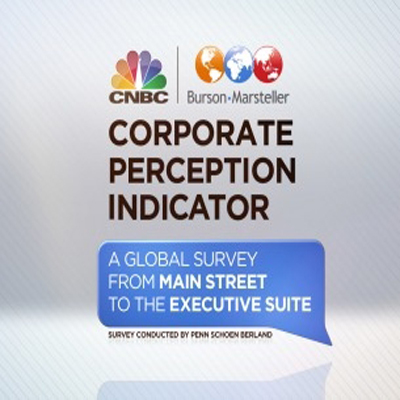
MUMBAI: CNBC and Burson-Marsteller, a global strategic communications firm, unveiled the results of the ‘CNBC/Burson-Marsteller Corporate Perception Indicator: A Global Survey from Main Street to the Executive Suite.’ Exclusively for this sweeping report, research firm Penn Schoen Berland surveyed more than 25,000 individuals from the general public and more than 1,800 business executives in 25 global markets on their opinions about the roles and responsibilities of corporations in society and in contributing to the economy. CNBC’s Becky Quick, co-anchor of “Squawk Box” will lead the network’s global on-air coverage of the survey.
The survey uncovered a sharp divide between the developed economies of North America and Western Europe, and emerging economies like China, Russia and Brazil, particularly in people’s disposition toward corporate influence over government, corporate stewardship of the environment, and perhaps most importantly, the role corporations play as engines of job creation and economic growth.
According to the survey, the general public in developed economies has a much more cynical view of corporations compared to the general public in emerging economies. In developed economies, 52% of the general public has a favorable view toward corporations versus 72% of the general public in emerging economies. A deeper dive into those emerging economies finds that the general public and business executives are much more likely to see corporations as a source of hope, rather than fear, when compared to their developed country counterparts.
When it comes to corporate taxation, however, the major markets are generally in agreement. Fifty-seven percent of the general population and 53% of executives say corporations take advantage of tax loopholes to avoid paying their fair share rather than paying what they owe. Most of the global markets agree that it’s important for corporations to pay their “fair share” of taxes including 70% of the general population and 67% of business leaders in the United States saying it’s very important. The exception is Russia, where only 12% say it is very important for corporations to pay their fair share and more than half said it is not important.
“We discovered in our initial reporting that there is a serious dearth of data spotlighting the way corporations are perceived from all points of view,” said CNBC Business News SVP & editor in chief Nikhil Deogun. “These findings will ignite debates and discussions important to CNBC’s audience across all platforms.”
“Six years after the economic crisis hit, this major survey makes clear that, while the reputations of corporations and business leaders are improving, there is still real work to do to dispel doubts about their impact,” said Burson-Marsteller worldwide chair and CEO Donald A. Baer. “The good news is this survey is a corporate compass that points in the direction of even deeper engagement between corporations and their leaders and the broader public about their essential roles in building the economy and improving society.”
Among the survey’s other findings:
- Health Care: Compared to people in other developed countries, Americans are much more likely to say corporations are responsible for providing health care insurance. Sixty-five percent of consumers in developed countries say the government is responsible for providing health care, but the United States is a major exception. In the U.S., only 37% of the general population says the government should provide healthcare coverage; 29% say individuals should be responsible; and 21% say corporations should be responsible.
- Retirement: Business executives around the world agree that corporations should have an obligation to provide retirement benefits to employees. In the U.S., a higher percentage of business executives (84%) hold this view, compared to just 75% of the general population.
- CEO Pay: Most of the world thinks CEO salaries are high with 38% of total respondents (and 32% of Americans) saying CEOs make more money than professional athletes, entertainers and heads of state. Thirty percent of Americans say teachers should be the highest paid workers in society, followed by police & firefighters (22%) and doctors (15%).
- Social Responsibility: Nearly one-third of the executive suite in the developed world says corporations are becoming less socially responsible. That view is especially prevalent in Western Europe where 52% of Germans, 46% of French, and 45% of Dutch say corporations have become less socially responsible over the past decade.
- CEO Reputation: In the U.S., 47% of the general population identifies CEOs as among the most powerful people in society, but only 9% view them as among the most respected.
- Corporate Nationalism: 63 per cent of the general population in China has a more favorable view of a corporation if it is American while 71% of the general public in America has a less favorable view of a corporation if it is Chinese. Sixty-one percent of the general population in Russia and 59% of the general population in Germany says they have a less favorable view of a corporation if it is American.
From June 28 – August 15, 2014, Burson-Marsteller and CNBC surveyed 25,012 individuals from the general population and 1,816 business executives in 25 global markets on their opinions about the role of corporations in society and the economy. The research was conducted using an online questionnaire in the native language of each global market by Penn Schoen Berland with sample provided by Kantar. The total general population sample has a margin of error of ±0.62%. The total business executive sample has a margin of error of ±2.3%.