I&B Ministry
I&B asks stakeholders to arrive at consensus on difficult issues for successful digitisation

NEW DELHI: Information and Broadcasting Ministry (I&B) additional secretary J S Mathur, who heads the Task Force for Phase III and IV of Digital Addressable Systems (DAS) for cable television has urged all stakeholders to come together and resolve issues, if targets have to be met.
Noting in the sixth meeting held on 13 March that only seven out of 100 multi-system operators (MSOs) had given the seeding plans for Phase Ill areas.

The data provided by them indicated that about 3.1 million set top boxes had been seeded by them with about 550,000 STBs in their stock and about 2.35 million STBs under orders of purchase. He remarked that the seeding so far was very low vis-a-vis the target.
He said, “Each day counts towards progress in digitisation.” He also said that progress would be slow without public awareness campaign by the stakeholders.
He said there was lack of mutual connect between broadcasters and MSOs with each stakeholder wanting to maximize self interests. There was need for coming to a consensus.
He added that the data on subscription revenue and carriage fee from the Indian Broadcasting Foundation and News Broadcasters Association was still awaited, despite assurances.
He emphasised that broadcasters have to contribute by mounting awareness campaign on their channels as was done by them during Phase I and Phase II and the MSOs have to contribute in this campaign. He said broadcasters should start a dialogue with MSOs immediately.
He welcomed the initiative taken by Telecom Regulatory Authority of India (TRAI) to hold a meeting with broadcasters and MSOs to resolve the issue of interconnect agreements.
However, the stakeholders should themselves get their act together and put in their utmost effort to ensure that such issues do not come in the way of achieving the goal of digitisation.
He said that as pointed out by some members of the Task Force, digitisation has begun to benefit all stakeholders. Activity on the ground needs to be accomplished from now itself as it is not a matter that can be put in place overnight.
Representative of MSOs said there were issues of content costing, due to which they were finding it difficult to plan digitisation in new areas. Seeding plans can be firmed up by MSOs only after knowing content cost. Till then, the MSOs can only give their seeding projections instead of seeding plans.
They also stressed that revenue from Phase Ill and Phase IV areas is about 20 to 30 per cent of the total revenue from the country. So content cost in Phase Ill and Phase IV areas cannot be same as that in Phase I and Phase II areas and this has to be taken into account by all stakeholders.
MSOs also complained that broadcasters were not entering into interconnect agreements with the MSOs for Phase Ill areas.
Unless the input cost is known, MSOs cannot educate the consumers about the rates and there are issues of local taxation levied by some State Governments apart from local cable operators switching over to analogue when the digital signal to them is cut off by the MSO.
Broadcasters’ representatives on the other hand said MSOs had not approached the broadcasters for entering into interconnect agreements in new areas. The broadcasters felt that this was because MSOs do not have concrete plans.
Seeding was done by MSOs in Phase I and Phase II without first entering into interconnect agreements with broadcasters and this should not be an issue now, some of the broadcasters said.
They claimed that channel prices had gone up due to technical upgradation from SD to HD, but there had been no increase in the advertisement rates.
A TRAI representative said that according to a TDSAT judgment, MSO/LCO providing cable TV services were free to provide digital cable service in new areas unless it trespasses other areas. He impressed upon the broadcasters to enter into interconnect agreements with MSOs who approach them for content in Phase Ill and Phase IV areas.
Representative of consumer forums mentioned that pricing is the main issue which the consumers are facing. He added that consumers should know the price before he switches over to digital.
Representative of CEAMA stated that they approached as many MSOs as possible to clear their doubts about indigenous set top boxes. However the response from the MSOs has not been encouraging. He reiterated that they have the capacity to meet the requirements of Phase Ill and Phase IV.
A representative of the Uttar Pradesh Government mentioned that CAF forms should be filled by the MSOs before changing to digital mode in Phase Ill and Phase IV areas. He added that the State Government was not having complete seeding data of Phase II cities.
The representative of Jammu and Kashmir wanted consumers to be informed about the set top box price.





I&B Ministry
CBFC speeds up film certification; average approval time cut to 22 days
Over 71,900 films cleared in five years as digital system shortens approval timelines
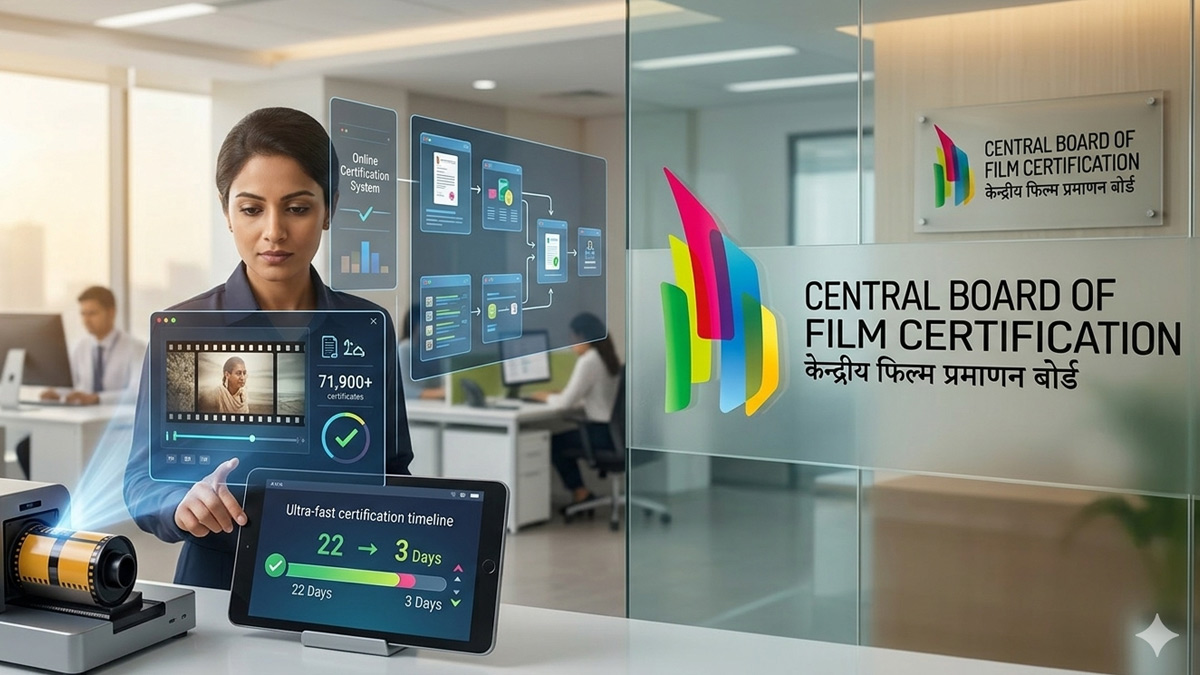
MUMBAI: The Central Board of Film Certification (CBFC) has significantly reduced the time taken to certify films, with the average approval timeline now down to 22 working days for feature films and just three days for short films.
Operating under the Ministry of Information and Broadcasting, the statutory body certifies films for public exhibition in line with the Cinematograph Act, 1952 and the Cinematograph (Certification) Rules, 2024. The rules prescribe a maximum certification period of 48 working days, though the adoption of the Online Certification System has sharply accelerated the process.
Over the past five years, from 2020-21 to 2024-25, the board certified a total of 71,963 films across formats. Of these, the majority fell under the U category with 41,817 titles, followed by UA with 28,268 films and A with 1,878 films. No films were certified under the S category during the period.
Film approvals have also steadily risen in recent years. The CBFC cleared 8,299 films in 2020-21, a figure that peaked at 18,070 in 2022-23 before settling at 15,444 films in 2024-25. During the same period, 11,064 films were certified with cuts or modifications.
Despite the high volume of certifications, outright refusals remain rare. Only three films were denied certification over the last five years, with one refusal recorded in 2022-23 and two in 2024-25.
The board may recommend cuts or modifications if a film violates statutory parameters relating to the sovereignty and integrity of India, security of the state, friendly relations with foreign states, public order, decency or morality, defamation, contempt of court or incitement to an offence.
Filmmakers can challenge CBFC decisions in court. Data shows that such disputes remain limited but have seen some fluctuation. Between 2021 and 2025, a total of 21 certification decisions were challenged before High Courts, with the number rising to 10 cases in 2025.
Responding to a question in the Rajya Sabha, minister of state for information and broadcasting L. Murugan shared the data. The question was raised by Mallikarjun Kharge.
With faster timelines and a largely digital workflow, the certification process appears to be moving at a far brisker pace, signalling a shift towards quicker clearances for India’s growing film output.







