iWorld
Telcos support net neutrality but root for checks on OTT platforms

NEW DELHI: While supporting net neutrality and firmly holding that access should be made available to all on a non-discriminatory manner, the Cellular Operators Association of India (COAI) has said that there is a need to evolve the regulatory framework for Over The Top (OTT) communication services to prevent various regulatory imbalances between the Telecom Service Providers (TSPs) and the OTT communication players.
It is response to the Telecom Regulatory Authority of India’s (TRAI) consultation paper on OTT, COAI has said a “common regulatory framework for businesses providing the same services is the need of the hour and will benefit all players as it will reduce legal ambiguity and prevent unnecessary litigations.”

At the outset, COAI said it welcomed the entry of OTT players and believes that they play an important role and offer many new services. However, the body added that, “it is pertinent to note that some of the services that are offered by the OTT players such as messaging/instant messaging and VOIP telephony are perfect substitutes of the services that can be offered by the telcos. These OTT players have rightly been classified by the Authority as “OTT Communication Services” players and their services are in direct competition with the licensed communication services offered by the TSPs.”
The COAI wants not only net neutrality, but also net equality – the need to connect the one billion citizens of India, who are still not connected to the internet, by facilitating an open, inclusive and affordable access to the Internet, and with the same rules being made applicable to the same services.
There is a need to review the regulatory framework and “we submit that the time is ripe for a comprehensive review to build a regulatory neutral, forward looking and transparent framework that ensures that the principles of “net equality” and “same service, same rules” are implemented.”
“The need of the hour is to connect the 80 per cent of India’s population, which is still unconnected; and our campaign “Sabka Internet, Sabka Vikas” reaffirms our commitment to the Government’s vision for “Broadband for All” and Digital India, for socio-economic inclusion of all strata of the society. We believe a customer should be free to choose the device, technology and access platform – paid or subsidized, as long as the Internet is always open in terms of access in a non-discriminatory manner. Also, we offer choice and do not block or provide preferential access to any website or application, thereby safeguarding Net Neutrality,” COAI said.
Some stakeholders have suggested that there are already adequate laws controlling the operations of OTT players such as Information Technology Act, Indian Penal Code, the Criminal Procedure Code etc. It is pertinent to point out here that such laws are general laws, which in its terms and effect apply to the entire country irrespective of the sector and framework in which they operate. While these laws are important and useful in a general context, they cannot be said to be a substitute of a common regulatory framework, which would govern and regulate similarly placed service providers and give them a common platform for the provision of services on common terms, which would ensure a level playing field.
The telecom industry has already invested over Rs 7,50,000 crore in setting up world class mobile networks over the last 20 years and is looking at investing another Rs 5,00,000 crore in the next five years to roll-out into rural areas and also upgrade existing networks to connect one billion Indians to the internet. Moreover, going by the Government’s commitments, the Digital India Programme itself will require investments to the tune of Rs 113,000 crore. Additionally, the Planning Commission’s 12th Five Year Plan requires an investment of Rs 943,899 crore with 93 per cent of the total investment expected to come from the private sector.
The Indian mobile telephony industry today, is in dire financial straits with a cumulative debt of over Rs 300,000 crore, and a one per cent return on investments, with many operators even making negative returns on their investments. This situation puts at risk the nation’s agenda of “Broadband for All”, as private operators will be unable to attract additional investments in the sector, required to support the ambitions of the government.
COAI said there were various regulatory imbalances that existed between the telecom operators and OTT communication players. “We would like to submit that the TSPs bear the cost of infrastructure, spectrum, and payment of license fees and spectrum usage charges, which are not applicable to the OTT communication players. The TSPs also have the obligations related to roll-out, meeting quality of service parameters and security related obligations. Many of these do not apply to OTT communication players, which result in an arbitrage opportunity. The National Security and consumer security, safety and privacy are of paramount importance, and should not be compromised at any cost. The security framework has evolved over the years along with the growth and proliferation of telecom services and all the telecom operators provide these services under a strict licensing framework, including compliances with the security conditions and service standards. The extensive and stringent security conditions laid down and required to be met by the licensed TSPs are not applicable to the OTT Communication players. Most of the OTT players do not meet the encryption and decryption requirements of the Law Enforcement Agencies (LEA).”
In response to a Parliamentary question on security threats from OTT applications, COAI said that the Telecom Ministry has acknowledged the fact that security/LEAs are facing difficulty while dealing with encrypted communication services provided by OTT service providers and the same may also be used by anti-national and criminal elements, posing a security threat. Lack of regulation on communication related application services could lead to serious national security and data privacy implications because they bypass the regulatory regime enforced on licensed service providers. Therefore, it is essential to ensure that the principles of “Same service, Same rules” are implemented.
Referring to claims by some stakeholders that Internet Based Services (IBS) players should not pay for use of the TSPs network over and above data charges paid by customers, COAI highlighted that increased data usage fails to compensate for loss of revenues to TSPs arising due to OTT services. Further, these services demand high-speed networks that require substantial investment in infrastructure, particularly for the development of the broadband infrastructure both from the fixed and mobile perspective. “We hereby advocate for the Open and Pro-innovation Environment wherein pricing flexibility is provided to the operators and the choice is provided to the customers.”
On traffic management for different OTT services, COAI said traffic management allows operators to secure their networks, prioritize time-critical services and match scarce network resources to service requirements. It is an essential function of networks to meet the performance expectations of different types of traffic to ensure better customer experience. Traffic management is a tool for consumer benefit not consumer harm as it provides a number of clear benefits to end users in terms of improved performance, innovation, consumer protection and efficiency.
On the contention that TSPs should not be allowed to implement non price based differentiation as it would be grossly uncompetitive and would kill competition leading to all traffic being cornered by a few, the Association said there is a need to look at the internet as a two sided market, which involves the consumer and the content app provider. The TSP is the platform that market together and needs to be given the flexibility of implementing based differentiation.







iWorld
JioHotstar brings HBO Max to India in exclusive Warner Bros. tie-up
Hit shows and global franchises arrive as platform sharpens streaming edge
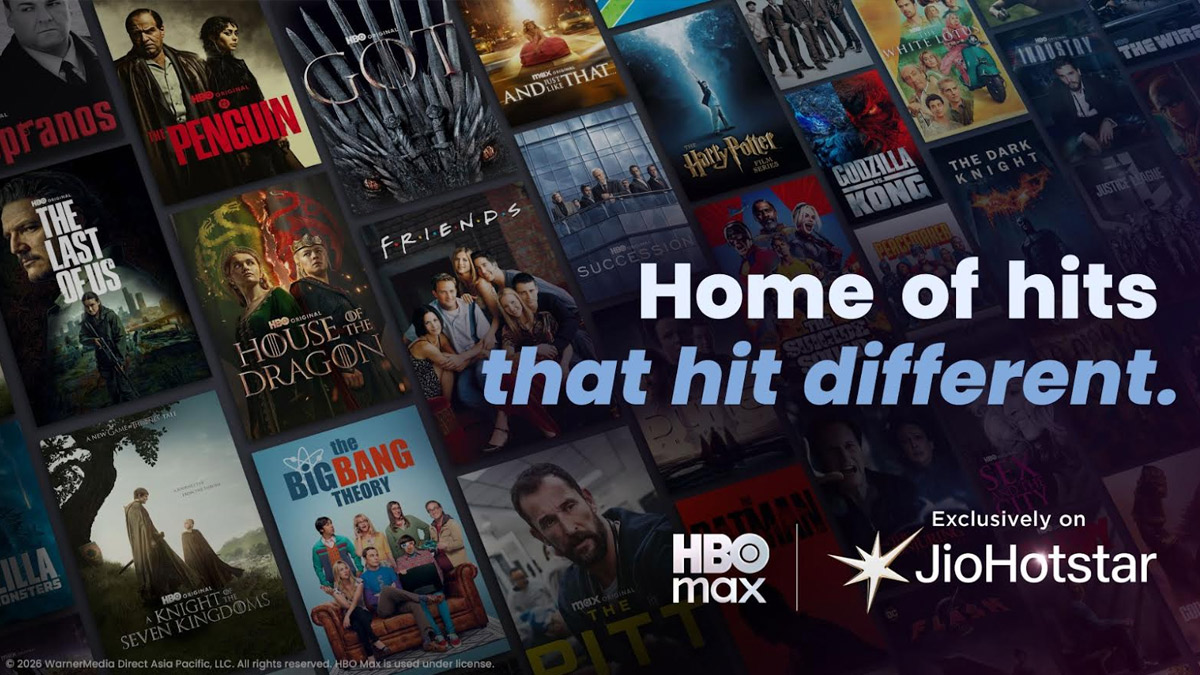
MUMBAI: JioHotstar has expanded its partnership with Warner Bros. Discovery to bring HBO Max to India, making it the exclusive home for the global streaming platform in the country.
The HBO Max hub, now live on JioHotstar, offers a wide catalogue spanning HBO, Max Originals, Warner Bros. Pictures, Warner Bros. Television and DC Studios, creating a unified destination for premium international content.
The launch gives Indian audiences access to some of the most anticipated titles of 2026, including new seasons of Euphoria and House of the Dragon, alongside an upcoming Harry Potter series. Popular titles already available include The Last of Us, Succession, Game of Thrones and The White Lotus.
In a first for the platform, subscribers can also stream iconic series such as Friends and The Big Bang Theory, along with other fan favourites like The Vampire Diaries, Supernatural and The Flash.
Commenting on the launch, JioHotstar CEO entertainment Kevin Vaz said, “This marks a defining moment in how premium global content is accessed and experienced in India.” He added that the integration brings together scale, curation and accessibility to deliver a more immersive viewing experience.
Echoing the sentiment, Warner Bros. Discovery president Apac James Gibbons said, “India is one of the most vibrant streaming markets globally, and in JioHotstar, we have a partner with unmatched scale and a deep understanding of local audiences.” He noted that the move strengthens the reach of the company’s global franchises in the country.
The HBO Max hub will sit alongside JioHotstar’s existing content library, with subscription add-on plans starting at Rs 49 per month, offering viewers broader access to international programming.
With streaming competition heating up, this tie-up signals a clear push by JioHotstar to double down on premium global content and cement its position as a one-stop destination for entertainment in India.







