News Headline
Chrome launches tool to study TV consumption pattern in rural India

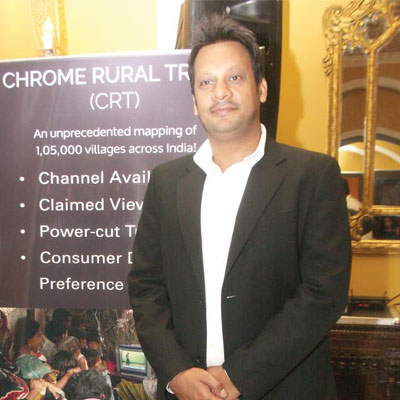
MUMBAI: India’s TV research and analytics company Chrome DM has launched Chrome Rural Track. Every month, Chrome Rural Track will map 1,05,000 villages across India to study the consumption patterns in television viewing.
The tracking will involve massive infrastructure of field staff and tele-callers, with knowledge of 22 languages, advanced technology, etc. through use of six proprietary tools.
The field-work for Chrome Rural Track was initiated in April 2015 and the data compilation for Phase I comprising 25,484 villages is underway. Every month, Chrome Rural Track will encompass channel availability, claimed viewership, power-cut trends and consumer durable preference and ownership (colour TV, LPG stove, ceiling fan, car/jeep/van, two wheeler, refrigerator, washing machine, air conditioner, PC/laptop and agricultural land).
The tracking will be categorised into four Chrome Rural Strata (CRS) based on population density. CRS 1 will be in villages with population greater than 20,000; CRS 2 between 10,001 – 20,000; CRS 3 between 5,000 – 10,000 and CRS 4 will track villages with population less than 5,000.
The monthly tracking is aimed to assist the marketers in strategising for rural India. It will also help bring the issues affecting rural India into mainstream discussion, thus bridging the urban-rural divide in social and economical considerations too.
Chrome DM CEO and founder Pankaj Krishna said, “The size and social-cultural complexity of India’s rural landscape warranted the tracking at such a scale. Despite constituting 69 per cent of the population, rural India remains considerably unmapped across segments. We believe that this is a part of our endeavour to bring rural representation on to the radar. Consumption patterns, consumer preferences and purchasing power of rural areas are significantly different from that of the cities. If we further dissect the data, there are radical differences in consumer behaviour within individual villages. Chrome Rural Track is our attempt to map the diversity that exists in our vast country and provide the industry/decision makers with rural data.”
He further added, “Along with agriculture and simplicity of life – Rural India is today unfortunately synonymous with racism, gender inequality, honour killings and the highest rates of female foeticide across the globe. There are over 1000 female abortions in day in India. Any happening that does well for a story, genuine or non-serious makes it to the headlines across multiple media; however most of these stories are skewed to happenings in and around metros and urban centres. With the launch of Chrome Rural Track, across an unprecedented 105,000 villages of India, our endeavour is to bring Rural India on to the media radar.”
Chrome Data Analytics & Media advisory board member Monica Tata asserted, “There is a huge gap in the understanding of India’s rural consumers. Marketers need information that is dissected to a village level across India. With television being the main tool to communicate with consumers, it is critical that the brands have a refined knowledge television viewing. Through Chrome Rural Track, we aim to bridge this gap. This data spanning 105,000 villages will be indispensable for both advertisers and agencies and help them take more informed decisions.”
Some of the interesting findings from Chrome Rural Track include vast differences in the percentage between Cable, DTH and Terrestrial modes among various states. While 99.1 per cent of Kerala villages, 85.4 per cent of Gujarat villages and 70.3 per cent of Maharashtra villages get TV through cable, 62.4 per cent of villagers in Uttar Pradesh and Bihar access TV through DTH.
Some of the other interesting findings are mentioned in the following table:

Source – Chrome Rural Track August 2015
Terming rural India as virtually a black hole in terms of available information on consumption habits, Chrome Data Analytics & Media member of advisory board Bharat Ranga said, “As part of the Zee Network and responsible for its multiple launches, I have actively used Chrome Data along with the highest levels of analytics. I am sure that Chrome Rural Track will help enhance our content production with a better understanding of rural tastes and lifestyle.”
Mentioned below is a state-wise comparison of media preferences in rural areas across seven states: