Comment
The New Government and Indian Media: Agenda for Reform


I will begin by taking a cue from a catchphrase Mr. Modi used frequently in his stump speeches through the electioneering. “More Governance. Less Government.”
If PM Modi follows this through in all those facets of the government that media industries deal with, he will simultaneously:

• Strengthen plurality of voices and reinforce the media’s ‘Fourth Estate’ role as our democracy’s watchdog and first line of defence
• Unlock investment interest, domestic and FDI, and quickly create thousands of new jobs in the people-intensive creative content sector
• Give fillip to revenue growth for the centre and state governments
• Allow freer play of market forces to accelerate growth in the still nascent media sector
Let us look at specific examples of each of these:
• It is nearly two decades since FM radio was first opened up to private broadcasters. Even today, licence conditions prohibit radio broadcasters from news and current affairs. In a laughable concession they are, however, permitted to retransmit, without any editing or alteration, All India Radio news bulletins. In the meanwhile, television, which reaches a much larger slice of the population, has a whole, officially recognised and duly licensed ‘news’ genre. Apart from a visceral fear of real free speech in both the legislative and administrative arms of the government, there seems to be no justification for this position. The Supreme Court admitted a public interest litigation on 17 October 2013 seeking the abrogation of this restriction. Can the new government show us that its heart is in the right place when this matter next comes up for hearing?
• While restrictions on foreign investment in the news business are nearly universal for easily understood reasons, the government will soon be hearing petitions from several players in the electronic news media about the dire straits they are in. While clearly appreciating the need to ensure that a clear majority in a news business must remain in Indian hands, could the government not consider pushing up FDI to 49 per cent? Similarly, the related-party restrictions on investments in the cable & satellite distribution plant (DAS, DTH, HITS etc.) impede the path for many natural investors. Given the ambitious path laid out to analog sunset at the end of this year, the sector is crying out for more investment and the progress of the digitisation project to date is evidence enough for the consumer and content creator benefits it brings in its wake.
• A very important reason for mandatory digitisation is that it lays to rest the unregulated analogue cable plant, which from the beginning, has operated in a twilight zone beyond the reach of the state. An unfortunate outcome, for central and state governments, is that incomes and profits of businesses in this segment of the media industry have stayed in the informal, ‘black’ economy. Given turnovers in tens of thousands of crore, the loss to the exchequer over the last several years is evidently sizable. The future, however, looks better. Now if the government acts to open FDI pathways into the distribution plant, this future of big service and entertainment tax revenues might be even closer at hand.
• The Telecom Regulatory Authority of India (TRAI) was an accidental invitee to the television industry. Once it got in, though, it behaved like the well-known fable about the Arab and the Camel. On a cold night in the desert, the camel requests the Arab if it can only get its freezing nose into the tent. One thing leads to another and soon the camel is in the tent and the poor Arab is freezing out in the open. TRAI has chosen to build a complex framework to regulate tariffs between content providers and distribution platforms with all sorts of caps and restrictions. Interestingly enough, it appears that the regulations work only to protect distribution interests while doing little or nothing for the final consumer. With a multiplicity of content providers and distribution platforms, the likelihood of any player or group of players being able to exert monopolistic or even oligopolistic economic power leading to extortionate impositions on the consumer now appear far-fetched. Under the circumstances, it may be time to wind down this onerous framework. In any case, an erstwhile TRAI chairman Pradeep Baijal, had indicated that regulation would make way for forbearance soon as the last-mile was competitive. How much more competitive can it get with half a dozen DTH players, hundreds of DAS platforms and indications of other initiatives like HITS in the pipeline?
The country has given an unequivocal mandate to Mr. Modi, his party and coalition. Expectations are stratospheric and everything that accelerates the wheels of business and commerce should be music to his and his government’s ears. BBC’s stated mission “To enrich people’s lives with programmes and services that inform, educate and entertain” is a great encapsulation of the mission of the entire media industry itself. Support this industry and you unleash a catalysing force of good, Mr. Modi.
Because ultimately, as the Clinton Campaign in 1992 put it pithily, it’s “The Economy, stupid.”
(These are purely personal views of Provocateur Advisory principal Paritosh Joshi and indiantelevision.com does not subscribe to these views)






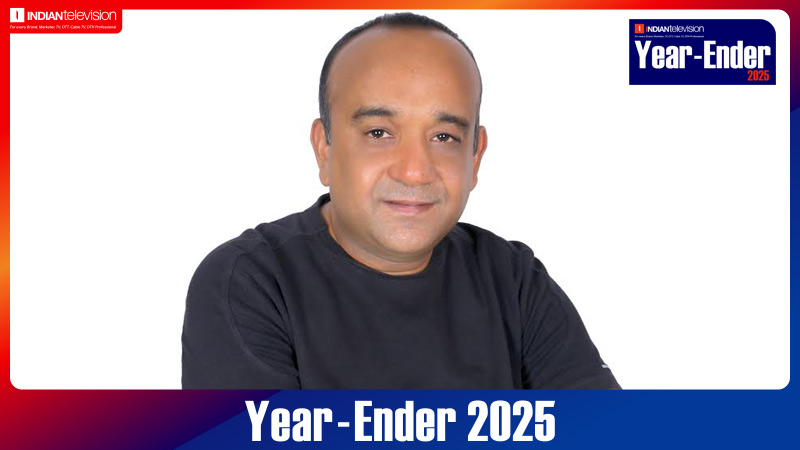
MUMBAI: 2025 will be remembered as the year India’s OTT industry stopped chasing scale for its own sake and began reckoning with how audiences actually consume content. Completion rates fell, patience wore thin and the limits of long-form excess became impossible to ignore. In this guest column, Pratap Jain, founder and CEO of ChanaJor, traces how micro-drama moved from the fringes to the centre of viewing behaviour, why short-form fiction emerged as a retention engine rather than a trend, and how platforms that respected time, habit and emotional payoff were the ones that truly grew up in 2025.
If there is one thing 2025 will be remembered for in the Indian OTT industry, it’s this: the industry finally stopped pretending.
Stopped pretending that bigger automatically meant better.
Stopped pretending that viewers had endless time.
Stopped pretending that scale without retention was success.
What began as a quiet reset in 2023 and a cautious correction in 2024 turned into a very visible shift in 2025. Business models matured. Content strategies tightened. And most importantly, platforms started aligning themselves with how Indians actually watch content, not how the industry wished they would.
At the centre of this shift was micro-drama—not as a trend, but as a behavioural inevitability.
When OTT finally understood the time problem
For years, long episodes were treated as a marker of seriousness. A 45–60 minute runtime was almost a badge of credibility. Shorter formats were pushed to the margins, labelled as “snack content” or “mobile-only.”
That belief quietly collapsed in 2025.
What platform data showed very clearly was not a drop in interest—but a drop in patience. Viewers weren’t rejecting stories. They were rejecting commitment.
Across platforms, the same patterns appeared:
* First-episode drop-offs on long-form shows kept increasing
* Completion rates continued to slide
* Viewers were sampling more titles but finishing fewer
At the same time, shows with episodes in the six to 10 minute range started showing the opposite behaviour: higher completion, higher repeat viewing, and stronger daily habit formation.
Micro-drama didn’t win because it was short. It won because it respected time.
Micro-Drama didn’t arrive loudly. It took over quietly.
There was no single moment when micro-drama “launched” in India. It crept in through dashboards and retention charts.
By mid-2025, it was clear that viewers were happy watching four, five, sometimes six short episodes in one sitting—even when they wouldn’t finish a single long episode. Romance, relationship drama, slice-of-life conflict, and grounded comedy worked especially well.
This wasn’t disposable content. It was compressed storytelling.
In shorter formats, there was no room for indulgence. Every episode had to move the story forward. Weak writing was punished faster. Strong writing was rewarded immediately.
Micro-drama raised the bar instead of lowering it.
Where ChanaJor naturally fit into this shift
ChanaJor didn’t pivot to micro-drama in 2025 because the market demanded it. In many ways, the platform was already built around the same viewing behaviour.
From the beginning, ChanaJor focused on short-to-mid-length fictional stories that felt close to everyday Indian life—hostels, rented flats, office romances, small-town relationships, young people figuring things out. Stories that didn’t need heavy context or cinematic scale to connect.
What worked in ChanaJor’s favour in 2025 was clarity:
* A clearly defined audience
* Tight episode lengths
* Storytelling that prioritised emotion and pace over spectacle
While several platforms rushed to copy global micro-drama formats, ChanaJor stayed rooted in familiar Indian settings and conflicts. That familiarity mattered. Viewers didn’t have to “enter” the world of the show—it already felt like theirs.
Why audiences started responding differently
One of the biggest misconceptions going into 2025 was that audiences wanted shorter content because their attention spans had reduced. That wasn’t entirely true.
What viewers actually wanted was meaningful payoff per minute.
On platforms like ChanaJor, episodes didn’t waste time setting the mood for ten minutes. Conflicts arrived early. Characters were recognisable within moments. Emotional hooks landed fast.
A typical consumption pattern looked like real life:
* One episode during a break
* Two more before sleeping
* A few the next day
This is how viewing habits are built—not through marketing spends, but through comfort and consistency.
Viewers came back not because every show was a blockbuster, but because they knew what kind of experience to expect.
2025 was also the year OTT faced business reality
The other big change in 2025 was on the business side. Subscriber growth slowed. Discounts stopped hiding churn. Customer acquisition costs rose.
Platforms were forced to ask harder questions:
* Are viewers finishing what they start?
* Are they returning without reminders?
* Is this content worth what we’re spending on it?
This is where micro-drama began outperforming expectations. A well-written short series could deliver sustained engagement without massive budgets. It didn’t peak for one weekend and disappear—it stayed alive through repeat viewing.
Platforms like ChanaJor benefited because they weren’t chasing inflated launch numbers. The focus was on consistency and retention, not noise.
Failures Became Visible Faster
2025 also exposed weaknesses brutally.
Several platforms assumed micro-drama was a shortcut—short episodes, quick shoots, instant traction. What they discovered was that bad writing fails faster in short formats than in long ones.
Viewers dropped off within minutes. Episodes were abandoned mid-way. Weak stories had nowhere to hide.
Micro-drama didn’t forgive laziness. It amplified it.
The platforms that survived were the ones that treated short storytelling with the same seriousness as long-form—sometimes more.
OTT Stopped Chasing Prestige and Started Chasing Habit
Perhaps the most important shift in 2025 wasn’t technical or creative—it was psychological.
OTT stopped trying to look like cinema. It stopped chasing validation through scale and awards alone. It began behaving like what it actually is in people’s lives: a daily companion.
Platforms like ChanaJor found their space here because that mindset was already baked in. The goal wasn’t to dominate a weekend launch. It was to quietly become part of someone’s everyday viewing routine.
That shift changed everything—from release strategies to how success was measured.
What 2025 Ultimately Taught the Industry
By the end of the year, three truths were impossible to ignore:
* Time is the most valuable thing a viewer gives you
* Retention matters more than reach
* Format must follow behaviour, not ego
Micro-drama didn’t take over because it was fashionable. It took over because it fit real life.
Looking Ahead
Micro-drama is not replacing long-form storytelling. It is redefining the baseline of engagement.
Longer shows will survive—but only when they earn their length. Short-form fiction will continue to evolve, becoming sharper, more emotionally confident, and better written.
Platforms like ChanaJor have shown that it’s possible to grow without shouting—by understanding the audience, respecting their time, and telling stories that feel real.
2025 wasn’t the year OTT became smaller. It was the year it became smarter.
Note: The views expressed in this article are solely the author’s and do not necessarily reflect our own.






