News Broadcasting
Synergy Communications director Anita Kaul Basu


Anita Kaul Basu is all about energy, gutsy individualism and great ideas. Anita’s determination has made her who she is now: the director of Synergy, a company that specialises in large studio based programmes, national participation, interactive shows, and is a leader in non-fiction programming.
A multi talented woman, Anita has acted in theatre, worked in the print media, styled the who’s who in society and even modeled, but, managed all only by letting her family be top priority. She has chosen to let her husband Siddhartha Basu hog the limelight.
Listing her strengths as team building, production, management and financial investments, she is known for creating an environment that puts pressure on delivering results but also gives time for “establishing relationships and having a very open communication style and systems.”

The Basus floated Synergy with a view to enhancing knowledge with fun amongst all and transcending all age barriers. They have defined their roles in the workings of the company on the basis of their individual strengths. While Anita veers towards management and production, Siddhartha handles the creative aspects of programming.
Synergy’s formats in quizzing have carved a niche for themselves amongst quiz aficionados all over the world. It has produced 30 series in 17 years, which means over 2,000 hours of programming. Synergy’s productions have also bagged 14 National level awards.
Carrying the hallmark of quality and credibility, Anita has worked with the team at Synergy to deliver many critically and commercially acclaimed quiz formats. Both, Anita and Siddhartha have a communications background. She was in the print media, and Siddhartha was actively into theatre. Quizzing happened quite by chance. “Looking back, I have not lost out on the important aspects of work. I feel I could do that only because I was working with my husband and not for another organization,” says Anita.
FAMILY BACKGROUND / EDUCATION
 Anita says, “My parents and my two brothers were all born in Srinagar, Kashmir. We are thorough bred Kashmiri Brahmins who have very strong links to the valley. We all speak the language, despite having been brought up in England. My father went to England in the early ’60s and has lived there ever since. A retired public health engineer, he is still living in Surrey along with my mother. Both my brothers are abroad; my elder brother Anup is in Montreal, Canada and my younger brother Arvind, a doctor, is in London.”
Says she, “My father introduced a sound aesthetic sense in us, he sensitized us to what quality is all about. My mother gave us the capacity to love and give, without any expectations. It is your childhood that usually determines the person you eventually become.”
She came back to India in 1975 to do her BA (Hons) in English Literature from Miranda House, Delhi University. Called ‘Fresher London’, she recalls how she bore the brunt of fierce ragging in college. “Snide remarks, catty comments and stolen clothes became part of my daily existence.”
 Not one to give up, she battled the assaults and completed her graduation. In July 1978, she did a course in Mass Communications from the Indian Institute of Mass Communications. Anita was very clear that she wanted to be in the media – more precisely in the electronic media. While studying for the Mass Communications course, she did an internship with Doordarshan (DD).
“I found DD to be a moribund, dysfunctional and bureaucratic organization! It was a come downer! I was traumatized as I imagined quite something else. I had applied to be a news reader but, couldn’t envision myself in that chaotic scenario. Fortunately, this precipitated my decision to switch channels and move to the print media. We had senior journalists giving lectures in our institute. I did have writing skills and could think clearly. With the guidance of the institute’s director H. Y. Sharda Prasad and other senior editors, I chose to enter the print media.”
She first joined ‘The Fortnight’ (a magazine which subsequently closed down). In 1980, Anita applied to India Today and was called by the then managing editor Suman Dubey for an interview, which she came through successfully.
EARLY CAREER IN MEDIA
It was a great break for Anita as India Today was the most challenging workspace. “Aroon Purie was dynamic, hands on and bubbling with fresh ideas. It was terrific to work with him as well as the close-knit team of young journalists who were there. They were the bold new breed that defied antiquated ways of approaching stories and created a fresh and bold writing style, which became a trademark of a kind. It was a very rich experience for me. I did the ‘Eye-catchers’ column and bookend stories on the arts, media, theatre and film.”
Anita had met Siddhartha in 1975 when Mira Nair (her senior in college) asked her to audition for a part in a play directed by Siddhartha. She got the lead part. Anita was struck by his strong sense of Indian-ness, despite being very modern in all respects.
 “Siddhartha and I got married in 1983. I went to London taking a three month maternity leave when I had my first child. Spending time with my new born, I decided that I did not want my child to be reared by someone else. Our parents lived in different cities, and I decided to invest myself completely in taking care of my kids. Most often, I think we go wrong by not understanding what it takes to be a parent. I was determined to raise my kids in a particular way with value systems.”
Things had begun to happen even as she was raising her kids at home. Just around that time, Siddhartha’s career took off with Quiz Time. That brought a lot of media attention. “Kids were, and till date are, priority number one. I went through all the frustrations and depressions of taking a backseat, but seeing my kids as well grounded as they are today, it feels right! I’d take my kids everywhere and did all I could, but worked it around my children’s schedule.”
Speaking of how she ended up styling television personalities, Anita says, “I always had an interest in clothes. I feel that often people go wrong in the way they dress as compared to their personalities, body types and fabrics used. Styling was not given any importance and there was no sensitization to the fact that one is visible on a medium where first impact counts. It is by accident, I got recognition in styling Siddhartha’s clothes and all the hostesses on Quiz Time.”
The second version of the popular quiz programme, launched in 1986, was also produced by the couple. It marked, in a way, Anita’s return to work, apart from initiating her into the art of TV production.
SYNERGY COMMUNICATIONS
In 1989, along with husband Siddhartha she set up Synergy Communications, a television production company. “Once we started our own company, I began working as a project co-coordinator, but on flexi time, so that I could spend time with my kids.”
Anita has worked in different roles–as the project coordinator and later executive producer on shows like the Quiz Time series, the India Quiz series and the award winning show, Kaun Banega Crorepati. She was also the executive producer on the debate programme for Star Plus —A Question of Answers, and Style Today, a lifestyle programme produced for TV Today. And, she has been the producer on Mastermind India and University Challenge, telecast on BBC World. Having set new standards on TV in a restrictive era with Quiz Time, there was no dearth of work.
 The early 90s saw the satellite TV boom in the country. Though many channels tried to bite a chunk of the quizzing pie, it was a cakewalk all the way for Synergy. In television terms, Synergy has worked on varied formats and genres. Other than quiz and game shows, they have produced teleplays, a lifestyle series, a poll driven debate series anchored by Vir Sanghvi, a science driven series, series based on theatre games and a large number of corporate and promotional films.
1996 was a tough year for her as she was struck with Hepatitis B that left her totally incapacitated. “Even turning on the bed or breathing was an impossible task. There was no medication and I had a severe arthritic attack before the Hepatitis virus manifested itself. Siddhartha handled both work and home remarkably well. With complete support from my in laws, my family and god’s magnanimity, as if by magic, a year and a half later, I was back on my feet and realized I could move without any pain at all. The same determination that made me stay back in India pulled me out of bed too,” says Anita.
MASTERMIND INDIA
 Then in 1998, Mastermind India with Synergy at its helm went on BBC. And it opened up Indian quizzing to an international audience. Anita kept herself busy in the wings to ensure that everything went according to plan.
Having had no formal training in production, Mastermind India was a priceless lesson. Anita did all the backend work and learnt a lot. Shooting this series involved starting from scratch, sending across 1,500 kilos of equipment – lights, generators, the works – and even couriering the famous black chair from Delhi. Here, Anita admits to being superstitious about certain things.
“All of a sudden, we were trying to make locations out of old buildings in every corner of the country. And, with only one day to achieve that task it only made things worse. It was a programme that really tested our potential,” says Anita. The show had five successful seasons on TV.
“We have terrific relations with BBC. Once they decide on something, they never batted an eyelid in the way we wanted things done. They are very professional in terms of payments and ideas. Channel support is so crucial to doing anything creative.”
She has also project managed the Mastermind India book publications, Hindi and English quiz columns for various Indian newspapers and multimedia live quiz shows across the country. All the young contestants on the quiz shows have spoken about the entire team at Synergy, especially Anita, sparing no efforts to make each child feel comfortable. “My strength lies is knowing the psychology of children, so I relate to kids well and am on par with them. Our future is in our kids and we should invest in them.”
KAUN BANGEGA CROREPATI
 In 2000, Star TV came knocking with a mega-project. Apart from redefining weekend viewing, Synergy’s Hindi remake ‘Kaun Banega Crorepati‘ (KBC) of the hugely popular “Who Wants To Be A Millionaire” was a program that single-handedly changed the fortunes of a flagging channel and an individual in financial gloom into a star in demand again.
KBC, hosted by film legend Amitabh Bachchan, tapped the nation’s raging get-rich-quick spirit with a basic formula of a mixture of lottery, greed and the glamour of appearing with Bachchan. Anita says, “It’s about human drama, hope and disappointment.”
The Rupert Murdoch-owned network was reportedly spending Rs 750 million over 130 episodes – nearly half the year’s programming budget. Bachchan’s fee alone was estimated at Rs 140 million. But the money paid off in entertainment value, a 41% viewership rating and unforgettable memory linked with KBC.
“He is a director’s actor and working with him was an absolute eye opener. He is very disciplined, professional, does not encourage a coterie on the sets and lets it be known that he is not there to interact with people. He values time,” says Anita on working with Bachchan.
Convincing Bachchan was a task, she remembers. “At the start, he was apprehensive about television per se and would say, ‘Mere se nahin hoga’. It is only after seeing the sets in London that he returned and told Siddhartha that he was game, provided we could create the very same atmosphere here. In a span of 2-3 months we got everything ready and only after seeing it, did he commit that he was on.”
Talking of her fantabulous relations with Star, she speaks of her interaction with Sameer Nair. “He has been very supportive. He is very sharp, takes risks and is a gambler. He was 100 per cent involved in the making of KBC.” KBC 2 was put on hold after Bachchan was asked to take it easy on health grounds. Will KBC be back? She laughs, “It cannot be got rid of, it will definitely be back.”
Synergy conducts live quizzes regularly for Tata Steel, Birlas, Limca Book Of Records, Delhi Police, Nestle, Taj Group of Hotels, HRD Network, Ranbaxy, XlRI, Maruti, Kerala Tourism, Tihar Jail, Cry, Microsoft, IIT, IIMs, Khaleej Times, amongst many others.
Synergy counts amongst its clients, leading Indian and international media houses and corporates like Star, BBC World, Doordarshan, Zee TV, Hindustan Times, Aaj Tak, Microsoft, Maruti, CII and Tata. Over the years, their effort in helping build their client’s businesses has led to strong and durable relationships.
Their other productions include India’s Child Genius, University Challenge, Bluffmaster and Mum Tum Aur Hum, 3…2..1., A Question Of Answers, Akshar Mela, India Quiz On Freedom, Jaane Kya Toone Kahi, India Quiz, spectrum- A Saarc Quiz, Aao Guess Karen, Eureka, Style Today, Kamzor Kadii Kaun, Russian Roulette, Beanstalk Quiz Summit, Kissa Kursi Ka, IQ- The new Age, Manch Masala and Saiyyan Bhaye Kotwal.
That their television productions have huge audiences is undeniable, but the collective participation and infectious spirit of their live events have to be experienced to be believed.
 “Quiz as a mind sport has become synonymous with us. In Delhi, our live shows at the Talkatora Stadium have over 6000 children creating an amazing buzz. It is entertaining and educational in a land where knowledge is premium. It is no longer just a question and answer thing. KBC proved that we are pioneers in changing the nature of what a quiz can be. We have made it interactive and entertaining by finding the formula of just engaging people.”
Siddhartha and Anita share an evolving relationship and are colleagues at work. Realizing they are working towards common goals, they don’t allow egos to take over. On this Anita says, “I think over the years, maturity has set in and we have finally achieved equanimity. Disagreements are inevitable. Given a particular situation, I guess there are only two ways out – being miserable or accepting and turning things to your advantage, subtly.”
VIEWS
On exploring other mediums, she says, “We have done a huge number of live, multimedia shows in the country and abroad. We have produced a series of books, provided content for many organizations and hope to broaden our strength bases to go into other areas under the media umbrella.
On whether she fights male dominance in the industry, Anita says, “I don’t think there’s been a very obvious bias. There are probably more women working in this industry than there are men. And, fortunately they are all doing extremely well. A certain amount of gender bias is inevitable in every sphere and the media is no different. Eventually it’s all about proving your worth and being sincere. Women, I find have the capacity and the skills to work harder and not buckle under pressure.”
“I have a marvelous team who are dedicated, sharp and very hard working, and they are mostly women. Personally, I find the male ego a huge dampener and prefer to circumvent that and fight it at the subconscious and subterranean level rather than attack it full on in an aggressive and vocal manner,” adds Anita.
In these times of more viewer choices and greater audience fragmentation, she gives her take on the future of the medium saying it is exciting times ahead and the dawn of new frontiers.
“Television is here to stay. The numbers are daunting. Television is the medium of now and the future- more than films, more than newspapers, and much more than radio or any other medium. The pie will become bigger and spread evenly. People are going to settle down to a viewership pattern that becomes habitual. Therefore, whether its niche or mass, there’ll be something for everyone to watch and view. It’s already sectored – income groups, age groups, gender, cities, small towns and even underprivileged section. Advertisers are having a field day – they have a lot to choose from and evenly spread over their revenues accordingly.”
Her formula for success is “Work your butt off and never be hierarchical about that. Chase the right work and not always the money. Never ever step off the learning curve. Learn time and money management, these are two very crucial ingredients to success and always carry your sense of humour with you. It always works.”
CURRENT ISSUES ON HER AGENDA
“We have been in the business for 20 years now and are one of the first independent producers and have stayed small, primarily to have creative and production control. We have never done any show for the sake of doing work. Our strength is content. We have to believe in the projects that we choose and put in a hundred per cent into them, often at the cost of our own revenues. It’s a tough curve to take.”
 “We have to keep evolving, contemporizing and have to be here and now by developing new formats. There is always a rip off, but creating new formats is a challenge. We are looking at areas we are strong in and coming from a theatre background, we hope to develop formats that are not regressive soaps but dramas. It about creating a buffet of formats to give the viewers the much needed choice they desire. In a medium where nothing is sacrosanct, ideas and implementation hold sway – but only for a while. Constant innovation and big ideas hold the key for the future,” says Anita.
Anita strikes you as one who has all the skills of a good communicator- clarity, brevity, diction and audibility…but, has strangely kept away from facing the camera.
“The camera just frightens me. Prannoy Roy always asks, like many others, as to what I am doing behind the camera. The truth is, I get tongue tied in front of the camera. As confident as I am talking to a roomful of people I become a piece of jelly when I see the eye of the camera on me. One needs different set of skills and I don’t have them,” says Anita.
What are the major challenges in the near future? Says she, “The growth will happen not just with the induction of state-of-the-art equipment, but investing in the right people and ideas. People are all important. It is not just a financial investment, it is also an emotional investment. At Synergy, we work like a family. All here treat it as their home. We need to love, motivate and appreciate people who work for us and that is the edifice of Synergy.”
And for Synergy, she says, “We’re positioned for growth and – in an increasingly tough world – to use the power of our ideas to make a real difference.”
On the ideal job, Anita says, “Really, where does this dream world exist! All of us are on a constant quest. I have yet to meet anyone who loves in totality, their work. I would like to be a gardener, a teacher maybe, teaching kids who have no access to education, a story teller or maybe a monk who sold her Santro!!!”
| Philanthropist efforts/ special interests | I have been associated with the Cancer Patients Aids Association for the last few years. I spend time with cancer patients who are kids and come from underprivileged backgrounds. It’s a very humbling experience and at the same time gives me an adrenalin rush. They go through their pain ever so cheerfully and I feel we have it all and are still so miserable! It’s a paradox! It takes a very spiritual mind to realize that and be grateful for what we have. |
| Stress buster | My pet Golden Retriever Sheroo, who is great fun and ever so loving; pottering around and talking to my plants in the garden; my children Aditya, 21 and Medha, 17; sessions of reiki and daily meditation. However, I love music and dancing – an instant stress busters for me. |
| Best trait | Organised, loving, giving, seldom judgmental, sense of humour and very hardworking. |
| Pet Peeve | Dishonesty, insincerity, uptight and disorganized people. |
| Dream Gizmo | My Ipod and in the future, a robotic cook!! |
| Favourite Holiday spot | Glass House on the Ganges, Rishikesh, England and Paris. |
| Worst nightmare | If anything should happen to my loved ones, especially my children. And, drowning in a sea of muck!!!! |
| Two guests she would love to dine with | Robert De Niro (a complete actor) and Bill Gates (for building a revolution out of virtually nothing). |
| What makes her laugh | Anything and everything. Currently, I am absolutely hooked on to a Canadian, Indian stand up comic called Russell Peters. He is hilariously cruel, witty and absolutely brilliant. |
| On her children | Aditya wants to be a filmmaker. He just made a film 125 years of St Stephen’s College, which has been aired on Doordarshan. He is currently working with film director Shaad Ali in Mumbai and plans to do his masters in filmmaking next year. My daughter Medha has just finished her 12th and is headed to study sociology in London. |



News Broadcasting
Network18 channels lead YouTube news viewership in March 2026
CNN-News18, News18 India and CNBC channels top categories with record views
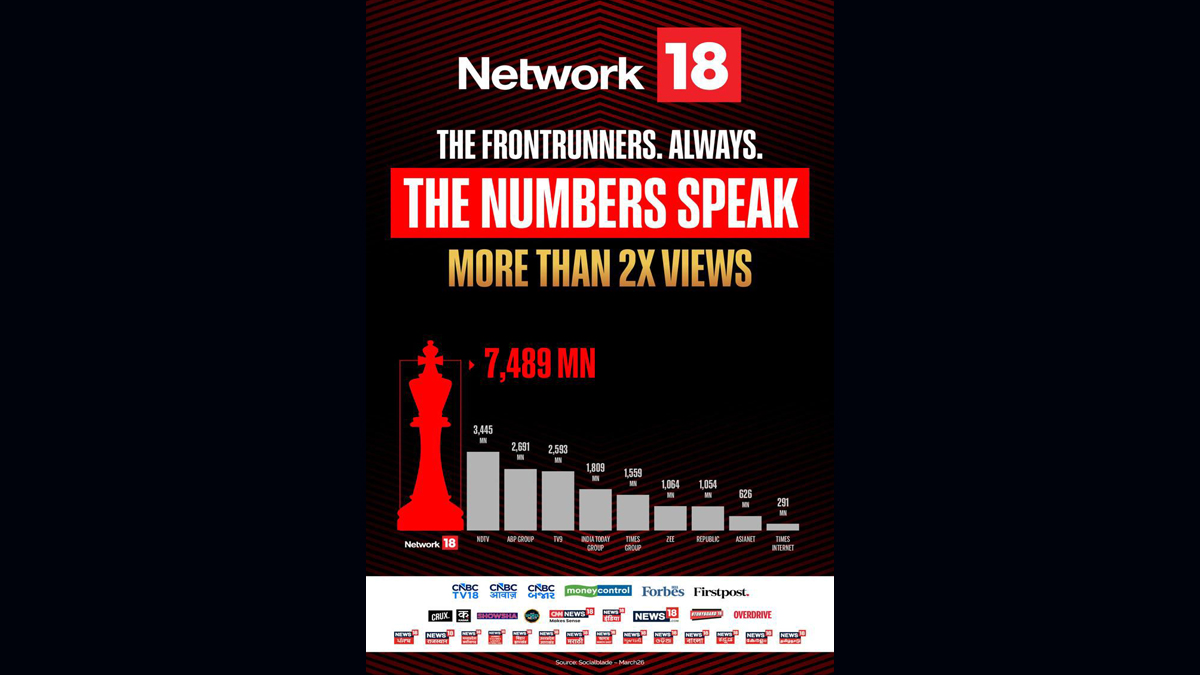
MUMBAI: When the world hit refresh on breaking news, Network18’s channels were already streaming ahead. As geopolitical tensions and war-driven headlines fuelled a surge in global news consumption, the network’s digital playbook delivered big clocking record Youtube viewership across English, Hindi and business news categories in March 2026.
At the forefront was CNN-News18, which emerged as the clear leader in the English news segment with 130 million live and video-on-demand views. The channel edged past competitors such as Times of India (126.5 million), Times Now (101.1 million), India Today (88.2 million) and NDTV (77.5 million), according to Databeings data for March.
In the Hindi news arena, News18 India delivered a commanding performance, racking up a staggering 3,297 million views on YouTube. The channel comfortably outpaced NDTV India, which recorded 3,119 million views, underlining its deep reach and consistent engagement with mass audiences, as per Playboard data.
The network’s dominance wasn’t confined to general news. In the Hindi business segment, CNBC Awaaz topped the charts with 92 million views, narrowly ahead of Zee Business (90 million) and well ahead of ET Now Swadesh (57 million). Meanwhile, its English counterpart CNBC-TV18 posted a strong 58 million views, reinforcing the network’s cross-category strength.
The spike in viewership reflects a broader shift in audience behaviour, with viewers increasingly turning to digital platforms particularly Youtube for real-time updates and in-depth coverage during high-intensity news cycles. For Network18, the numbers signal more than just scale; they underline the effectiveness of a multi-platform strategy that blends speed, credibility and continuous coverage.
In a month where the news never paused, it seems viewers chose to stay tuned where the stream never stopped.






