News Broadcasting
Pakistan gets broadcasting regulations


Even as Indian officials hem and haw over promulgating broadcasting regulations, its neighbour and arch rival Pakistan has gone ahead and issued an executive order to get its laws in place. India‘s Broadcasting Bill has been garbaged (after four years of blowing hot and cold) and brought under the Communications Convergence Bill, which itself has been put on the back burner for nearly two years.
The Pakistani government has had it easier, partly because it is governed by a military leader. Within two years of promising to open the floodgates to private TV channels, General Musharraf this week approved an ordinance that allows private sector television in Pakistan.
The PEMRA (Pakistan Electronic Media Regulatory Authority) Ordinance 2002 allows the establishment of an umbrella body that will issue licenses to broadcasters who have been labelled as broadcast media operators. The move is meant to bring in the element of ‘transparency and an invisible system of accountability through media available at local community, provincial, national, and international levels.‘

This spells competition not only for the three state controlled channels in the country, but also to those from across the border that beam their programmes into Pakistan, and have a loyal following.
The PEMRA will have a chairman and nine members who will be Presidential appointees, with the chairman being a prominent professional. Five of the PEMRA members are to be chosen from the private sector, including two women, with credentials in the media, law, human rights and social services.
| The Pakistan Media Regulatory Authority Ordinance says that foreign television channels however will not be allowed entry, nor will licenses be granted to promoters who are not citizens or residents of Pakistan. |  |
| TV Viewers in Pakistan: Will the new law mean more variety or less? (Pic courtesy: Time) |
The umbrella body is to also have three ex-officio members – the secretaries of Information and Interior and the chairman, Pakistan Telecommunication Authority.
The PEMRA has the responsibility of regulating the setting up and operation of all broadcast stations including radio and television and cable TV in the country. The Pakistan government is slated to provide it with seed money initially, but it will have to generate revenues through licensing fees and subscription.
CATV Networks, which were earlier supervised by the ministries of Information and Media Development and Science and Technology, have been brought into the fold of this law and the Pakistan Telecommunication Authority will continue to guide and support its technical side.
The PEMRA Ordinance includes a Code of Conduct for media broadcasters and CATV operators to ensure decency and responsibility, and a clause stipulating that programming content of broadcasts is to be strictly and regularly monitored. A council of complaints has also been provided in the law to respond to people‘s complaints, and recommendations for disciplinary action against broadcasters violating the code of ethics and other provisions of the law have also been provided.
Foreign television channels however will not be allowed entry, nor will licenses be granted to promoters who are not citizens or residents of Pakistan. Among others excluded from setting up shop in Pakistan are foreign companies established under the laws of any foreign government, companies the majority of whose shares are owned or controlled by foreign nationals or companies whose management or control is vested in foreign national or companies.
The ordinance took some time to be promulgated as minor changes had to be made in the draft law earlier approved by the Cabinet in the shape of Rambo (Regulatory Authority for Media Broadcasting Organisations). What delayed things further was the round of fisticuffs between the ministries of Information and Media Development and Science and Technology over who should control the electronic media.
The key issue confronting Indian broadcasters whose channels have been extremely popular in Pakistan is how the new regulations will impact their operation there. Broadcasters such as Zee TV, Star and Sony have encrypted in order to increase subscription revenues from India primarily, followed by south Asia. Zee TV oversees its Pakistan business and distribution from its office in Sharjah. Star India was the only network which was allowed to be received and distributed in Pakistan after a recent ban on Indian channels.






News Broadcasting
UDF poised to return to power in Kerala, says Manorama-CVoter survey
Massive opinion poll projects shift in Kerala politics ahead of 2026 Assembly elections.
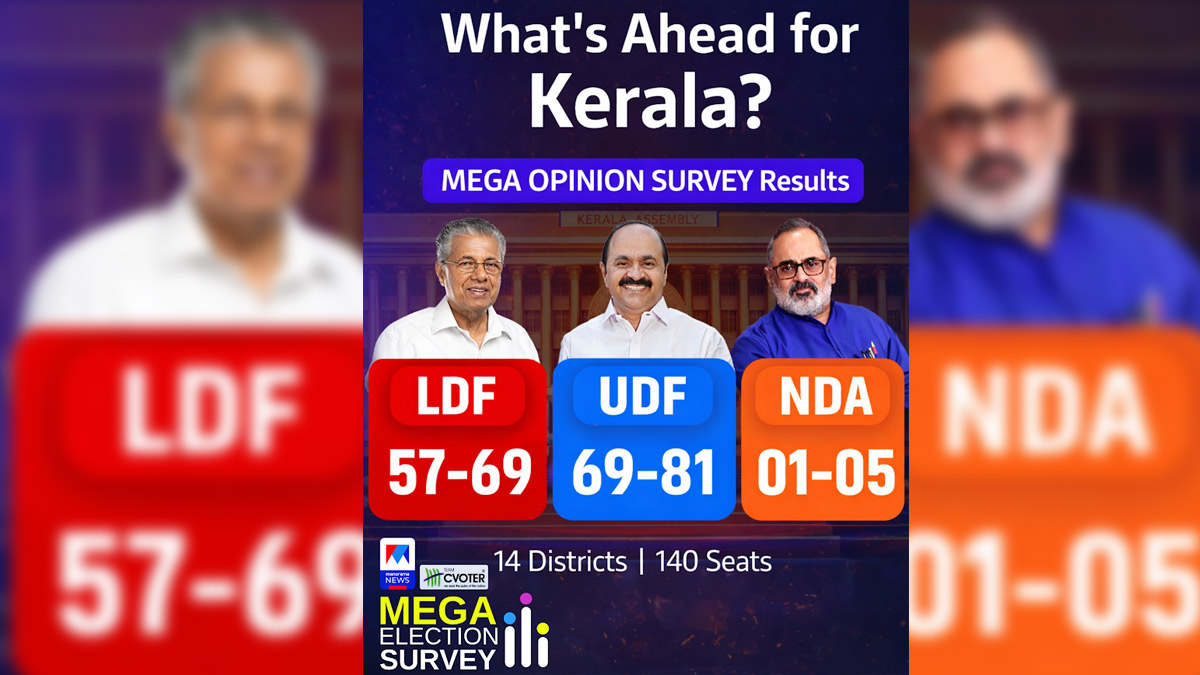
MUMBAI: The winds of change appear to be blowing through Kerala’s political landscape and this time, they seem to favour the United Democratic Front. A comprehensive mega opinion survey conducted by Manorama News in partnership with CVoter projects a potential comeback for the UDF in the upcoming Kerala Legislative Assembly Elections 2026. The survey, covering all 140 constituencies with a massive sample size of nearly 90,000 respondents, predicts the UDF could win between 69 and 81 seats.
The ruling Left Democratic Front (LDF) is expected to secure 57 to 69 seats, a significant drop from the 99 seats it won in the 2021 elections. This would mean the LDF losing 30 to 42 of its sitting seats. Meanwhile, the National Democratic Alliance (NDA), which drew a blank in 2021, is projected to open its account with 1 to 5 seats.
Region-wise, the UDF is expected to make strong gains in Malabar, winning 25 to 34 out of 48 seats, and in Central Kerala, where it could bag 29 to 33 out of 53 seats. In South Kerala, the LDF is likely to retain an edge with 21 to 25 seats, while the UDF may improve to 12 to 16 seats. The NDA could pick up 1 to 3 seats in the southern region.
The survey was conducted between 14 and 26 March 2026, with additional tracker and snap polls carried out from December 2025 to March 2026. A total of 89,693 respondents participated, ensuring representation across all demographics and social segments.
Manorama News has a strong track record of accuracy, with its previous projections closely matching the actual results of the 2019 and 2024 Lok Sabha elections as well as the 2021 Kerala Assembly polls.
In Kerala’s famously fierce political battles, this survey suggests the pendulum may be swinging back. Whether the final verdict matches these numbers or throws up another surprise, one thing is clear, the 2026 Assembly elections are shaping up to be one of the most keenly watched contests in the state’s history.






