News Broadcasting
News channels stay on high growth curve; regional leads charge


There’s no business like the news channel business. Three years and counting and there is still no let-up in the double digit growth this genre of television broadcasting has been withnessing. And neither is there any let-up in the number of new channels that are readying to enter the arena.
News as a genre has stayed in the news for a variety of reasons: Impressive growth over the last years, emergence of new regional news markets, additional number of brands etc. Year 2005 saw launches of five national news channels.
Does this lead to audience fragmentation within the existing viewer base or does every news channel create its own space with the overall category exhibiting growth? That is the poser that Tam Media research had before it when it conducted a special study on the news genre for indiantelevision.com.

News channel category over the years
The growth of News category has been very significant. The category has registered double digit growth over years. In 2003 the category grew by 19 per cent over 2002 while in 2004 the category grew by 72 per cent over 2002 and by 43 per cent over 2003. Even in the current year the category has registered a growth of 23 per cent over 2004.
Further a closer look reveals that the News category is divided into different genres. The above chart shows that the Hindi news genre has the largest share followed by Regional news genre. An interesting fact to note is that the Hindi news genre has been witnessing a decline in the current year while Regional news channel have been growing consistently from 2003. The Regional news genre grew by an alarming 108 per cent in 2004 over 2003. The Hindi news genre dipped by 11 per cent in 2004 over 2003 while in 2005 it has dipped by 5 per cent. A look at regional Languages
In the current year Hindi news command a share of 69 per cent while Regional news genre constitutes 18 per cent of the total viewership. Apart from this it would be interesting to know how much viewership comes from regional news languages compared to Hindi and English news languages.
Delving further into news languages, a closer look reveals that regional languages commands a 42 per cent share among all languages while Hindi language accounts for 52 per cent and English language for 6 per cent.Even within regional languages Telugu and Tamil languages together account for 20 per cent of the entire viewership. Profile of Viewers:
Another important aspect in News genre is the profile of viewers that it attracts. A look at the universe sizes states that CS 35+ yrs have a 34 per cent share among all while CS 25-34yrs constitute only 20 per cent of the total population. On comparing the universe sizes with Hindi mass sizes the proportion remains the same while the Hindi news have a different set of viewers. Major viewership for Hindi news comes from CS 25+ yrs which accounts for more than 65 per cent of the total Hindi mass universe. Effect of Events on News Genre :
News channel thrive on events and Breaking news to the world. News events have a tremendous effect on the viewership of a news channels and the above chart proves the point. Every time there has been a major news event in India or across the globe the viewership has jumped to new heights. The recent Tsunami or the Mumbai deluge saw the viewership of News channels grow tremendously. A case in study – How events change the viewership in News genre Ayodhya Attack :
As seen earlier events have a major effect on News viewership. So looking further into specific events will just enable to understand how the viewership grows. In the case of the recent Ayodhya attack the viewership of News genre jumped by 45 per cent. The Mumbai Deluge :
Taking the case further lets look at a more recent event that is the Mumbai downpour. On comparing the share of viewership of news genre 4 weeks before the deluge and during the deluge throws light on how the viewership grew in a span on 4 weeks. The news genre had a 8 per cent share before the deluge but during the deluge the share of news genre jumped to 17 per cent of the total viewership. |









News Broadcasting
Network18 channels lead YouTube news viewership in March 2026
CNN-News18, News18 India and CNBC channels top categories with record views
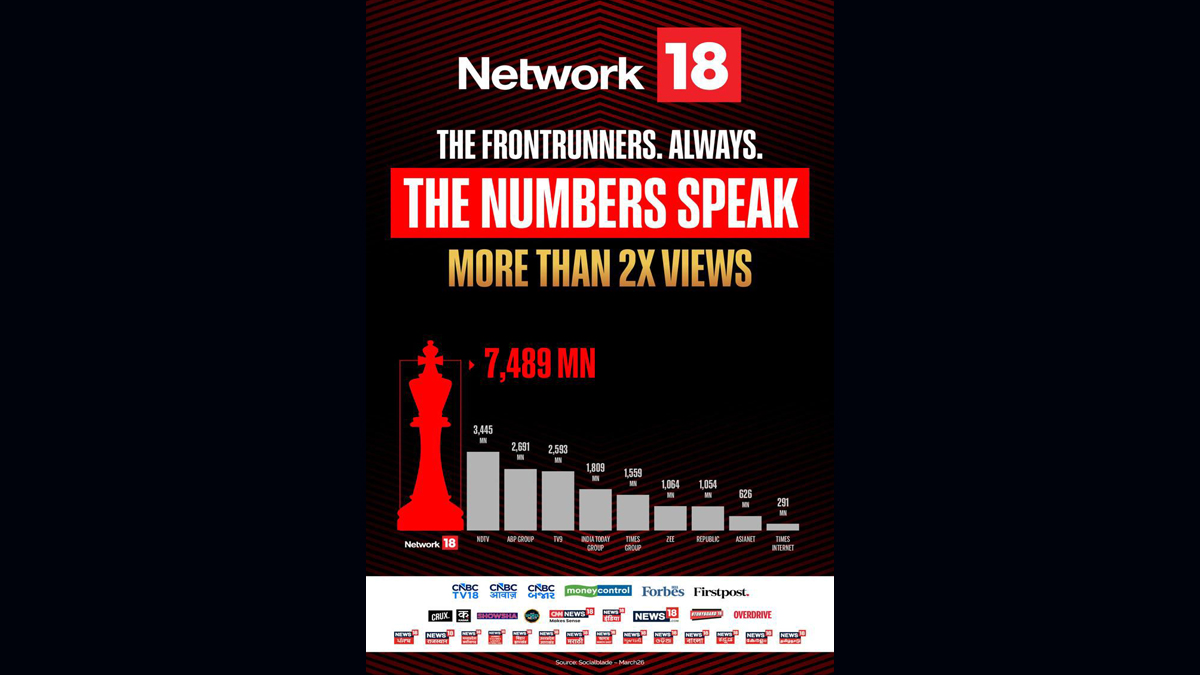
MUMBAI: When the world hit refresh on breaking news, Network18’s channels were already streaming ahead. As geopolitical tensions and war-driven headlines fuelled a surge in global news consumption, the network’s digital playbook delivered big clocking record Youtube viewership across English, Hindi and business news categories in March 2026.
At the forefront was CNN-News18, which emerged as the clear leader in the English news segment with 130 million live and video-on-demand views. The channel edged past competitors such as Times of India (126.5 million), Times Now (101.1 million), India Today (88.2 million) and NDTV (77.5 million), according to Databeings data for March.
In the Hindi news arena, News18 India delivered a commanding performance, racking up a staggering 3,297 million views on YouTube. The channel comfortably outpaced NDTV India, which recorded 3,119 million views, underlining its deep reach and consistent engagement with mass audiences, as per Playboard data.
The network’s dominance wasn’t confined to general news. In the Hindi business segment, CNBC Awaaz topped the charts with 92 million views, narrowly ahead of Zee Business (90 million) and well ahead of ET Now Swadesh (57 million). Meanwhile, its English counterpart CNBC-TV18 posted a strong 58 million views, reinforcing the network’s cross-category strength.
The spike in viewership reflects a broader shift in audience behaviour, with viewers increasingly turning to digital platforms particularly Youtube for real-time updates and in-depth coverage during high-intensity news cycles. For Network18, the numbers signal more than just scale; they underline the effectiveness of a multi-platform strategy that blends speed, credibility and continuous coverage.
In a month where the news never paused, it seems viewers chose to stay tuned where the stream never stopped.






