Sports
How India paused to watch the T20 final
From society lawns to crowded pubs, India’s T20 World Cup victory turned the match into a shared national moment
MUMBAI: For a few hours last night, India did something unusual. It slowed down.
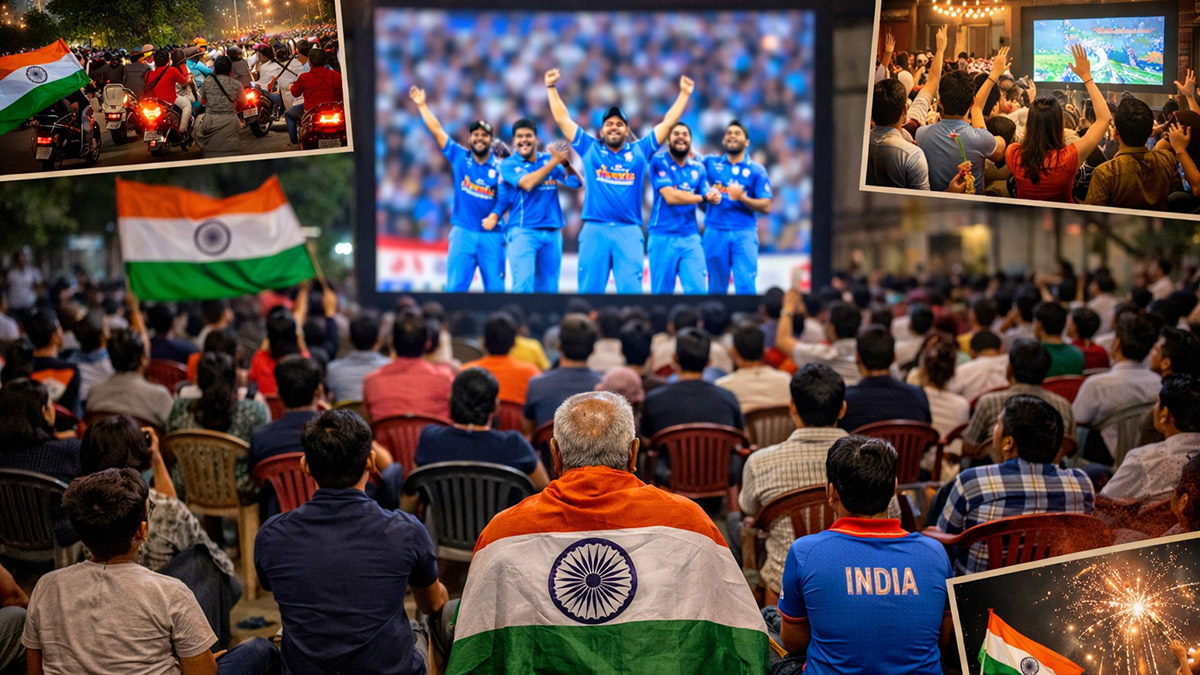
As the T20 World Cup final unfolded, the country pressed pause on its routine and gathered to watch. Apartment societies rolled out projectors in their courtyards. Banquet halls opened their doors and placed rows of chairs before giant screens. Pubs and bars filled to capacity as fans turned up not merely for a drink, but for the drama of cricket.
The match was everywhere, yet it was rarely on a mobile phone.
Instead, India chose the bigger spectacle. Families, neighbours and strangers watched together on televisions, LED screens and projectors that transformed ordinary spaces into impromptu stadiums. In residential complexes, children sat cross-legged on the ground while older residents occupied plastic chairs arranged in neat rows. In pubs, every boundary and wicket was greeted with cheers loud enough to drown out the commentary.
For once, the small screen lost its grip. Laptops remained shut. Phones were used mostly to capture the moment rather than consume it. The heroes of the evening were the bigger screens. The television in the living room, the projector on the society wall and the giant display above a crowded bar counter.
And with good reason. India delivered.
The national side clinched a historic second consecutive ICC Men’s T20 World Cup title, defeating New Zealand in the final and cementing their dominance in the format after the triumph of 2024. The victory was clinical and emphatic enough to spark celebrations almost immediately.
Soon after the final ball, the country erupted.
Motorbikes roared through neighbourhood streets with riders waving the tricolour. Firecrackers lit up the night sky. Groups gathered outside buildings, clapping and cheering as if the team could hear them across continents. In many homes and public spaces, strangers exchanged smiles and handshakes, an unspoken acknowledgement of shared joy.
By morning, the victory had become the nation’s first conversation.
“Did you watch the match yesterday?”
“Congratulations to Team India.”
From office corridors to neighbourhood tea stalls, the match dominated discussions. For a country of 1.4 billion people with wildly different routines and interests, the previous night had produced a rare moment of unity.
What made it remarkable was not just the win, but the way it was watched.
From Gen Z students to millennials and boomers, people chose to experience the match collectively. Cricket turned into a community event again, something to be shared in a crowd rather than consumed alone on a handheld device.
In an era when entertainment is increasingly individual and algorithm-driven, the final reminded India of a simpler ritual. Gathering around a screen and feeling every moment together.
The scoreboard will remember India’s title defence.
But the night will be remembered for something else too. The sound of a billion people watching, cheering and celebrating as one.

Sports
India’s women are playing cricket and they are just getting started
A sweeping BBC-Collective Newsroom study finds women’s participation doubled in six years, viewership is soaring, but stubborn stereotypes, safety fears threaten to derail the momentum
NEW DELHI: Cricket. It always comes back to cricket. But this time, the story is not about Virat Kohli or the men in blue. It is about the 10 per cent of Indian women who now pick up a bat and play, double the number who did six years ago. Add the women’s World Cup triumph on home soil in 2025, the explosion of the Women’s Premier League and a generation of young women who have decided that sport is, finally, for them, and the picture that emerges from the most comprehensive study of women and sport in India ever conducted is one of genuine, measurable, exhilarating change.
The BBC and Collective Newsroom commissioned global research firm Kantar to survey 10,304 people aged 15 and over across 14 Indian states between December 2025 and January 2026. The results, published today, are compared with an identical survey conducted in 2020. The findings cover a population base of 751.62 million people.
Cricket dominates and the gender gap is closing fast
The headline number is stark. Women’s cricket participation has doubled, from 5 per cent in 2020 to 10 per cent in 2026. Among women aged 15 to 24, the jump is even more dramatic: from 6 per cent to 16 per cent, one in six young women. The gender gap, once a chasm, has narrowed sharply. In 2020, five men played cricket for every woman; today that ratio has fallen to three to one. A quarter of all cricket players in India are now women.
The gains are not confined to one corner of the country. All but two of the 14 states surveyed, Maharashtra and Bihar, reported rises in the share of women playing cricket. In Uttar Pradesh, the number grew tenfold, from 1 per cent to 10 per cent. The UP Warriorz franchise, which plays in the Women’s Premier League, has invested heavily in talent development; in late 2025 Lucknow University reported its highest-ever turnout at women’s cricket trials.
Cricket has now decisively broken away from kabaddi as India’s most played sport. Kabaddi participation has since fallen across most demographic groups, particularly among older and less affluent respondents. Cricket, by contrast, is skewing younger and more affluent: 26 per cent of the most affluent respondents now say they play it.
Badminton is the other bright spot. Women’s participation rose from 4 per cent to 6 per cent nationally, with Andhra Pradesh and Telangana seeing a threefold increase. In Punjab, where Tanvi Sharma has been winning on the international circuit, 11 per cent of women now say they play.
Half of India is watching women’s sport
The audiences are arriving in force. Fifty-one per cent of respondents said they had seen coverage of any women’s sport in the past six months, only 12 percentage points behind the equivalent figure for men’s sport. For live events, 43 per cent said they had watched a women’s match, against 54 per cent for men’s. In-person attendance tells a similar story: 29 per cent said they had attended a women’s game, just 8 points behind the 37 per cent who had attended a men’s match.
The Women’s Premier League is at the heart of this surge. Twenty-eight per cent of respondents said they watch the WPL, nearly double the 15 per cent who watched its predecessor, the Women’s T20 Challenge, in 2020. The gap to the men’s Indian Premier League is now just 6 percentage points: 34 per cent watch the IPL. The ICC Women’s World Cup, which India won at home in the autumn of 2025, clearly turbocharged interest: 36 per cent of current women’s sports viewers say they began following women’s sport less than six months ago.
Men, it turns out, are genuine converts. Nearly half, 47 per cent, of male respondents said they had watched a women’s sporting event in the past six months, and a third had attended one in person. Young men aged 15 to 24 are the most enthusiastic: six in ten consume any coverage of women’s sport. For context, 23 per cent of Americans follow women’s sport and 37 per cent of British viewers watched women’s live sport in 2025.
The primary motivation for watching has also shifted tellingly. In 2020, audiences said they watched women’s sport because they loved sport. By 2026, the top reason, cited by 54 per cent of viewers, is wanting to support the Indian team. Supporting an individual sportswoman was the second reason, up from 21 per cent to 33 per cent. Love of the game has been relegated to third.
Sania, Smriti and the power of the role model
The names that people reach for are revealing. When asked to name their favourite sportswoman of all time, respondents cited Sania Mirza, who retired in 2023, most often, at 9 per cent. Smriti Mandhana, the Indian cricket team’s vice-captain, was a close second at 8 per cent and the top choice among 18-to-24-year-olds. The favourite sportsman of all time, Virat Kohli, was named by 22 per cent: a gap that underlines how far women’s sport still has to travel in the public imagination, but also how quickly it is getting there.
The visibility is translating into career ambitions. One in six women, 17 per cent, now say they have considered sport as a profession, up 70 per cent on 2020. For women under 25, the figure is one in four. Tamil Nadu leads at 27 per cent, followed by Madhya Pradesh and Meghalaya at 19 per cent each. Nearly nine in ten parents say they would encourage their child, son or daughter equally, to pursue a sporting career, a gap that previously favoured sons but has now all but closed.
Support for equal prize money is overwhelming and rising. In 2020, 85 per cent agreed that men and women should receive equal prize money in Indian sport. That figure is now 89 per cent. India moved early: in 2022, the Board of Control for Cricket in India equalised match fees for international cricketers, making the country only the second, after New Zealand, to do so in cricket.
The barriers that stubbornly remain
None of this means the job is done. Overall sports participation has barely budged, up just one percentage point to 37 per cent since 2020. More than six in ten respondents still say they engage in no sport or physical activity at all. Urban participation has actually fallen by 4 percentage points; rural areas are gaining ground but from a lower base.
Time is the enemy that no policy can easily defeat. Two-thirds of non-participants, 65 per cent, cite lack of time as the reason they do not play sport, up sharply from 45 per cent in 2020. Among those in full-time work, the figure rises to 72 per cent; for men in full-time work, 74 per cent. India ranked 42nd out of 60 countries in the 2025 Global Work-Life Balance Index; a 2024-25 International Labour Organisation study identified it as one of the world’s most overworked nations, with more than half the population working 49 hours or more a week.
Safety is the barrier that most clearly divides women from men. Thirteen per cent of women who do not play sport cite safety concerns, equivalent to 32.7 million women across the states surveyed. The problem is worst where perceptions of sexual violence are most acute: in Tamil Nadu, 84 per cent of respondents think sexual violence against women has increased over the past decade, and 21 per cent of non-participating women there cite safety as a barrier. Bihar and Meghalaya, where fewer women perceive rising violence, have far lower safety-barrier figures.
Girls are also constrained by where they are permitted to play. Women who were active in childhood are far more likely than men to say they played predominantly at school, 37 per cent versus 26 per cent for men; men were more likely to play in neighbourhood spaces and informal settings. If school is the only arena open to girls, the pathway into adult recreational sport is narrow. Fewer women now cite a lack of school facilities as a barrier, down from 25 per cent in 2020 to 16 per cent, which suggests investment is working. But 10 per cent of young women aged 15 to 24 still report it, corresponding to 1.5 million young women across the states surveyed.
The stereotypes are getting worse, not better
Here the report delivers its most uncomfortable finding. Behaviours are changing; attitudes are not. The proportion of respondents agreeing that sportswomen should look attractive has risen from 37 per cent in 2020 to 46 per cent. Those who believe sportswomen have difficulty having children: up from 38 per cent to 44 per cent. Those who think women’s sport is less entertaining than men’s: up from 38 per cent to 43 per cent. Those who say sportswomen are not feminine enough: up from 37 per cent to 40 per cent. Those who believe sportswomen are simply not as good as sportsmen: up from 32 per cent to 38 per cent.
More troublingly still, women are more likely than men to agree that sportswomen should look attractive. And young respondents, the generation supposedly driving change, are more likely than older ones to say there is already too much coverage of women’s sport. Three in five respondents overall, 59 per cent, hold that view, up from 49 per cent in 2020.
Domestic attitudes are shifting in worrying directions too. Fifty-three per cent of respondents agree that a woman should tolerate violence in order to keep her family together, up from 51 per cent in 2020. Fifty-seven per cent believe a wife should obey her husband, up from 47 per cent. And 54 per cent still believe a woman’s place is at home, even as 84 per cent say they support women working outside it.
What the people behind the study say
Tim Awford, regional director for South Asia at BBC News, said it was encouraging to see that more Indian women were playing, following and watching sport compared with 2020. The BBC, he added, was proud to help raise the profile of sportswomen across its platforms and remained committed to telling their stories.
Rupa Jha, editor-in-chief and co-founder of Collective Newsroom, did not shy away from the contradictions. The findings showed both progress and continuing barriers, she said. While participation and viewership were rising fast, stereotypes and practical challenges remained. She hoped the data would prompt further discussion and action to support women athletes.
The broader picture: gender equality, slowly
The study situates sport within India’s wider gender story, and here too the picture is mixed. Ninety-seven per cent of respondents agreed that men and women should have equal rights. Seventy per cent said gender equality had improved over the past five years. Women’s financial independence is measurably growing: 73 per cent of women surveyed now hold a bank account, up from 62 per cent in 2020, and 89 per cent operate it themselves. The proportion of young women aged 15 to 24 who are already married has fallen from 42 per cent in 2020 to 32 per cent, a development that directly expands the time and mobility available to them for sport.
Childhood is being experienced differently too. In 2020, 36 per cent of women said they were restricted in childhood because they were girls; by 2026 that had fallen to 18 per cent. School sports facilities are more accessible: fewer than one in ten young women now cite their absence as a reason for not playing as a child, against one in four in 2020.
The 2036 Olympics and the window of opportunity
The report notes that India is bidding to host the 2036 Summer Olympics, a moment that could accelerate every trend this study has identified, or expose every weakness it has found. The momentum is real: cricket participation is soaring, the viewership gap to men’s sport is narrowing, young women are dreaming of sporting careers and parents are finally cheering them on equally. The infrastructure, school pitches, public parks, neighbourhood courts, is improving.
But 32.7 million women are still sitting out because they do not feel safe. Sixty-five per cent of non-participants say they have no time. Nearly half of all respondents think sportswomen must be physically attractive to deserve attention. And three in five Indians, including a striking proportion of the young women who are supposedly leading the revolution, say women’s sport is already getting too much coverage.
India has produced Manu Bhaker, the double Olympic medallist; a women’s cricket team that lifted the World Cup on home soil; a kabaddi team that won both the World Cup and the Asian Championship in 2025. The women are winning. The question is whether, off the field, the country is ready to let them.
Methodology: The survey was conducted by Kantar between 26 December 2025 and 30 January 2026. Researchers interviewed 10,304 people aged 15 and over face to face across 14 Indian states: Bihar, Odisha, Meghalaya, Andhra Pradesh, Telangana, Tamil Nadu, Kerala, Maharashtra, Gujarat, Madhya Pradesh, Uttar Pradesh, Punjab, Haryana and Rajasthan. The sampling methodology was multistage stratified random sampling. Results were compared with an identical survey conducted in 2020. The margin of error at the total respondent level is 0.97 per cent at a 95 per cent confidence interval. The research was commissioned as an independent study by the BBC and Collective Newsroom. Fieldwork in Manipur was not conducted this year due to ongoing security concerns; Meghalaya replaced it in the sample.