News Broadcasting
Esha Media Research sees upsurge in demand for political content clips


KOLKATA: With the 2014 Lok Sabha elections likely to become a case study for the whole country, Esha Media Research, a media monitoring and research company, has registered an increase in inquiries seeking clips of political content of top political leaders.
If sources are to be believed, Trinamool Congress’s advertising agency, after the party’s performance in the 16th Lok Sabha polls, has approached Esha Media to conduct a media perception study on the elections as whole.

According to Esha Media Research managing director RS Iyer, of the 1200 hours of business content they track, 700 hours comes from channels that have negligible proportion of political content. “However, during the election season, we have monitored and tracked political content of 45 hours per month resulting in 2,000 clips every month for the past three months,” informs Iyer.
“Apart from political parties and leaders soliciting these clips, we are also receiving inquiries from media agencies and business houses tracking the economic content of certain political leaders,” he adds.
Without revealing the names of the clients and agencies, Iyer informs that some forums are interested in getting the speeches of Prime Minister elect Narendra Modi.
He also emphasised that the demand for content clips is higher in politics than in business news. “For instance, 100 clips are derived from every 12 hours of business content while in the political content the same number of clips is derived in 2 hours 15 minutes. This indicates that more number of people are chasing the same portion of content in the political segment,” Iyer explains.
So what is it that is getting viewers attracted to the political content? Answers Iyer, “The oratory skills of the political leaders have attracted the attention of TV channels to go live and reach out to the drawing rooms of the citizens across the country.”





News Broadcasting
Network18 channels lead YouTube news viewership in March 2026
CNN-News18, News18 India and CNBC channels top categories with record views
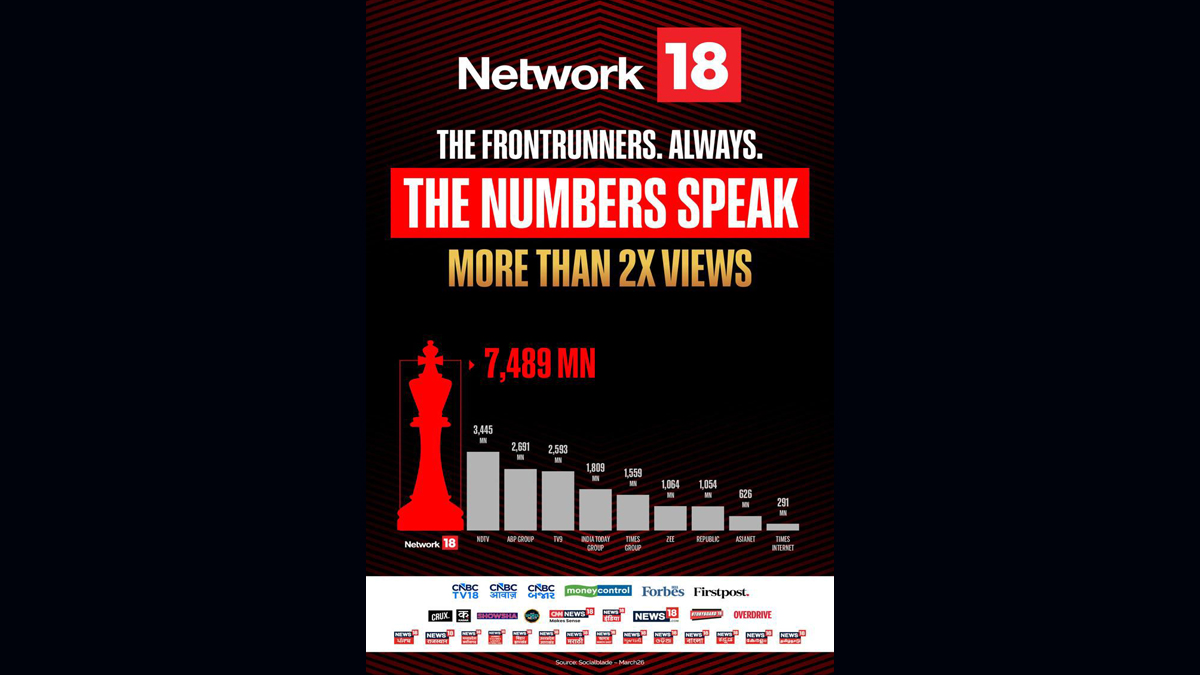
MUMBAI: When the world hit refresh on breaking news, Network18’s channels were already streaming ahead. As geopolitical tensions and war-driven headlines fuelled a surge in global news consumption, the network’s digital playbook delivered big clocking record Youtube viewership across English, Hindi and business news categories in March 2026.
At the forefront was CNN-News18, which emerged as the clear leader in the English news segment with 130 million live and video-on-demand views. The channel edged past competitors such as Times of India (126.5 million), Times Now (101.1 million), India Today (88.2 million) and NDTV (77.5 million), according to Databeings data for March.
In the Hindi news arena, News18 India delivered a commanding performance, racking up a staggering 3,297 million views on YouTube. The channel comfortably outpaced NDTV India, which recorded 3,119 million views, underlining its deep reach and consistent engagement with mass audiences, as per Playboard data.
The network’s dominance wasn’t confined to general news. In the Hindi business segment, CNBC Awaaz topped the charts with 92 million views, narrowly ahead of Zee Business (90 million) and well ahead of ET Now Swadesh (57 million). Meanwhile, its English counterpart CNBC-TV18 posted a strong 58 million views, reinforcing the network’s cross-category strength.
The spike in viewership reflects a broader shift in audience behaviour, with viewers increasingly turning to digital platforms particularly Youtube for real-time updates and in-depth coverage during high-intensity news cycles. For Network18, the numbers signal more than just scale; they underline the effectiveness of a multi-platform strategy that blends speed, credibility and continuous coverage.
In a month where the news never paused, it seems viewers chose to stay tuned where the stream never stopped.






