News Broadcasting
‘Election Express’ flies high with Quidich’s aerial cams


MUMBAI: In an election season when every second channel is belting out poll-related news and shows, how does one stand out in a crowd?
The answer lies in how Headlines Today has deployed a new technology from a little-known company, Quidich, to give a facelift to its show, Election Express (EE).
Launched in December 2013, Quidich provides aerial photography and videography using quadcopters and octocopters. Till date, Quidich members are busy touring the country with Headlines Today editor-at-large, Rahul Kanwal and his EE team.

Quidich is constituted by three young men including CEO Rahat Kulshreshtha, who studied at the University of Westminster and worked with Star News, Nirvana Films and the British film industry; technical head Tanuj Bhojwani, an IIT Mumbai alumnus who left a management consultancy firm for Quidich; and marketing head Gaurav Mehta, a mechanical engineer from the College of Engineering, Pune. Currently, the office is based out of New Delhi and there are plans to have another one in Mumbai to tap into the Hindi film industry. For now, it’s a six-strong team with four permanent members.
 |
Aerial machines are fitted with cameras to provide shots which are called drones or multi-rotors. Explains Bhojwani, “The technology behind these drones is easy to grasp, but hard to master. It’s very easy to get something into the air, but to keep it there and stable is a very hard task.’
The essential part of the equipment is the flying object which needs to be designed based on the client’s needs and the flight time. Next is the flight controller, which consists of a remote in the hand of the pilot and a microchip on the drone that receives the remote’s signal. Handling of this decides the precision and stability of the flight.
For EE, two quadcopters (four motors) and one octocopter (eight motors) are being used. The batteries used are 7700 mAh, whose drainage is inversely proportional to the size of the copter. For example, an octocopter with a 5D DSLR can work with two such batteries for approximately 15 minutes in air. More motors means capacity to carry bigger cameras.
Then comes the essential part of stabilizing the camera on the drone. An essential scientific technology called gimbal, which is present in a variety of instruments like gyroscopes and accelerometers, is utilized to stabilize the camera. After all, you wouldn’t want to break expensive cameras! For advanced and larger equipment with expensive flight controllers, the camera may also be programmed for self-control or manipulated using a device such as an iPad from the field so that it can fly on a set pattern.
 |
Using these drones, the Quidich and EE teams have been touring India for the past few weeks with the day beginning at 6:00 am and ending at 10:30 pm. Of this, a lot of time is consumed by bus travel while shooting goes on for about two to three hours a day. “We have our own drones but Quidich’s drones fit our bill as they are on the higher end and their operators are unbelievably deft with the controls,” says India Today group chief creative officer and India Today group digital chief operating officer Kalli Purie.
So how did Quidich come up with the idea of the aerial camera? “The idea for the aerial camera actually came from our own experience. Rahat was trying to shoot a video for which he required aerial cameras. Attempting to experiment with the camerawork being employed, he discovered that services in India for aerial footage were literally non-existent or non-affordable. It was then that the idea to facilitate such a process was seeded, and shortly after, Quidich was formed,” says Bhojwani.
Quidich services have also been employed for a short film for IRCTC, Volkswagen Motor Sports and NDTV for one of their companies called Red Dot Films. Bhojwani points out that such a service is used on a small scale in India mainly due to requirements of large scale production for news services, advertisements, sports coverage and feature films.
 |
 |
Drones have been used in news channels for producing stock footage, unlike its usage for live telecast in EE. The range of the shot varies from 500 metres to 10 kms while the height can go up to 500 feet. Currently, Quidich owns three GoPro cameras that are used for action shots, one Nikon D500 mini, and one Nikon D800. While the GoPro is built for such shots, it cannot work precisely in low light and narrow areas. Tie ups with camera rental companies assure that the client’s needs are met with good pricing. Now it is looking at buying the portable Blackmagic Design production camera that records 4k videos and supports different types of lenses.
The bigger copters weigh about six to seven kg and are built of carbon fibre that is a lighter version of steel while the smaller ones are made of sturdy plastic and weighs about 1.5 kg. This, along with the gimbal ensures that the drone doesn’t crash and neither is it blown away by the wind.
Although Quidich presently provides video services, it is looking at exploring other possibilities. Work is currently on on developing innovative options for out-of-home branding for marketers in India through quadcopters such as sky writing. “We are not restricting ourselves to being a technology company. There are just eight to 10 such large scale operators in the country,” says Kulshreshtha.
For live transmission, radio equipment is fitted on the drone that corresponds to receiving stations on the ground. One signal beams back the video to the pilot that works on radio frequency while the main signal sent to the mixing station for live or recorded use is through OFDM (Orthogonal frequency-division multiplexing) technology. This ensures uninterrupted HD video being sent back unlike in radio frequencies. The RF tech can cost around Rs 15,000 to Rs 20,000 while the OFDM is on the higher end at about Rs 1 lakh. The setup for a live link can be up and running in 15 minutes.
Purie feels that the usage of drones has given the viewer a more realistic experience apart from the five existing cameras on the show. “Good election coverage happens on the ground and drones are a perfect compliment,” she adds.
The alternative options that are currently in use are helicopters and Jibs that are cumbersome and unable to fly to heights. “In contrast to any of these methods, Quidich’s technology can be availed at competitive rates and less than around one fifth the cost,” says Bhojwani. Pricing for this technology depends on a range of things such as type of copter, camera, timing, footage receiver etc, but for a full day shoot, prices could range from Rs 20,000 to Rs 1.5 lakh.
The only thing the pilot has to concentrate on is to steer the drone away from obstacles or keep it away from the reach of passer-bys. So how do they deal with people staring into the flying camera while shooting? “We start flying five to ten minutes before actual live time so they get bored after that,” laughs Bhojwani.
 |
“We at Quidich believe in always providing state-of-the-art service to our clients, so that we can push the limits of what is possible,” says Kulshreshtha. On the experience working with EE, Bhojwani says, “It may be one thing to step out of the comfortable confines of a news studio to make your reporting distinct, but it is another ball game altogether to be negotiating with that amount of travel on a daily basis. With everyone pushing themselves physically and mentally, it was a gruelling but deeply satisfying experience.”
EE being Quidich’s first big assignment, has the company managed to get some eyeballs? “We are currently in talks with a diverse group of prospective clients. These include an ad film for a sports brand, a full-length regional feature film that may be shot in Ladakh, and a Bollywood film that would be shot in Goa. We are also negotiating offers for corporate films that include property clients. Unfortunately, given that we are still finalizing most of these assignments, I would be unable to get into the specifics of these offers,” says Bhojwani.
TV Today on the other hand has already decided to sign up with Quidich for a new show.




News Broadcasting
CNN-News18 to host Fury in the Gulf conclave on West Asia crisis
Three-hour summit to unpack geopolitical fallout and impact on India
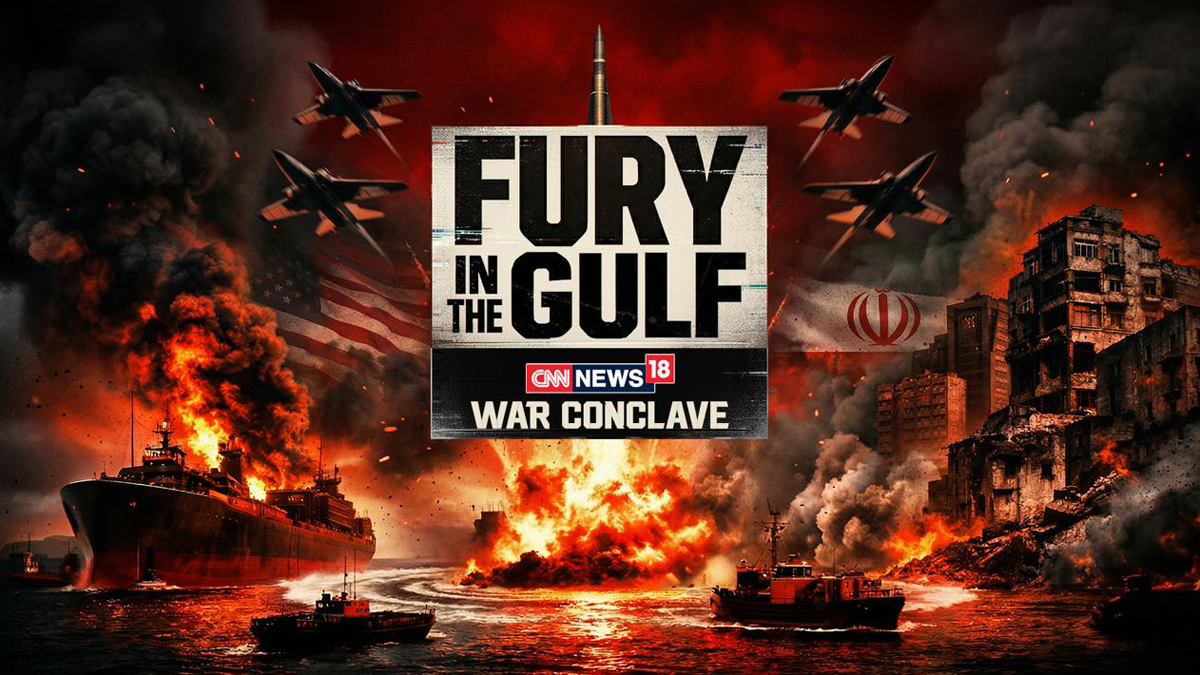
MUMBAI: CNN-News18 is set to host a special three-hour broadcast, Fury in the Gulf – War Conclave, on April 7, aiming to decode the escalating West Asia crisis and its far-reaching implications for India.
Scheduled from 4:00 PM to 7:00 PM, the conclave comes at a time when tensions between Iran and the United States are reshaping global geopolitics and triggering economic uncertainty. With India’s deep energy ties, trade links and large diaspora in the Gulf, the developments carry significant domestic relevance.
Built around the theme ‘Conflict, Consequences, and The Future,’ the programme will feature six curated sessions combining one-on-one interviews and panel discussions. The focus is to cut through the clutter and offer viewers a clearer understanding of the fast-evolving situation.
Key sessions include ‘Diplomacy in Times of War’ featuring Shashi Tharoor, and ‘World After the Iran Conflict’ with voices such as Ram Madhav, Reuven Azar, representatives from the European Union and the Iranian Deputy Envoy. Another session titled ‘Another Dunkirk?’ will bring together K. J. S. Dhillon and Jitin Prasada among others.
CNN-News18 editorial affairs director Rahul Shivshankar said, “In times of war, clarity becomes the most powerful tool. Fury in the Gulf – War Conclave brings together credible voices to address the questions and confusion that arise amid an overwhelming influx of information.”
He added that the initiative is aimed at delivering “facts, perspective, and insight” at a time when misinformation can easily cloud public understanding.
Echoing the sentiment, CNN-News18 CEO– English and business news Smriti Mehra said the conflict marks a defining global moment, with consequences that extend well beyond the region. She noted that the conclave seeks to present the crisis with “depth, nuance and responsibility” so audiences can better grasp its real-world impact.
As geopolitical tensions continue to dominate headlines, the conclave positions itself as an attempt to bring order to the noise, offering viewers a structured, insight-led look at a complex and rapidly shifting global situation.






