News Broadcasting
Brands ready to outshine on Diwali

Inflation be damned! Diwali is here and consumers are more than willing to loosen their purse strings. Exactly, why a majority of brands go all out to woo them.
It is a critical period for most companies and hence, elaborate plans are made to reach out to consumers, says Llyod Mathias
In any case, most companies are known to allocate nearly 25 to 35 per cent of their marketing budget to the festive season. Not surprisingly, it’s that time of the year when newspaper supplements get to look fatter and fancier, and television ads and hoardings get a colourful new lease of life.

Says marketing veteran Lloyd Mathias: “It is a critical period for most companies – consumer durables, auto, paints etc. – and hence, elaborate plans are made to reach out to consumers, who are also not hesitant to shell out money.”
Apart from aggressively marketing existing products, many brands even launch new products.
Titan, for instance, has launched a new campaign featuring Katrina Kaif to promote its latest Raga collection – Raga Pearls. Says global marketing head Rajan Amba: “In addition to Raga, we also have outdoor campaigns for our premium brands – Nebula & Xylys.” In a first, Titan plans to offer a Tanishq gold pendant free with every purchase below Rs 70,000, and a Tanishq gold and diamond pendant free with every purchase about Rs 70,000. Titan also plans to launch 180 variants in keeping with the festive spirit.
At Raga we strive to create memorable stories every year, explains Rajan Amba, The World Gold Council, undeterred by soaring gold prices, has launched its new collection named Azva. “This season is the main spending time for us and will go all out with it. GECs, movies, music, regional channels as well as OOH and print will be utilized in the 360 degree marketing plan to optimize sales,” says WGC jewellery director Vipin Sharma.
There’s no undermining the importance of sweets during Diwali, and this year, Cadbury plans to leverage the entire Mondelez International Portfolio to create a cross-category gift pack containing Cadbury chocolates, Choclairs, Cadbury Bournvita and Oreo biscuits for customers. “As we get into the Diwali season, we will again look at getting consumers to celebrate the true spirit of the festival. The essence of the festival, of spending time together with your loved ones, seems to have been lost. Through, Cadbury Celebrations thus, we look forward to actually enabling people to come together and spend quality time this Diwali,” says Cadbury India chocolate – gifting & strategy AVP Amarpreet Anand. At Cadbury, gifting is all about re-establishing closeness with loved ones which seems to have been replaced in today’s age of technology, busy lives and consumerism; Anand points out.
In sharp contrast, PepsiCo India plans to capitalize on the ‘sweets overkill’ to promote their salty snack brand Kurkure.
Vipin Sharma says that the festive season is the main spending time and WGC will go all out with it
“Over the years, through its campaigns that encourage consumers to spend more time with family, Kurkure has constantly re-invented itself to remain relevant to the Indian ethos and culture.
Festivals hold special importance in our annual marketing calendar and offer an ideal platform to reach out to consumers. Kurkure, with its unique take on celebrations, seeks to cut down the excessive sweetness that accompanies celebrations. So every year around the festival season, we bring in new flavours and innovative gifting options that strengthen our much loved proposition of ‘Zyaada Meetha ho Gaya? Iss Diwali Muh Kurkure Karo’,” says PepsiCo India Indian snacks category director Nalin Sood. Indeed, Kurkure is launching a new range of ‘Raja Rani’ gift packs designed by Ray and Keshavan, a leading South Asian brand & design consulting firm.
The festive period also sees a lot of consumer spending in the FMCG and automobile categories. Says Godrej Appliances sales & marketing executive VP Kamal Nandi: “At Godrej, our attempt is to delight our consumers with Best in Class innovative products. Continuing this tradition, we are launching a breakthrough technology in washing machines, which will be a revolution in this category and most of our marketing activity will be focusing on this product this festive season The pre-launch phase of this special campaign has already been launched on digital media and which in itself is a first of its kind initiative in the industry.”
Godrej plans to focus on consumer engagement through facebook and YouTube apart from regular digital advertising, SEM, etc.
Godrej plans to focus on consumer engagement through facebook and YouTube apart from regular digital advertising, SEM etc, elaborates Kamal Nandi
Similarly, Fiat Group Automobiles India has come up with a new ad for its recently launched Linea Classic. The campaign showcases Fiat Linea Classic as an affordable car designed to make the sedan far more accessible to hatchback users, in turn making them ‘feel big’.
In the electronics segment, Dell India has kicked off its ‘Celebrate Dell Se’ campaign a few weeks ago, part of which is the ‘Hint a Gift’ TV commercial for its Inspiron notebooks. Says Dell India marketing director Ritu Gupta: “Building an emotional connection between our customers and technology is integral to Dell’s branding strategy. In line with our on-going achievement “I can do kuch bhi” campaign, we decided this festive season to inspire the youth with the idea that they have the power to get what they want by hinting to their loved ones about their preferred gift for Diwali, which in this case is the Dell Inspiron range of touch laptops.”
All said, brands may try to outdo and outshine one another but it is ultimately up to the customer to decide which one to give preference to…



News Broadcasting
CNBC India unveils new logo, rolls out refreshed identity across network
Debuted at IBLA, the redesign signals a sharper, digital-first future
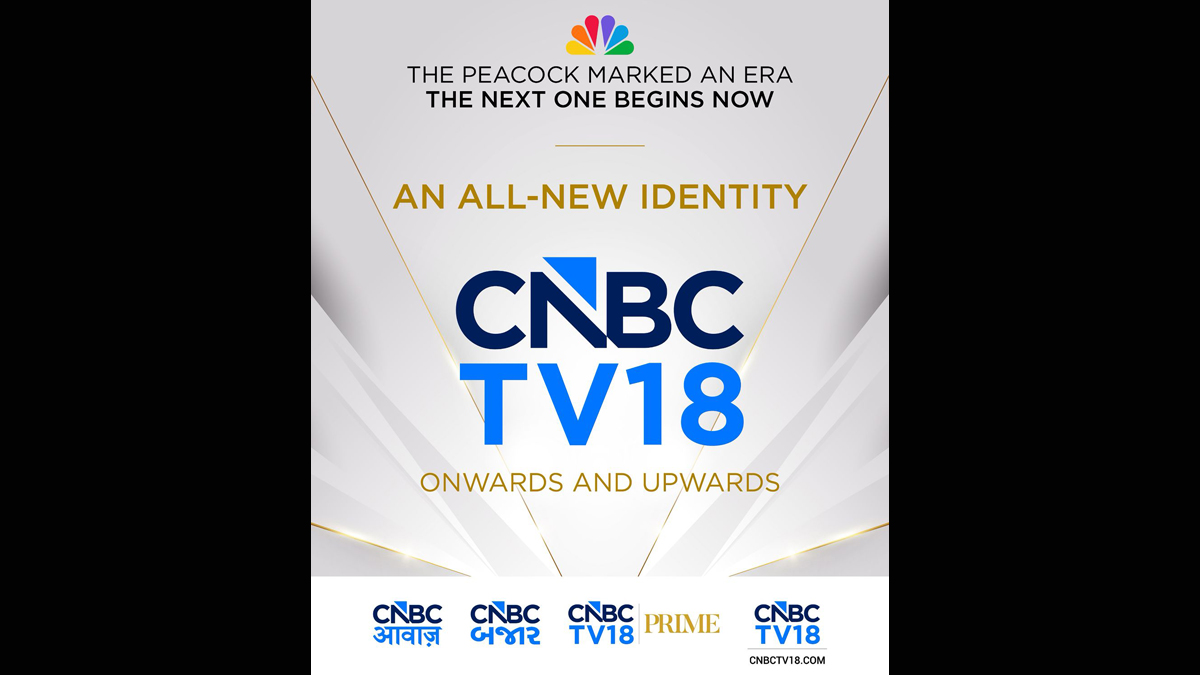
MUMBAI: CNBC has unveiled a refreshed brand identity across its India network, introducing a new logo and visual system that reflects a more modern, digital-first direction.
The rebrand was officially revealed at the India Business Leader Awards held in Mumbai on March 14, marking the first public showcase of the updated design at one of the network’s most prominent platforms.
The overhaul is among the most visible brand updates for CNBC in recent years, aimed at aligning its look and feel with evolving audience habits and a growing multi-platform presence.
At the centre of the refresh is a redesigned logo that moves away from the network’s long-standing multi-coloured peacock motif, opting instead for a cleaner and more minimalist aesthetic. A key visual cue is a blue upward-pointing arrow embedded within the letter ‘N’, symbolising forward momentum, growth and a focus on the future.
The new identity is being rolled out across the entire CNBC cluster in India, including CNBC-TV18, CNBC-TV18 Prime, CNBCTV18.com, CNBC Awaaz and CNBC Bajar. The move brings a more cohesive and contemporary design language across television and digital platforms alike.
The rollout began on March 30, with the network aiming to create a unified viewer experience regardless of how audiences access its content, be it on broadcast, online or connected devices.
With this refresh, CNBC is signalling its next phase of growth in India, blending legacy credibility with a sharper, forward-looking identity designed for an increasingly digital news ecosystem.