Comment
Blossoming of a ‘Sunrise’ industry, with help from a ‘Sunshine’ Budget


Literary purists will expect an op-ed on the media and entertainment sector’s budget wish-list to begin with a reference to Chanakya’s Arthashastra or Manu’s Manusmriti; and rightly so, for they contain priceless public policy principles that hold good even today. However, as someone who is tasked with navigating an innovative organisation that takes pride in its ability to win the hearts of Indians across the world, I will opt for a more recent, relevant and simpler quotation, with a creative twist:
‘Kuch to phool khilaye ‘aapne’, aur kuch phool khilane hai Mushkil yeh hai bag me ab tak, kaante ‘kuch’ purane hai’
Shri Arun Jaitleyji

Honourable Finance Minister, Government of India
28 February, 2015, Union Budget Speech
Last year, the FM listened to two of our industry’s requests. Withholding tax rates on payment of royalty were reduced to 10 per cent and a new, comprehensive foreign trade policy (SEIS) ensured that service sectors are treated at par with their counterparts in manufacturing. This time we have three sets of requests: those that remain from last year, those that are relatively more recent and those that are apply uniformly to all industries.
Irrespective of which part of the value chain they might represent, all industry stakeholders will agree that consolidation is a much-needed, ongoing business reality that is critical for our sector to flourish. It is only natural that as this trend gathers steam, the regulation should treat our sector at par with other sectors like telecom and software when it comes to the carrying forward of losses in case of a merger or amalgamation. All this needs is an amendment in Section 72A of the IT Act to include the ‘broadcasting, media and entertainment sector.’ The second issue is an oft-repeated one and refers to the treatment of hire charges for transponders as royalty. This leads to an unnecessary tax burden given that there is no transfer of technology taking place. Moreover, even foreign jurisdictions don’t treat these payments as royalty. A simple clarification from the authorities can help resolve this issue.
Amongst the more recent requests, the first pertains to how we treat payments for content production. These are not ‘fees for technical services’ (u/s 194J) and should instead be treated as ‘work’ (u/s 194C). This will bring clarity regarding the applicability of withholding taxes and help reduce litigation. The other pertains to the sponsorship of ground events. Currently, despite the recipient of the service paying service tax in entirety, set off of CENVAT credit is not available to the sponsorship service provider. This anomaly needs to be corrected.
The final category pertains to requests that will help industry at large and not just our sector. However, this very aspect makes them even more critical for the M&E sector given our role as a ‘force-multiplier.’ Around $18 billion of investment proposals have been received in electronics manufacturing under the ambitious ‘Make in India’ programme, driven mainly by mobile handset manufacturers. Without high-quality engaging video content, that device with a 5-inch HD screen, 64GB storage and oodles of computing power has practically no use. Media rights are the single largest contributor to almost all sporting leagues in this country. FMCG companies spend a significant portion of their top-line (~10-15 per cent) on advertising because it contributes significantly to their growth. The moot point here is that we power several ecosystems, beyond our own. In keeping with this philosophy the top four requests are (1) reduction in Minimum Alternate Tax (MAT) rate (2) utilisation of credit of Education Cess and Secondary and Higher Education Cess lying in CENVAT balance (3) allowing CENVAT credit on Swachh Bharat Cess (SBC) and (4) removing restrictions on claiming CENVAT Credit.
While MAT may eventually have lesser relevance (as corporate tax rates and the number of exemptions available to companies reduce), it is in the transitory period that a reduction in the MAT Rate (ideally coupled with the possibility of claiming MAT Credit over an indefinite period of time) can be extremely beneficial. On the issue of Education Cess and Secondary and Higher Education Cess, a simple clarification will suffice. Finally, the Swachh Bharat mission is a unique, much-needed effort that has several positive externalities. So much so, that many organisations are, in their individual capacity, trying their best to support it. At MTV we’ve launched the Junkyard Project, where we are helping with the cleaning and beautification of junkyards. In its current avatar, it is likely that the burden of the SBC will be passed on to the end consumer, after the effects of cascading. Therefore, it will be helpful if CENVAT Credit is allowed on the Swachh Bharat Cess. The government has placed huge emphasis on the ease of doing business. A smooth, seamless flow of tax credits is a critical aim in this regard. As a precursor to the GST regime, it will be helpful if all restrictions on claiming CENVAT credit are removed, including those related to timelines and specific inputs and input services.
At Viacom18 we take the value of ‘listening deeply’ very seriously. In addition to some of the points above, my op-ed before the last year’s Budget had also argued for a more ‘innovative’ style of dissemination of the budget speech (‘engaging, multi-lingual, audio-visual with info graphics’). I hear that this time around the Finance Ministry has launched an official YouTube channel. Clearly the prashaasan is listening. Now it’s our turn to switch on the TV sets on and grab the popcorn. We’re all ears for Budget 2016.
(These are purely personal views of Viacom18 group CEO by Sudhanshu Vats and Indiantelevision.com does not necessarily subscribe to these views.)






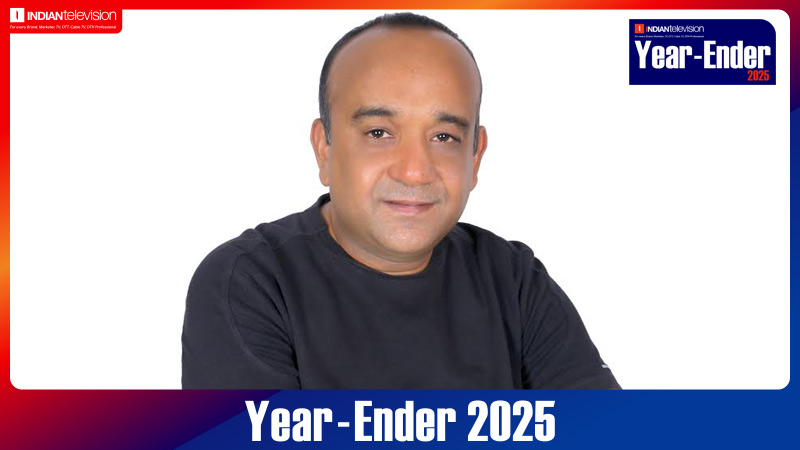
MUMBAI: 2025 will be remembered as the year India’s OTT industry stopped chasing scale for its own sake and began reckoning with how audiences actually consume content. Completion rates fell, patience wore thin and the limits of long-form excess became impossible to ignore. In this guest column, Pratap Jain, founder and CEO of ChanaJor, traces how micro-drama moved from the fringes to the centre of viewing behaviour, why short-form fiction emerged as a retention engine rather than a trend, and how platforms that respected time, habit and emotional payoff were the ones that truly grew up in 2025.
If there is one thing 2025 will be remembered for in the Indian OTT industry, it’s this: the industry finally stopped pretending.
Stopped pretending that bigger automatically meant better.
Stopped pretending that viewers had endless time.
Stopped pretending that scale without retention was success.
What began as a quiet reset in 2023 and a cautious correction in 2024 turned into a very visible shift in 2025. Business models matured. Content strategies tightened. And most importantly, platforms started aligning themselves with how Indians actually watch content, not how the industry wished they would.
At the centre of this shift was micro-drama—not as a trend, but as a behavioural inevitability.
When OTT finally understood the time problem
For years, long episodes were treated as a marker of seriousness. A 45–60 minute runtime was almost a badge of credibility. Shorter formats were pushed to the margins, labelled as “snack content” or “mobile-only.”
That belief quietly collapsed in 2025.
What platform data showed very clearly was not a drop in interest—but a drop in patience. Viewers weren’t rejecting stories. They were rejecting commitment.
Across platforms, the same patterns appeared:
* First-episode drop-offs on long-form shows kept increasing
* Completion rates continued to slide
* Viewers were sampling more titles but finishing fewer
At the same time, shows with episodes in the six to 10 minute range started showing the opposite behaviour: higher completion, higher repeat viewing, and stronger daily habit formation.
Micro-drama didn’t win because it was short. It won because it respected time.
Micro-Drama didn’t arrive loudly. It took over quietly.
There was no single moment when micro-drama “launched” in India. It crept in through dashboards and retention charts.
By mid-2025, it was clear that viewers were happy watching four, five, sometimes six short episodes in one sitting—even when they wouldn’t finish a single long episode. Romance, relationship drama, slice-of-life conflict, and grounded comedy worked especially well.
This wasn’t disposable content. It was compressed storytelling.
In shorter formats, there was no room for indulgence. Every episode had to move the story forward. Weak writing was punished faster. Strong writing was rewarded immediately.
Micro-drama raised the bar instead of lowering it.
Where ChanaJor naturally fit into this shift
ChanaJor didn’t pivot to micro-drama in 2025 because the market demanded it. In many ways, the platform was already built around the same viewing behaviour.
From the beginning, ChanaJor focused on short-to-mid-length fictional stories that felt close to everyday Indian life—hostels, rented flats, office romances, small-town relationships, young people figuring things out. Stories that didn’t need heavy context or cinematic scale to connect.
What worked in ChanaJor’s favour in 2025 was clarity:
* A clearly defined audience
* Tight episode lengths
* Storytelling that prioritised emotion and pace over spectacle
While several platforms rushed to copy global micro-drama formats, ChanaJor stayed rooted in familiar Indian settings and conflicts. That familiarity mattered. Viewers didn’t have to “enter” the world of the show—it already felt like theirs.
Why audiences started responding differently
One of the biggest misconceptions going into 2025 was that audiences wanted shorter content because their attention spans had reduced. That wasn’t entirely true.
What viewers actually wanted was meaningful payoff per minute.
On platforms like ChanaJor, episodes didn’t waste time setting the mood for ten minutes. Conflicts arrived early. Characters were recognisable within moments. Emotional hooks landed fast.
A typical consumption pattern looked like real life:
* One episode during a break
* Two more before sleeping
* A few the next day
This is how viewing habits are built—not through marketing spends, but through comfort and consistency.
Viewers came back not because every show was a blockbuster, but because they knew what kind of experience to expect.
2025 was also the year OTT faced business reality
The other big change in 2025 was on the business side. Subscriber growth slowed. Discounts stopped hiding churn. Customer acquisition costs rose.
Platforms were forced to ask harder questions:
* Are viewers finishing what they start?
* Are they returning without reminders?
* Is this content worth what we’re spending on it?
This is where micro-drama began outperforming expectations. A well-written short series could deliver sustained engagement without massive budgets. It didn’t peak for one weekend and disappear—it stayed alive through repeat viewing.
Platforms like ChanaJor benefited because they weren’t chasing inflated launch numbers. The focus was on consistency and retention, not noise.
Failures Became Visible Faster
2025 also exposed weaknesses brutally.
Several platforms assumed micro-drama was a shortcut—short episodes, quick shoots, instant traction. What they discovered was that bad writing fails faster in short formats than in long ones.
Viewers dropped off within minutes. Episodes were abandoned mid-way. Weak stories had nowhere to hide.
Micro-drama didn’t forgive laziness. It amplified it.
The platforms that survived were the ones that treated short storytelling with the same seriousness as long-form—sometimes more.
OTT Stopped Chasing Prestige and Started Chasing Habit
Perhaps the most important shift in 2025 wasn’t technical or creative—it was psychological.
OTT stopped trying to look like cinema. It stopped chasing validation through scale and awards alone. It began behaving like what it actually is in people’s lives: a daily companion.
Platforms like ChanaJor found their space here because that mindset was already baked in. The goal wasn’t to dominate a weekend launch. It was to quietly become part of someone’s everyday viewing routine.
That shift changed everything—from release strategies to how success was measured.
What 2025 Ultimately Taught the Industry
By the end of the year, three truths were impossible to ignore:
* Time is the most valuable thing a viewer gives you
* Retention matters more than reach
* Format must follow behaviour, not ego
Micro-drama didn’t take over because it was fashionable. It took over because it fit real life.
Looking Ahead
Micro-drama is not replacing long-form storytelling. It is redefining the baseline of engagement.
Longer shows will survive—but only when they earn their length. Short-form fiction will continue to evolve, becoming sharper, more emotionally confident, and better written.
Platforms like ChanaJor have shown that it’s possible to grow without shouting—by understanding the audience, respecting their time, and telling stories that feel real.
2025 wasn’t the year OTT became smaller. It was the year it became smarter.
Note: The views expressed in this article are solely the author’s and do not necessarily reflect our own.