GECs
Bad girls have a blast in telly land

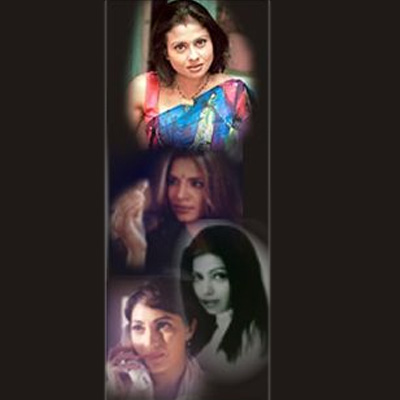
(While some people love the shrews on television, others love to hate them. How important are they to a script ?Are the formulaic arched eyebrows, rolling eyes, smirk routine the only way to depict them ?)
 |
The hand that rocks the cradle may rule the world may be a truism. But in the big bad world of television you just cannot do without those conniving “Cruella De Vil” types ever ready to unleash their claws. And don’t we just love to hate those “bad girls” on the tube.
Though one may think it is taking women’s liberation a bit too far, the truth is – not only the good but the bad on television are undoubtedly women.
It is no longer the stereotypical, sati savitri diabetically sweet characters draped from head to toe that call the shots on television but the vixens wearing dresses with plunging neck lines, puffing cigarettes, with the clichéd arched eyebrows, rolling eyes and smirk act, that do.

For those who beg to differ on this premise, we have a comprehensive list as evidence. These are truely the Queen B…..s of Tellyland – Shweta Kawatra who plays Pallavi in Kahaani Ghar Ghar Ki, Sweta Keswani (Anu in Des main Niklla Hoga Chand), Kavita Kapoor (Rewa in Kittie Party), Jaya Bhattacharya (Payal in Kyunki…), Sudha Chandran (Ramola Sikand in Kaahin Kissi Roz), Rakhi Tandon (Rubina in Heena ) and Nigar Khan (Sheetal Singhania in Lipstick).
How vital are these negative bitchy characters to a script? Are these archetypal characterisations becoming too much to stomach?
 |
Stomach them or not, what you certainly cannot do is ignore them. And no, the credit for this doesn’t go to the loud make-up they adorn, but the kind of impact they have on the audience and most definitely the script.
Parvati and Pallavi – the good and the bad of Kahaani Ghar Ghar Kii
“Ramayan mein agar Ravan nahi hota to kya Ram, Ram hota? For any serial to have drama there needs to be conflict provided by the positive and negative characters. We enhance the positive role by showing negativity is at its peak. For example Tulsi in Kyunki …. is so good because Payal is so bad. Payal combats Tulsi’s goodness with evil,” says Rajesh Joshi the scriptwriter of Kyunki Saas… and Kasauti Zindagi Kay.
BM Vyas:
Clichéd’ facial expressions, mannerisms, extreme close-ups and one-liners bring the dramatic elements into the spotlight.
BM Vyas, who penned a few episodes of Kahaani Ghar Ghar Ki, believes that: “You need to look at a script in its totality. The normal trend is to first establish the distinct positive and negative characters. Once that is accomplished, the negative female character is shown hatching all kinds of plots and the positive character counter reacting with (negative) acts which are invariably justified. And of course, to add to the melodrama we have the clichéd facial expressions, mannerisms, extreme close-ups and one-liners to bring the dramatic elements into the spotlight.”
 |
Thus props the next issue – The portrayal of negative characters on television. Are arched eyebrows,rolling eyes, sly smiles and sexy glamorous outfits with a special background score which conditions the viewers that trouble is round the corner – synonymous with evil, vicious and calculative viragos?
Jaya Bhattacharya: I was made to wear hazel coloured lenses to give the tacky look in Kyunki….
“In soaps, the physical appearance of negative and positive characters is given detailed attention. Especially the costume and hairstyle play a significant role. If your look is correct, half the battle is won and the rest falls into its place. For Kyunki… I was made to wear hazel coloured lenses to give the tacky look,” says Jaya Bhattacharya who plays the role of Payal.
Sweta Keswani:” I call it reaction 44 B- the formulaic arched eyebrows, smirks sly knowing look.”
 |
Confirming this fact, Sweta Keswani who plays the role of Anu in Des Mein… adds, “I call it reaction 44 B – the formulaic arched eyebrows, smirks and the sly knowing look, which is supposed to automatically convey the dark shades of the negative character. It is too clichéd.” She however asserts ” I try to highlight the negative traits of the character I play through my eyes.” Interestingly, Kittie Party on Zee TV shows women in a different light. Based on upper-class urban women and their lifestyles it seems to break away from the saas bahu sagas and shows a women as having multi-faceted personalities. The characters have their shades of grey and deal with slightly different issues. According to Vinod Ranganath,the scriptwriter of Kittie Party “We have made a conscious attempt to ensure that none of the characters be shown as out and out bitchy or too goody goody. They are characters whom people can relate to.”
Vinod Ranganath: Channels interfere and demand that the negative characters be shown in a specific way.
 |
An interesting revelation made by him is the fact that, “Many a times the channels interfere and demand that the negative characters be shown in a specific way.” He is quick to add that fortunately Kittie Party and its team enjoyed absolute freedom in this regard.
According to Star India, senior vice president content and communication, Tarun Katial, “Negative characters are essential to a story as they add a different flavour altogether. An antagonist is vital to a soap because she gets in the dramatic element. We actually design and tailor make the antagonist to suit the serial.” It is probably this logic that is behind Star Plus’ recent announcement that its two mega serials Kahaani … and Kyunki … are headed for a dramatic overhaul.
Do the actors playing negative roles want to play positive roles?
 |
|
Vinod Ranganath: Channels interfere and demand that the negative characters be shown in a specific way. |
Shweta Kawatra: You can be vicious,spiteful and bitchy in numerous ways.
Shweta Kawatra , one of the most sought after women states emphatically, “If asked to do a positive role , I need to do just more than crying . In how many ways can one cry anyways? But in the case of negative roles, you can be vicious,spiteful and bitchy in numerous ways. There is a lot of spice in the role and its fun. During the first year of Kahaani…. Ghar Ghar Kii when I was at my devious best, people used to hesitate to come to me. As an actor I was elated because it clearly meant that I had portrayed the character so well that people actually took me to be an evil person.”
Surprisingly, Sweta Keswani is of the opinion that “Negative roles too can get boring. Personally I enjoy playing characters which have varying shades as the more erratic the graph of a character the more challenging it is.”
One-dimensional these ladies certainly are not. Kaahin Kissi Roz “bad girl” Sudha Chandran was unavailable for comment as she was out of town on a visit to the Hindu pilgrim centre of Vaishnodevi. Kittie Party’s Kavita Kapoor, however, though very much in the city, could not manage the time to respond to queries from indiantelevision.com.
Are the cruella de vils a must on television?
 |
|
Shweta Kawatra: You can be vicious,spiteful and bitchy in numerous ways. |
In a nutshell, it is entirely up to the actor how she plays the role and evokes the desired response.
Well known scriptwriter Ashwini Dhir feels that “Portrayal of the negative character of a woman needs to be improved. We need to have better scripts and even better plots. We need to have a whole new dimension, a new story angle if possible.” Is anybody listening?
If today cinema is a man’s prerogative, then television is definitely a woman’s. The big bad world of television has been invaded by the fairer sex. Call them the dragons of television but these sexy sirens are quintessential to soaps on air. So love them or detest them, they are definitely here to stay.





GECs
Sahara One reports financial results, notes director exit and business realignment
Muted revenues, steady expenses and strategic adjustments shape company’s current phase
MUMBAI: In a tale where the sands seem to be slipping faster than they can be gathered, Sahara One Media and Entertainment Limited has reported another quarter of wafer-thin income and widening losses, even as a boardroom exit adds to the unease.
The company informed the Bombay Stock Exchange that its board, in a meeting held on April 4, approved its unaudited financial results for the quarter ended September 30, 2025. The numbers paint a stark picture. Total income for the quarter stood at just Rs 0.13 lakh, unchanged sequentially and sharply down from Rs 0.26 lakh a year earlier.
Losses, meanwhile, deepened. The company posted a net loss of Rs 24.16 lakh for the quarter, compared to Rs 18.81 lakh in the June quarter and Rs 39.69 lakh in the same period last year. For the six months ended September 2025, the cumulative loss stood at Rs 39.69 lakh, while the full-year loss for FY25 was reported at Rs 60.72 lakh.
Expenses continued to outweigh income by a wide margin. Total expenses for the quarter came in at Rs 24.30 lakh, led by employee benefit costs of Rs 6.51 lakh and other expenses of Rs 17.78 lakh. Earnings per share remained in the red at Rs (0.11) for the quarter.
The balance sheet reflects a company with significant assets on paper but limited operational momentum. Total assets stood at Rs 23,065.57 lakh as of September 30, 2025, broadly unchanged from March 2025. Equity share capital remained steady at Rs 2,152.50 lakh, while total equity was reported at Rs 18,004.85 lakh.
Cash and cash equivalents saw a modest uptick to Rs 6.75 lakh from Rs 4.68 lakh earlier, supported by a positive operating cash flow of Rs 180.01 lakh for the period.
Yet, beneath these numbers lies a more complex narrative. The company’s auditors flagged their inability to obtain sufficient evidence to form a conclusion on the financial statements, citing lack of access to records. They also raised concerns over the company’s ability to continue as a going concern, pointing to insufficient funds, delayed recoveries, and stalled content investments.
Adding to the governance overhang, the company disclosed that Rana Zia has resigned as whole-time director, effective October 16, 2025, citing other professional commitments. The resignation, noted and accepted by the board, also brings an end to her role across company committees.
Regulatory pressures continue to loom large. The Securities and Exchange Board of India has already initiated penal actions for non-compliance with listing norms, with trading in the company’s shares remaining suspended. There is also a risk of promoter demat accounts being frozen.
Legacy legal issues remain unresolved. A substantial deposit of Rs 694,027.88 thousand linked to the long-running OFCD dispute involving Sahara group entities is still under the purview of the Supreme Court of India. Restrictions on asset disposal continue to weigh on the company’s financial flexibility.
Operationally, challenges persist across multiple fronts. Advances worth Rs 1,92,916 thousand given for film content remain stuck, with delays in project completion and uncertain recoverability. The company’s YouTube channel, despite being operational, has generated no revenue for over three years due to compliance lapses. In a further twist, management has indicated that revenues may have been fraudulently diverted through unauthorised changes to its AdSense account, with a police complaint in the works.
There are also missed revenue opportunities. Television content rights continue to be used by a related party despite the expiry of the licence agreement, with fresh negotiations still underway.
For now, Sahara One Media and Entertainment Limited appears caught between legacy disputes and present-day operational hurdles. As losses linger and governance questions mount, the road to recovery looks less like a sprint and more like a slow trudge through shifting sands.






