English Entertainment
Are channels wooing viewers with weekend adult fare?


An investigation by the indiantelevision.com team into the issue of “objectionable shows” on the small screen threw up some startling findings.
Was there more to I&B minister Sushma Swaraj‘s comments devoted to the elimination of obscenity from the small screen at the recently held DD Awards 2002 than pet bugbear Fashion TV?
Indiantelevision.com decided to delve deeper as to what exactly Swaraj was talking about when she said: “If this (adult fare) is all that sells, don‘t sell,” she told her in absentia targets, “and we will make up your deficit in material terms.”

At first glance, it would seem as if she was referring to the foreign channels like FTV. However, it is also possible that the minister might have been referring to indiscretions on the part of the ‘Indian‘ channels as well.
An investigation into the issue of “objectionable shows” on the small screen threw up some startling findings. The main one being that it is not just FTV that has “hot” shows to hock. Other TV channels have also been putting their bets on the ‘three-letter word‘ to deliver a captive audience and make no bones about it either.
 Since the past few months, Zee MGM has been slowly building up a base of a loyal ‘voyeuristic‘ audience for its Saturday night 11 pm slot. The slot, known as the ‘Naughty Fun and Frolic‘ slot, also portrayed frontal nudity in films such as The Bikini Shop (26 October), Miracle Beach (2 November), To Kill For (9 November), Dream Lover (16 November), Liebestraum (23 November) and Secret Admirer (30 November).
When questioned about it last week, Zee MGM Business Head Ajay Trigunayat clarified: “Objectionable scenes are either pixilated or cut. We have a slot called the ‘Naughty Fun Frolic slot‘ wherein some of the movies mentioned above (and also screened in the Saturday 11 pm slot) can be categorized.”
When questioned about the movies mentioned above, Trigunayat had said: “That must be an aberration. Whenever we have received any feedback about such lapses, we have rectified the same.” Trigunayat‘s statement was borne out by the fact that last Saturday‘s late night movie Hot Bubble Gum (aired on 7 December), had all objectionable scenes either cut or pixilated.
Star Movies and HBO, which follow far stricter censorship codes, have opted for the “safer” horror route for the thrill seekers. Star Movies has also branded the post 11 pm slot on Saturdays as ‘Sat After Dark‘. It has screened sequels of movies like Psycho in the month of November. Meanwhile, HBO had also screened Psycho and sequels of Friday The 13th in November.
The indiantelevision team conducted a study on the trends in TVRs of the above-mentioned channels for the Saturday midnight slot.
Data provided by TAM Media on the ratings trends for the Saturday late night slot are revealing. The ratings (9 cities TG 4+ 26 October to 23 November 2002) of Zee MGM either surpass or compare well with Star Movies and stay clearly ahead of HBO. Also, the ratings of Zee MGM in the 11 pm slot increases on Saturdays as compared to Fridays.
 |
Trigunayat however, asserts that it was not as if only the Saturday slot was getting strong viewership. “There are some slots like ‘Romantic Mondays‘ and the ‘Sun Down Show‘ where our programmes have higher ratings as compared to Star Movies and HBO. We have been making gains with our selection of films such as the much-acclaimed movie Traffic,” he stated.
 |
Critics might also claim that regional Malayalam language channel Surya TV (part of the Sun stable) has already been following this strategy since the past year or so. The Malayalam movies being shown on the Saturday ‘midnight‘ slot have no pretensions to quality and can only be termed as sleazy.
 |
Another interesting aspect is that the TVRs of the programmes shown on Surya TV before and after the Saturday midnight slot dip considerably.
It is worthwhile mentioning that Asianet had stopped screening such movies ever since Swaraj declared war against such forms of broadcasting obscenities.
Local cable networks also have such slots. Hinduja Group MSO INCableNet‘s movie channel CVO has earmarked the 11 pm slot on Fridays for dishing out adult fare. CVO calls it the Hollywood Movies band.
Music videos are another area where the channels cash in. The Star Network‘s Channel [V] has slots devoted to “hot songs”. Rated R, which airs on Tuesdays and Thursdays at 11 pm and makes its pitch as a show “that shows all… well almost!” Music channel Southern Spice has a daily 11 pm to 11:30 pm where such fare is aired. MTV India has been telecasting The Grind since many years.
 |
|
EMEDIAPLAN SEARCH RESULT FOR TOP 3 PROGRAMMES IN SPECIFIC MARKETS FOR C&S AND ALL TV HOUSEHOLDS FOR WEEK STARTING 18 MARCH 2002
Base: C&S TV Households, All 4+, Specific Mkts |
|
HYDERABAD C&S TV HOUSEHOLDS |
||||||
|
1 |
TEFF-SANCHALANAM |
Gemini TV |
23/03/02,Saturday |
13.58 |
45.89 |
354.71 |
|
2 |
MIDNIGHT MASALA |
Gemini TV |
23/03/02,Saturday |
13.25 |
59.11 |
346.09 |
|
3 |
PAVITRABANDHAM |
Gemini TV |
19/03/02,Tuesday |
11.69 |
36.46 |
305.34 |
|
HYDERABAD ALL TV HOUSEHOLDS |
||||||
|
1 |
TEFF-NUMBER ONE |
DD8 (Telugu) |
24/03/02,Sunday |
9.41 |
47 |
388.35 |
|
2 |
TEFF-SANCHALANAM |
Gemini TV |
23/03/02,Saturday |
8.57 |
33.29 |
353.68 |
|
3 |
MIDNIGHT MASALA |
Gemini TV |
23/03/02,Saturday |
8.36 |
36.85 |
345.02 |
And it‘s not just the music channels that are making merry on music. Many general entertainment channels, more so those from the south, devote their late night slot for “steamy songs”.
Gemini TV (Telegu) and Udaya TV (Kannada) have programmes called Midnight Masala on Saturdays around midnight. These 30-minute duration programmes telecast film songs that include titillating ‘rain dance‘ sequences. Ratings show audiences have been lapping up this fare.
 |
That the late night is “male time” for all channels is clear even when you look at infotainment channels like Discovery. The channel also has programmes like Sex, Dice and Las Vegas Law & Order in the post 11 pm slot on Saturdays. The themes are adult, and though there are elements of graphic content in some of the shows, there can be no faulting either the intent or quality of these programmes. The kind of advertising that Discovery‘s late night slot is also skewed towards the male, whether it be deodorants, motor bikes, cars, engine oil and the like.
So there it is, some like it hot and some not so hot. Different channels are looking at it in different ways but the target is very definitely male.
What these findings reveal is that titillating television, like in almost any other market, works in India, and gets viewers glued to their TV sets, goggle eyed, sleepy though they may be. Even in more restrictive regimes such as Singapore and Malaysia the thinking is to be more liberal as the laws have not been able to curb a large section of viewers innate urge for voyeurism.
On the government‘s part there does not seem to be too much clarity either. FTV is a case in point. Swaraj raised Cain about it for a few weeks and then forgot it for months. This works as a deterrent for a while, a week or so, following which the “skin flash” brigade bounces back even stronger.
In fact, some channel executives claim in private that Swaraj‘s diatribe against the French fashion channel was the best marketing and promotion exercise FTV could have asked for. And it cost the fashion channel zilch.
Sure TV channels have to follow programming codes of the country where they are uplinking from – which they will all say they are doing. Of course while some will adhere to it strictly, there will always be those who try to work around it. Even DD at times goes easy on its own programming code especially as far as some of the international movies it airs are concerned. Will the private satellite TV channels follow the DD code?
The fact is clear that there is a market for adult-oriented television. The government has to take a decision to treat its citizens like adults, which is presumably what everyone becomes after becoming 18. These adults can decide whether they want to watch adult oriented programming or not. Earlier this year it disagreed to the demand to allow adult oriented cinema to be shown in designated cinema halls. That is fine. If it wants to do the same with television it can choose to do so. Or it can open up like the programmers have been increasingly doing so as far as skin is concerned.







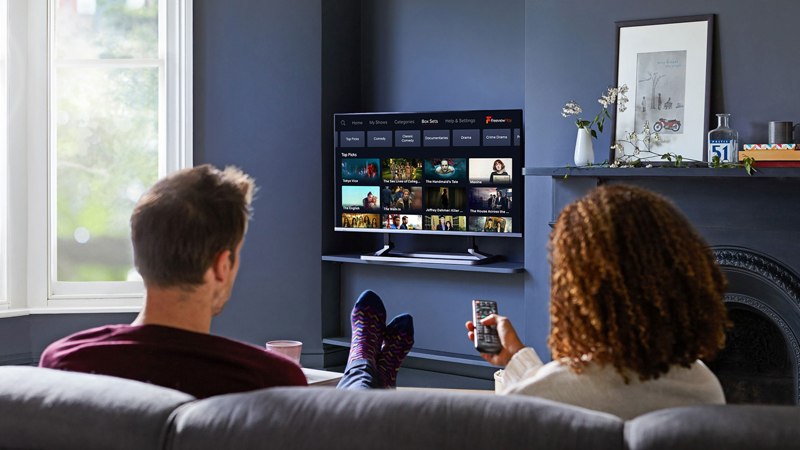
UK: The aerial is losing its grip. As broadband becomes the default way Britons watch television, the UK is edging towards a decisive, and divisive, question: should Freeview be switched off by 2034? The issue, highlighted in reporting by The Guardian, has exposed deep fault lines over access, affordability and the future of public service broadcasting.
For nearly 25 years, Freeview has delivered free-to-air television from the BBC, ITV, Channel 4 and Channel 5 to almost every corner of the country. Even now, it remains the UK’s largest TV platform, used in more than 16m homes and on around 10m main household sets. Yet the same broadcasters that built it are now pressing for its closure within eight years.
Their case rests on a structural shift in viewing. Smart TVs, superfast broadband and the Netflix-led streaming boom have pulled audiences online. Advertising economics have followed. By 2034, the number of homes using Freeview as their main TV set is forecast to fall from a peak of almost 12m in 2012 to fewer than 2m, making digital terrestrial television, or DTT, increasingly costly to sustain.
But critics say the rush to switch off risks abandoning those least able, or least willing, to move online.
“I don’t want to be choosing apps and making new accounts,” says Lynette, 80, from Kent. “It is time-consuming and irritating trying to work out where I want to be, to remember the sequence of clicks, with hieroglyphics instead of words. If I make a mistake I have to start again.”
Lynette is among nearly 100,000 people who have signed a “save Freeview” petition launched by campaign group Silver Voices. She fears the government is about to “take [Freeview] away from me and others who either don’t like, can’t afford, or can’t use online versions”.
Official figures underline the fault lines. A report commissioned by the Department for Culture, Media and Sport estimates that by 2035, 1.8m homes will still depend on Freeview. Ofcom’s analysis shows those households are more likely to be disabled, older, living alone, female, and based in the north of England, Wales, Scotland and Northern Ireland.
Freeview is owned by the public service broadcasters through Everyone TV, which also operates Freesat and the newer streaming platform Freely. After two years of review, DCMS is expected to set out its position soon, drawing on three options proposed by Ofcom: a costly upgrade of Freeview’s ageing technology; maintaining a bare-bones service with only core PSB channels; or a full switch-off during the 2030s.
The broadcasters have rallied behind the third option. They argue that 2034 is the logical cut-off, when transmission contracts with network operator Arqiva expire. By then, they say, the cost of broadcasting to a dwindling audience will far outweigh the returns from TV advertising.
Ofcom agrees a crunch point is approaching. In July, the regulator warned of a “tipping point” within the next few years, after which it will no longer be commercially viable for broadcasters to carry the costs of DTT.
Others see risks beyond economics. Questions remain over whether internet TV can reliably deliver emergency broadcasts, such as the daily Covid updates, in the way that universally available DTT can. The UK radio industry has also warned that an internet-only future for TV could push up distribution costs and force some radio stations off air if PSBs no longer share Arqiva’s mast network.
“It is a political hot potato,” says Dennis Reed, founder of Silver Voices, who says he has “dissociated” his organisation from the government’s stakeholder forum, which he believes is “heavily biased” towards streaming.
The Future TV Taskforce, representing the PSBs, counters that moving online could “close the digital divide once and for all”. “We want to be able to plan to ensure that no one is left behind,” a spokesperson says, adding that rising DTT costs could otherwise mean cuts to programme budgets.
The numbers show the scale of the challenge. Of the 1.8m Freeview-dependent homes projected for 2035, around 1.1m are expected to have broadband but not use it for TV. The remaining 700,000 are forecast to lack a broadband connection altogether.
Veterans of the analogue switch-off, completed in 2012 after 76 years, recall similar fears of “TV blackout chaos”. Around 6 per cent of households were labelled “digital refuseniks”, yet a targeted help scheme and a national campaign, fronted by a robot called Digit Al voiced by Matt Lucas, delivered a largely smooth transition.
This time, the BBC is less keen to foot the bill. Tim Davie, the outgoing director general, has said the corporation should not fund a comparable support programme for a Freeview switch-off.
Research for Sky by Oliver & Ohlbaum suggests that with early awareness campaigns and digital inclusion measures, only about 330,000 households would ultimately need hands-on help ahead of a 2034 shutdown.
Meanwhile, viewing habits continue to fragment. Audience body Barb says 7 per cent of UK households no longer own a TV set, choosing to watch on other devices. In December, YouTube overtook the BBC’s combined channels in total UK viewing across TVs, smartphones and tablets, albeit measured at a minimum of three minutes.
That shift may accelerate. YouTube has recently blocked Barb and its partner Kantar from accessing viewing session data, limiting transparency just as online platforms consolidate power.
“When the government chose British Satellite Broadcasting as the ‘winner’ in satellite TV it was Rupert Murdoch’s Sky instead that came out on top,” says a senior TV executive quoted by The Guardian. “There already is such an outsider ready to be the winner in the transition to internet TV; it is YouTube.”
Freeview’s future now hangs on a familiar British dilemma: modernise fast and risk exclusion, or protect universality and pay the price. Either way, the aerial’s days as king of the living room look numbered.








