I&B Ministry
Govt panel clears D2M broadcasting, flags stakeholder review
Policy momentum builds for D2M ahead of expected 2026 rollout


NEW DELHI: The government has taken a decisive step towards rolling out direct-to-mobile (D2M) broadcasting in India, with the Committee of Secretaries giving in-principle approval to the proposal while simultaneously ordering a deeper examination of stakeholder concerns, according to a Storyboard18 report.
People familiar with the discussions said the decision reflects the Centre’s determination to push ahead with next-generation broadcast technologies, even as it seeks to manage growing resistance from telecom operators wary of the impact on mobile video revenues.
The move follows a referral by the Ministry of Information and Broadcasting to the committee of secretaries, rather than placing the proposal directly before the Union Cabinet, as was initially envisaged. The inter-ministerial panel includes representatives from the Department of Telecommunications, the Ministry of Electronics and Information Technology, the Department of Space, and the MIB.

“The clearance keeps the policy engine running without ignoring due process,” said a senior industry executive, requesting anonymity. “It signals commitment without forcing a rushed decision.”
Public broadcaster Prasar Bharati, working with IIT Kanpur and Saankhya Labs, now part of Tejas Networks, is conducting D2M trials across more than 19 cities. The technology allows live television and multimedia content to be transmitted directly to mobile phones without internet connectivity or a SIM card.
Officials see D2M as a strategic public-interest tool, particularly for regions with weak digital infrastructure. Use cases include education, disaster alerts and emergency messaging. “This is being framed as a complement to telecom networks, not a replacement,” said an executive involved in the consultations.
Telecom operators remain unconvinced. They argue that D2M could undercut mobile video consumption, one of the sector’s fastest-growing revenue streams and have questioned both the commercial logic and technical robustness of the trials.
Industry body Cellular Operators Association of India has criticised the testing process, alleging departures from principles of transparency, consultation and technology neutrality, and has called for fresh trials with broader stakeholder participation.
The government and Prasar Bharati have countered these objections with technical evidence. Studies led by IIT Kanpur found that D2M operations in the 470–582 MHz band do not cause harmful interference with existing 4G and 5G networks, nor do they lead to abnormal handset heating. The findings were independently certified by Aracion Technology, a NABL-accredited firm.
The MIB has been among D2M’s strongest advocates, frequently pointing to India’s access gap. Of roughly 280 million households, about 190 million have television access, leaving nearly 90 million TV-dark. By contrast, the country has around 800 million smartphone users and another 250 million feature-phone users.
The newly constituted committee will examine spectrum frameworks, regulatory safeguards and stakeholder concerns, even as pilot deployments continue. Industry executives say the signal from the Centre is unmistakable. “The question now is execution, not intent,” said a senior broadcast executive.
Commercial rollouts are expected to begin by mid-2026, with wider launches towards the end of the year. The MIB has also appointed Ernst & Young as project management consultant to design a national D2M roadmap, including a viable revenue and business model.




I&B Ministry
India tightens anti-piracy law, blocks sites and Telegram channels
New rules bring jail terms, fines and faster takedowns of illegal content
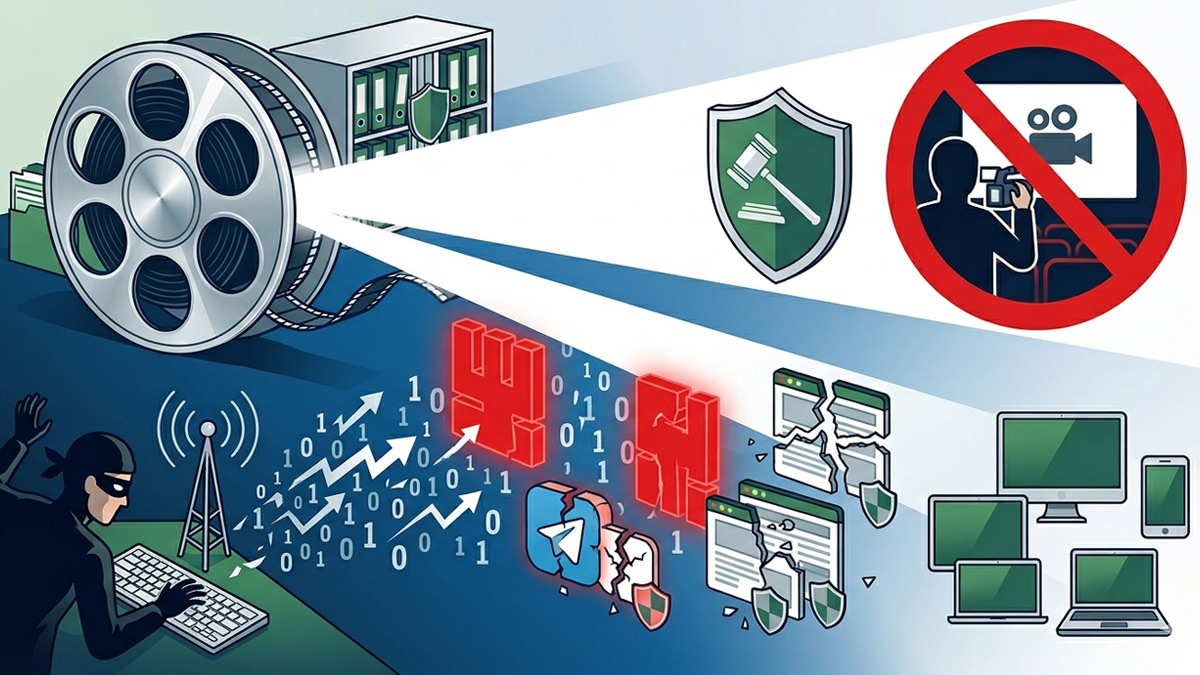
NEW DELHI: The Government of India has stepped up its fight against film piracy, invoking stricter provisions under the Cinematograph Amendment Act 2023 to crack down on unauthorised recording and distribution.
The law now imposes tougher penalties, including jail terms ranging from three months to three years and fines starting at Rs. 3 lakh, which can go up to 5 per cent of a film’s production cost. The provisions target both illegal recording in cinemas and unauthorised online transmission.
In a fresh enforcement push, authorities have notified the Telegram platform to act against piracy, leading to the identification of 3,142 channels allegedly distributing copyrighted content without permission. In parallel, access to around 800 piracy websites has been blocked through internet service providers.
The action has been taken under the Information Technology Act 2000, which empowers the government to direct intermediaries to remove unlawful content. The framework is further reinforced by the Information Technology Rules 2021, requiring platforms to act swiftly when notified of violations.
An institutional mechanism is also in place, allowing copyright holders and authorised representatives to file complaints through designated nodal officers. Once verified, these complaints trigger takedown notices to intermediaries for disabling access to infringing content.
The update was shared in Parliament by Government of India minister of state information and broadcasting l murugan in response to a query from Parimal Nathwani.
The government’s latest move signals a sharper, more coordinated approach to tackling piracy across both physical and digital channels. For the film industry, it is a step towards protecting revenues, while for viewers, it reinforces the shift towards legitimate content consumption.