Comment
Comment: 3 areas that new MIB minister Rathore needs to target


In a recent reshuffle of his cabinet colleagues and their portfolios initiated by PM Modi, a surprise move was not Ministry of Information and Broadcasting (MIB) minister Smriti Irani’s removal, but handing the independent charge of the portfolio to her till-now junior, Rajyavardhan Rathore.
There is some merit in giving Rathore full responsibility of MIB, which was conceptualised by the nation’s founding fathers to be the government interface with the media and public, in general. That MIB could have lost its relevance in this digital age – an issue being debated in certain quarters – is another story altogether for some other time. Why Rathore at the helm of MIB seems just what the doctor advised?
First, he is young and suave. Second, he comes with a good pedigree of being an army officer and an Olympic medalist. Third, he’s comparatively young and has built a youth and people-friendly image, apart from his work as independent charge holder at Ministry of Youth Affairs and Sports – his latest initiative on Twitter, #HumFitTohIndiaFit , aimed at encouraging fitness by inviting celebs is already a hit on social media.

As Rathore has served as a junior MIB minister long enough to get to know the complex issues that come with the terrain, it is expected that he is best suited to address the challenges being faced by the media industry. But for that, he needs to aim at the following three areas and hit the bull’s eye.
Content Regulation
The previous MIB minister waded into controversies because of her largely perceived unpopular move to create a panel in April this year to explore regulations for online media/news portals and online content. It did not help her or the government’s cause as this announcement, though being hinted at for several months, came close on the heels of a widely protested move to cancel the accreditation of journalists if found peddling fake news, while the government did not define clearly what constituted a fake news. Though the order was rescinded at the behest of the PM’s Office, the online content committee lingers on directionless and with nobody willing to father the baby presently. That this move antagonised not just online journalists, but also social media players (many of whom are backed and funded by government’s sympathisers) and video-on- demand portals is a story in itself.
Rathore knows media in India enjoys certain constitutional freedoms, including the right to exercise freedom of speech and expression. Therefore, any move targeted at “regulating” such content shall only be interpreted as silencing criticism. That the online committee is packed with government officials with minuscule industry representation and zero presence of online media raises questions on government’s motives.
What’s more, doubts have also been raised on the jurisdictional propriety of MIB to create such a committee in the first place. The government allocation of business rules that determine the remit of various government agencies clearly highlights that for all “policy matters relating to information technology; electronics; and Internet” only Ministry of Electronics and IT (MeITY) is competent to make decisions. The ambit of MIB is limited only to “the enunciation and implementation of the law relating to radio and television broadcasting in India by private Indian companies or Indian nationals”.
With multiple laws applicable on online content, there seems to be no need of any additional regulation for online content, though MeITY could think otherwise, but it’s for it to take a call. Still, a self-regulating mechanism that places uniform standards over user-generated content platforms and video-on-demand portals is the need of the day. This shall also be in line with Rathore’s views expressed after assuming full charge at MIB where he stressed upon self-regulation as the only means of regulating media.
As the final authority at MIB now, Rathore needs to walk the talk on online content regulation and, probably, let the committee set up by his predecessor die a natural death.
Online content aside, in the world of traditional broadcasting there is a need to strengthen the already established self-regulatory mechanisms such as the Broadcasting Content Complaints Council (BCCC) of the IBF and a similar self-regulatory set-up of the NBA India.
Ease of Doing Business
It would be an understatement to say that the past year has been a difficult period for the Indian media and entertainment (M&E) sector what with after-effects of demonetisation of high-value currency notes and a new tax regime of GST rolled out last year. The story remains the same for ease of doing business in the sector as well.
On this aspect, Rathore could focus on the recommendations made by Telecom Regulatory Authority of India (TRAI) on`Ease of Doing Business in Broadcasting Sector’ and implement them in letter and spirit.
A unilateral decision by the previous leadership of MIB to impose a processing fee of Rs 100,000 per day/channel on temporary live uplinking of events (such as sports) and the same amount for seeking minor amendments (like change in name, logo, etc) has been causing heart burns.
What was the rationale behind such moves to review processing fees? Allegedly non-revision for several years and that such a move could bring in some revenue for the government. But, should a government use licensing/permission fee as means of revenue maximisation? Probably, no.
Another issue that demands attention from Rathore is the denial of permissions by DoS to satellite TV channels using private satellite capacity, especially foreign. Here, the newly appointed minister shall have to display his trademark leadership and try to resolve the concerns of his constituents (TV channels, DTH operators, teleport operators, etc) vis-a-vis DoS.
Building an Investment Friendly Environment
In the recently held global Asia Media Summit 2018 in New Delhi, PM Narendra Modi said that Asia has emerged as a promising region for media businesses and offers opportunities for international cooperation. This statement highlights his government’s push for increasing investment inflow across sectors of the Indian economy – including creative industries such as M&E.
In this respect, Rathore will have to hit the road running — which he has done — and look at all the factors impeding investments in the sectors under him. This could necessitate reviewing licensing conditions and guidelines, which many in the industry believe hamper investments.
Can Rathore bite the bullet and recreate the magic that he unveiled one fine day years back to get India the first Olympic medal in an individual event? Certainly, he can. Keep tuned in for the next episode.
Also Read :
MIB clears TV channel applications; Rathore calls for stakeholder meets
Comment: India’s NTP 2018 gets digital makeover but needs complimentary policies
Comment: MIB’s botched whip on fake news akin to testing waters
M&E to add 1 mn jobs in 5 years: Sudhanshu Vats





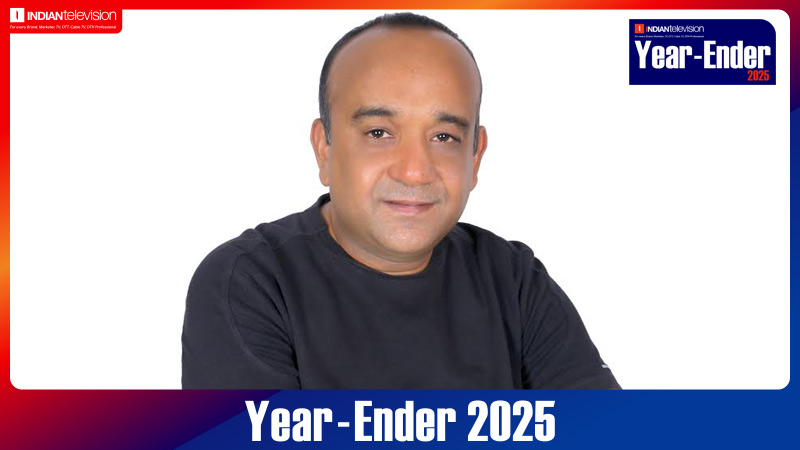
MUMBAI: 2025 will be remembered as the year India’s OTT industry stopped chasing scale for its own sake and began reckoning with how audiences actually consume content. Completion rates fell, patience wore thin and the limits of long-form excess became impossible to ignore. In this guest column, Pratap Jain, founder and CEO of ChanaJor, traces how micro-drama moved from the fringes to the centre of viewing behaviour, why short-form fiction emerged as a retention engine rather than a trend, and how platforms that respected time, habit and emotional payoff were the ones that truly grew up in 2025.
If there is one thing 2025 will be remembered for in the Indian OTT industry, it’s this: the industry finally stopped pretending.
Stopped pretending that bigger automatically meant better.
Stopped pretending that viewers had endless time.
Stopped pretending that scale without retention was success.
What began as a quiet reset in 2023 and a cautious correction in 2024 turned into a very visible shift in 2025. Business models matured. Content strategies tightened. And most importantly, platforms started aligning themselves with how Indians actually watch content, not how the industry wished they would.
At the centre of this shift was micro-drama—not as a trend, but as a behavioural inevitability.
When OTT finally understood the time problem
For years, long episodes were treated as a marker of seriousness. A 45–60 minute runtime was almost a badge of credibility. Shorter formats were pushed to the margins, labelled as “snack content” or “mobile-only.”
That belief quietly collapsed in 2025.
What platform data showed very clearly was not a drop in interest—but a drop in patience. Viewers weren’t rejecting stories. They were rejecting commitment.
Across platforms, the same patterns appeared:
* First-episode drop-offs on long-form shows kept increasing
* Completion rates continued to slide
* Viewers were sampling more titles but finishing fewer
At the same time, shows with episodes in the six to 10 minute range started showing the opposite behaviour: higher completion, higher repeat viewing, and stronger daily habit formation.
Micro-drama didn’t win because it was short. It won because it respected time.
Micro-Drama didn’t arrive loudly. It took over quietly.
There was no single moment when micro-drama “launched” in India. It crept in through dashboards and retention charts.
By mid-2025, it was clear that viewers were happy watching four, five, sometimes six short episodes in one sitting—even when they wouldn’t finish a single long episode. Romance, relationship drama, slice-of-life conflict, and grounded comedy worked especially well.
This wasn’t disposable content. It was compressed storytelling.
In shorter formats, there was no room for indulgence. Every episode had to move the story forward. Weak writing was punished faster. Strong writing was rewarded immediately.
Micro-drama raised the bar instead of lowering it.
Where ChanaJor naturally fit into this shift
ChanaJor didn’t pivot to micro-drama in 2025 because the market demanded it. In many ways, the platform was already built around the same viewing behaviour.
From the beginning, ChanaJor focused on short-to-mid-length fictional stories that felt close to everyday Indian life—hostels, rented flats, office romances, small-town relationships, young people figuring things out. Stories that didn’t need heavy context or cinematic scale to connect.
What worked in ChanaJor’s favour in 2025 was clarity:
* A clearly defined audience
* Tight episode lengths
* Storytelling that prioritised emotion and pace over spectacle
While several platforms rushed to copy global micro-drama formats, ChanaJor stayed rooted in familiar Indian settings and conflicts. That familiarity mattered. Viewers didn’t have to “enter” the world of the show—it already felt like theirs.
Why audiences started responding differently
One of the biggest misconceptions going into 2025 was that audiences wanted shorter content because their attention spans had reduced. That wasn’t entirely true.
What viewers actually wanted was meaningful payoff per minute.
On platforms like ChanaJor, episodes didn’t waste time setting the mood for ten minutes. Conflicts arrived early. Characters were recognisable within moments. Emotional hooks landed fast.
A typical consumption pattern looked like real life:
* One episode during a break
* Two more before sleeping
* A few the next day
This is how viewing habits are built—not through marketing spends, but through comfort and consistency.
Viewers came back not because every show was a blockbuster, but because they knew what kind of experience to expect.
2025 was also the year OTT faced business reality
The other big change in 2025 was on the business side. Subscriber growth slowed. Discounts stopped hiding churn. Customer acquisition costs rose.
Platforms were forced to ask harder questions:
* Are viewers finishing what they start?
* Are they returning without reminders?
* Is this content worth what we’re spending on it?
This is where micro-drama began outperforming expectations. A well-written short series could deliver sustained engagement without massive budgets. It didn’t peak for one weekend and disappear—it stayed alive through repeat viewing.
Platforms like ChanaJor benefited because they weren’t chasing inflated launch numbers. The focus was on consistency and retention, not noise.
Failures Became Visible Faster
2025 also exposed weaknesses brutally.
Several platforms assumed micro-drama was a shortcut—short episodes, quick shoots, instant traction. What they discovered was that bad writing fails faster in short formats than in long ones.
Viewers dropped off within minutes. Episodes were abandoned mid-way. Weak stories had nowhere to hide.
Micro-drama didn’t forgive laziness. It amplified it.
The platforms that survived were the ones that treated short storytelling with the same seriousness as long-form—sometimes more.
OTT Stopped Chasing Prestige and Started Chasing Habit
Perhaps the most important shift in 2025 wasn’t technical or creative—it was psychological.
OTT stopped trying to look like cinema. It stopped chasing validation through scale and awards alone. It began behaving like what it actually is in people’s lives: a daily companion.
Platforms like ChanaJor found their space here because that mindset was already baked in. The goal wasn’t to dominate a weekend launch. It was to quietly become part of someone’s everyday viewing routine.
That shift changed everything—from release strategies to how success was measured.
What 2025 Ultimately Taught the Industry
By the end of the year, three truths were impossible to ignore:
* Time is the most valuable thing a viewer gives you
* Retention matters more than reach
* Format must follow behaviour, not ego
Micro-drama didn’t take over because it was fashionable. It took over because it fit real life.
Looking Ahead
Micro-drama is not replacing long-form storytelling. It is redefining the baseline of engagement.
Longer shows will survive—but only when they earn their length. Short-form fiction will continue to evolve, becoming sharper, more emotionally confident, and better written.
Platforms like ChanaJor have shown that it’s possible to grow without shouting—by understanding the audience, respecting their time, and telling stories that feel real.
2025 wasn’t the year OTT became smaller. It was the year it became smarter.
Note: The views expressed in this article are solely the author’s and do not necessarily reflect our own.






