ces
Whoa! CES 2017 Opens with Next-Generation Innovation


LAS VEGAS: CES® 2017 officially opened its doors today, celebrating the show’s 50th anniversary with a recording-breaking exhibit floor spanning more than 2.6 million net square feet. More than 3,800 companies will launch innovative products this week at CES, including an unprecedented 600 startups in Eureka Park. Owned and produced by the Consumer Technology Association (CTA)TM, CES 2017 runs through Sunday, 8 January in Las Vegas, Nevada.
“What an incredible way to celebrate the 50th anniversary of CES – with the largest show floor in our history showcasing the next generation of innovation that will revolutionize our world,” said CTA president & CEO Gary Shapiro. “The products and services unveiled at CES 2017 will touch nearly every single global industry. From the latest in virtual reality, smart home, self-driving vehicles, robotics, wearables, health and fitness tech and more, CES 2017 is unveiling the future of the connected experience and what it means for consumers around the world.”
CES welcomed NVIDIA founder & CEO Jen-Hsun Huang to the keynote stage Wednesday night, where he made multiple groundbreaking announcements based on the company’s leadership in developing advanced graphics processors and artificial intelligence. Mass Effect: Andromeda, a popular video game made by BioWare, was previewed by NVIDIA along withGeForce NOW™, a streaming service that turns any PC into a powerful gaming PC from the cloud. Huang also unveiled a new version of the Shield TV — now just called Shield — which will support 4K HDR for both games and movies making it the world’s first 4K HDR entertainment platform. To support Shield’s Artificial Intelligence (AI), Huang introduced NVIDIA SPOT, a plug-in device that understands natural language and complex patterns to help build a user’s AI experience. Huang also announced an AI car supercomputer called Xavier used in NVIDIA’s own self-driving car BB8 and a new capability on the NVIDIA AI car computer called AI Co-Pilot, which provides drivers with road alerts and recognizes facial expressions and voice recognition to improve drivers’ experience.

Huang further announced an expanded partnership with Audi to develop artificial intelligence for a new generation of self-driving cars, with plans to have vehicles on the road by 2020. He also provided details on partnerships with mapping companies HERE and ZENRIN; and two of the world’s largest automotive suppliers, ZF and Bosch.
Wednesday also kicked off the C Space Storytellers series, with key influencers and newsmakers sharing best practices surrounding the relationships among brands, entertainment and technology. In the series’ first session, Spotify’s Alex Underwood moderated a panel with executives from GroupM, Nestle S.A. and Wordsworth and Booth providing a 30,000 foot view of the advertising opportunities in audio.
During the Nielsen Storytellers session, Nielsen’s Executive Vice President & Global Retail Practice Leader Louise Keely discussed new technologies for advertising for consumer-facing companies. In this “period of great disruption” in the consumer path to purchase, companies must change measurement tools and methods.
Preshow media events kicked off on Tuesday which included the largest CES Unveiled in history. The official media event of CES 2017 featured a record 190 exhibiting companies, an 18 percent increase over 2016, including 60 startups from Eureka Park, the most startups ever showcased at CES Unveiled. Featuring the latest in virtual reality, companion sensing robots, wireless headphones, sleep trackers, smart lighting, wearables and more, CES Unveiled provided the more than 2,000 media attending with a sneak peak of the innovation launching this week at the show. The official CES Unveiled highlights reel can be viewed here.
New for 2017, CES included two full Media Days where companies large and small introduced products to the global market. Setting the stage for a week filled with innovation, 28 companies hosted preshow news conferences, with a wide array of major product announcements:
• A&D Medical/Mobile Health – The MobileHelp Tablet Medical Alarm with MobileVitals Monitoring.
• BMW – Prototype of BMW’s 7-fully automated sedan.
• Bosch – Concept car featuring face recognition and intelligent personalization, gesture control with Ultra Haptics, a crystal-clear OLED display and digital exterior mirrors.
• Carnival – Ocean Medallion, a highly personalized wearable concierge service, which enables elevated service through enhanced guest interactions during the entire cruise experience.
• Casio – PRO TREK, a smart watch, which uses Android Wear 2.0 and is equipped with low-power GPS and new full-color map functionality.
• Continental – High-Resolution 3D Lash Lidar, capable of 3D measurement of the environment in challenging conditions such as fog, dust, rain and light.
• Faraday Future – The FF 91, a fully-electric, fully-connected, self-driving, keyless vehicle experience with a “driverless valet” function that allows the car to park itself from your smartphone.
• FCA – Portal, a concept car, is battery electric, cloud connected and offers fully self-driving capabilities.
• Hisense – The H10D 4K HDR TV, featuring proprietary ULED display technology, quantum dot wide color gamut and full array local dimming.
• Huawei/Honor Brands – The Honor 6X dual-camera, dual-sensor smartphone, retailing for $250 USD.
• Hyundai – IONIC Scooter, a “micro mobility” fold-up scooter aimed at those who live in urban environments with limited parking options.
• LG – LG Signature OLED TV W, or the “The Wallpaper TV.” The 65” model is 2.57 mm wide – 1/10th of an inch – with no gap between the TV and wall.
• Lucaro – iRobotics 7 Medical Massage Chair, a full-body massage chair that also uses blood pressure and heart rate monitoring for added comfort and options.
• Monster – Soundstage 2, to be integrated with Amazon Alexa.
• Panasonic – Lumix GH5 mirrorless camera that excels at shooting video and has 4K and 6K capabilities.
• Qualcomm – Snapdragon 835, the first 10 nanometer mobile processor, with enhanced efficiency that helps to create thinner phones with longer battery life.
• Royole – The Royole Moon, a 3D virtual mobile theater combining 1080p AMOLED displays at over 3000 ppi resolution that simulate a giant 800” curved screen, with stereoscopic 3D and noise-cancelling headphones for a completely immersive experience.
• Samsung – The Wash and FlexDry IoT-enabled washer/dryer system featuring four separate compartments for washing and drying, letting you maximize efficiency and customize how you manage your laundry.
• Sony – Crystal LED integrated structure display, with superfine LED structures serving as a light source, making it virtually impossible to see the pixels.
• TCL – The Xess series – X2 and X3 models – which are edgeless, flat and curved proving ultimate picture quality.
• Toyota – Concept-i, a self-driving car allowing passengers to interact with the car’s artificial intelligence agent named “Yui,” which anticipates drivers’ needs, measures emotions and responds automatically.
• Valeo – The 360AEB Nearshield, an emergency braking system that eliminates drivers’ blind spots, bringing the vehicle to a stop in emergency situations.
• VOXX – Terk delivers the strongest Wi-Fi signals throughout the home, as well as free HDTV. The soon-to-be released Terk Omni features circle beam technology, which will allow you to receive broadcast signals up to 65 miles away.
• ZF – The ZF ProAI, a deep learning software and ZF’s first step into artificial intelligence that goes beyond automotive applications.
• ZTE – The Hawkeye, the world’s first crowdsourced phone.
Wednesday afternoon also featured ShowStoppers LaunchIt, the Official Pitch Event at CES, built around the entrepreneurial companies that exhibit in Eureka Park, the home for startups at CES. Twelve startups pitched their products to a standing room-only crowd. First prize was awarded to Nonda, makers of a family of connected, app-enabled devices for the vehicle. Kino-mo, developer of high tech smart holographic displays, took second place. Third place was awarded to In&Motion, creator of a smart wearable that aims to reduce the risk of serious injury due to falls. Attendees can experience these and other innovative startups at the Eureka Park Marketplace, located in the Sands, Level 1, Hall G.




MUMBAI: There is a lot of excitement in the US about NextGen TV or TV broadcasts based on the ATSC 3.0 standard. With 76 per cent of U.S. households now able to receive the signals, America’s local TV broadcasters are hailing the introduction of new ATSC 3.0 receivers that will first be shown at next week’s Consumer Electronics Show (CES) in Las Vegas. The affordable options will add to consumer choice, from high-end NextGen TV sets to affordable accessories that can transform Android and Fire TV devices already in consumer homes.
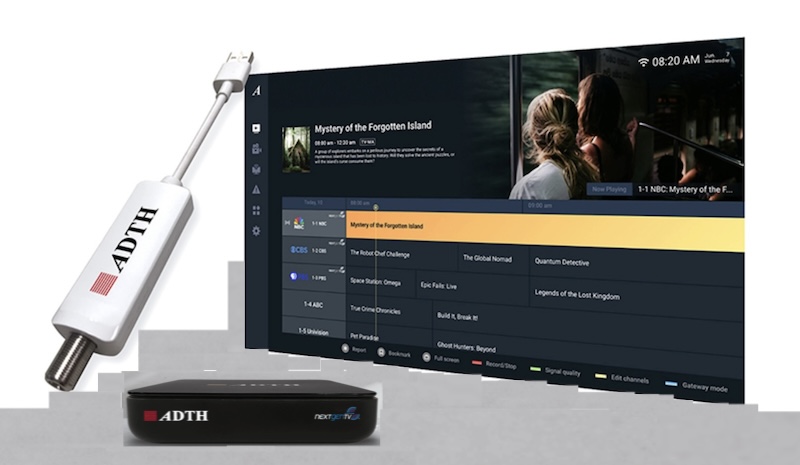
“We are very excited about the expanded offerings from accessory device manufacturers for NextGen TV. The new low-cost Atlanta DTH (ADTH) USB receiver, powered by Tolka, is built for existing Android and Fire TV televisions and will, at a very affordable price, expand the reach of NextGen TV into homes who already have those sets. ADTH is also about to introduce a new model that works without an internet connection and will be doing a software update for deployed ADTH devices to give them the same functionality. In addition, Zinwell is adding pause functionality to their accessory device, with an add-on hard disc drive. In 2025, RCA is also coming to market with two new NextGen TV sets that will join TV options already available from Panasonic, Sony, Samsung, Hisense, and TCL,” said Pearl TV managing director Anne Schelle. “We congratulate all of the manufacturers who are selling thousands of receivers each day to consumers looking for the best possible video and audio quality from local stations.”
Pearl TV is a business organisation of US broadcast companies with a shared interest in exploring forward-looking broadcasting opportunities, including innovative ways of promoting local broadcast TV content and developing digital media and wireless platforms for the broadcast industry. Pearl’s membership, comprising more than 820 TV stations, includes eight of the largest broadcast companies in America: Cox Media group, Graham Media group, Gray Television, Hearst Television, Nexstar Media group, Sinclair Broadcast group, the E.W. Scripps, and Tegna.
Broadcasters are loading up new services with new features for NextGen TV viewers, including interactive gaming options that will be launched by GameLoop.
GameLoop TV launches next week in Las Vegas on local NextGen TV channel 3.2 and will bring gaming directly to viewers with no additional hardware or subscriptions required. At the heart of GameLoop’s innovation is the channel’s exciting “play now” feature, which allows NextGen TV viewers to instantly play games showcased on the channel simply using their TV remote or mobile phone.
“We also salute TV broadcasters Gray and Sinclair, who are working to bring fun, interactive gaming to the living room through GameLoop – a service that utilises NextGen TV for web-based family fun that will work seamlessly with millions of installed NextGen TV sets. Easy interactivity is literally going to be a game-changer for viewers,” Schelle predicted.
High Dynamic Range (HDR) functionality is now live on more than 200 local NextGen TV services throughout the US , with more being added to enhance viewing of key sports games and other spectacles. Broadcasters are promoting the advantages of NextGen TV this sports season on stations throughout the country and plan to continue these promotions as they continue to rollout HDR and Dolby Atmos services nationwide.
A holiday promotion effort in NextGen TV markets that began before December continues through early February, with broadcasters now indicating onscreen to viewers when local NextGen TV programming is available in HDR.
“We’re very excited to announce that broadcast stations throughout the country are adding HDR10+ capability in their NextGen TV broadcast services to accommodate a broad array of TV manufacturers. With other flavors of HDR that also may be present in the service, this allows every receiver to present the best picture possible, showing that local television just keeps getting better and better, which is exactly what we promised with the rollout of NextGen TV services,” Schelle said. In addition to providing better video quality through HDR, many markets are adding Dolby Atmos audio coding, which delivers immersive audio capability.
“HDR began for sports with the Kentucky Derby last spring. It really made the Olympic Games pop with brilliant video. We know that sports is a big driver for buying new TV sets as well as for enjoying broadcast services — your favorite games look even better in High Dynamic Range,” Schelle said.
Throughout the country, local stations not already broadcast on over-the-air ATSC 3.0 transmissions are gaining access to NextGen TV viewers through the innovative addition of more channels through broadcast internet protocol – or broadcast IP. These additional channels are available as NextGen TV channels and have added more choices for viewers in a range of markets, from public to commercial broadcasters who now have their programming available for NextGen TV viewers.
Consumers can easily find details of what NextGen TV services are available in their markets by visiting WatchNextGenTV.com, a resource maintained by Pearl that lists individual services by market and a full range of more than 90 NextGen TV receivers and antenna products certified to work seamlessly with the new services.







