News Broadcasting
SES enables Chinese startimes to expand tv reach in Africa


MUMBAI: SES (NYSE Euronext Paris and Luxembourg Stock Exchange: SESG) announced today that StarTimes Communication Network Technology, China’s most influential system integrator, technology provider and network operator, has signed a 10-year contract on SES-5 at 5 degrees East to expand its media footprint in Africa and deliver direct-to-home (DTH) broadcast services across the continent.
StarTimes, which is the fastest-growing digital TV operator Africa and has over 2.6 million digital terrestrial television (DTT) subscribers, also acquired SES’ 20% shareholding in South African pay-TV operator Top TV.
The contract will see StarTimes utilise four transponders as of October 2013 and a fifth transponder from February 2014 to grow their DTH subscribers in Africa. The Chinese broadcaster will continue to broadcast TopTV on SES-5 by using three of the newly-contracted SES transponders that were formerly leased by ODM. The other two out of the five SES transponders contracted by StarTimes will be used to complement their DTT offering in remote and non-urban areas and grow their pay-TV business.

“The recent success of StarTimes’s strategic investment in ODM will allow us to reach new audiences in South Africa. The partnership with SES enables StarTimes to have a DTH platform in addition to the existing DTT and mobile TV (CMMB) platforms in sub-Saharan Africa. In addition, the high-powered SES-5 at the prime orbital location of 5 degrees East is ideal in overcoming the challenges of terrestrial coverage to reach large audiences. This will allow us to extend our broadcast reach across the continent and ensure excellent service and picture quality for our viewers,” said StarTimes Group Chairman and President Pang Xinxing.
“We are honoured that StarTimes has chosen to work with us to complement their DTT business across Africa and to deliver more exciting content to Africa’s dynamic markets,” said Ferdinand Kayser, Chief Commercial Officer of SES. “The new partnership with StarTimes will illustrate how the combination of DTH and DTT is a key enabler in Africa’s migration to digital TV and also help set pace in the continent’s digital migration race.”







News Broadcasting
Network18 channels lead YouTube news viewership in March 2026
CNN-News18, News18 India and CNBC channels top categories with record views
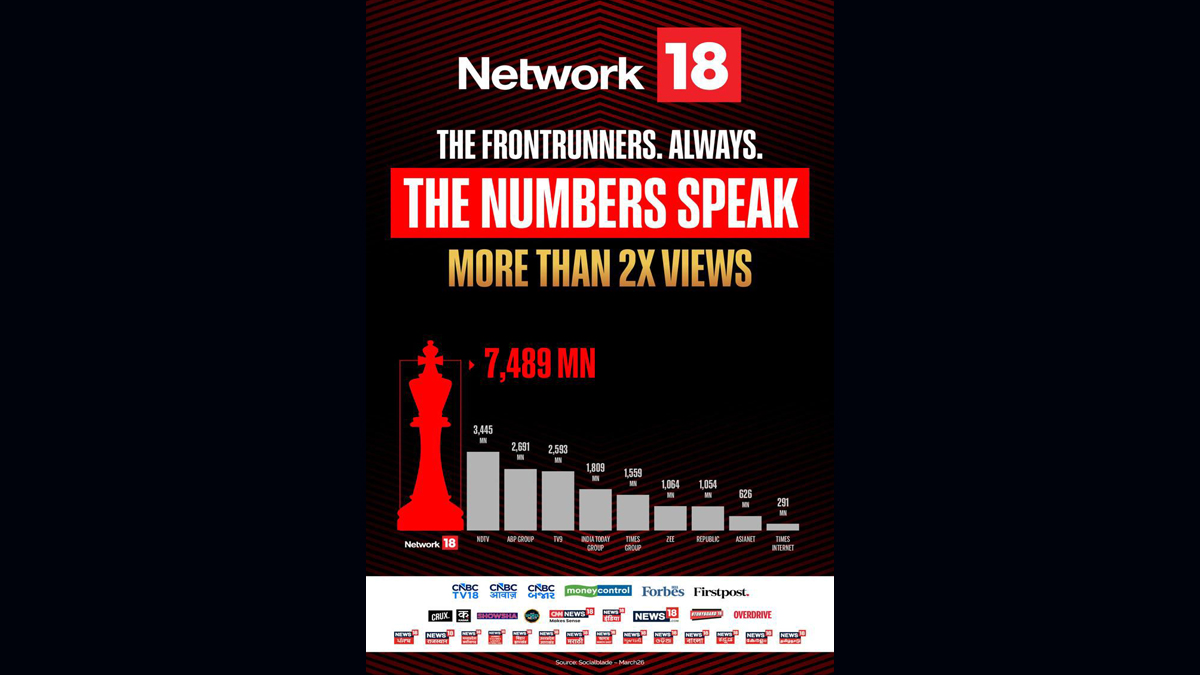
MUMBAI: When the world hit refresh on breaking news, Network18’s channels were already streaming ahead. As geopolitical tensions and war-driven headlines fuelled a surge in global news consumption, the network’s digital playbook delivered big clocking record Youtube viewership across English, Hindi and business news categories in March 2026.
At the forefront was CNN-News18, which emerged as the clear leader in the English news segment with 130 million live and video-on-demand views. The channel edged past competitors such as Times of India (126.5 million), Times Now (101.1 million), India Today (88.2 million) and NDTV (77.5 million), according to Databeings data for March.
In the Hindi news arena, News18 India delivered a commanding performance, racking up a staggering 3,297 million views on YouTube. The channel comfortably outpaced NDTV India, which recorded 3,119 million views, underlining its deep reach and consistent engagement with mass audiences, as per Playboard data.
The network’s dominance wasn’t confined to general news. In the Hindi business segment, CNBC Awaaz topped the charts with 92 million views, narrowly ahead of Zee Business (90 million) and well ahead of ET Now Swadesh (57 million). Meanwhile, its English counterpart CNBC-TV18 posted a strong 58 million views, reinforcing the network’s cross-category strength.
The spike in viewership reflects a broader shift in audience behaviour, with viewers increasingly turning to digital platforms particularly Youtube for real-time updates and in-depth coverage during high-intensity news cycles. For Network18, the numbers signal more than just scale; they underline the effectiveness of a multi-platform strategy that blends speed, credibility and continuous coverage.
In a month where the news never paused, it seems viewers chose to stay tuned where the stream never stopped.






