News Broadcasting
Sahara Star Celebrates the festive spirit of Christmas


MUMBAI: Sahara Star, known for celebrating Christmas every year with great zest and joy, brought in the festive spirit by including their guests in their annual fruit mixing activity on 30th October ‘13 for their Christmas cake. The event involves guests creating the batter and letting it ferment with alcohol over a period of time.
The activity hosted by Sahara Star every year, saw excited guests adorning the chef’s hat and gloves working on the batter by adding berries, dry fruits and diced fruits to the mixture. The most essential step of the process brought on many smiles as the guests worked in tandem with the chefs to pourcopious amounts of wine, rum and whisky to soak the fruits.
This mixture will later be used to bake the Christmas Cake. Other Christmas celebrations at Sahara Star include a special Desert Buffet decoration on 14th December and a special Xmas goodies shop being set up from 17th December onwards at Earth Plate. A Ginger Bread house will be set along with the lighting of the Christmas tree in the lobby on 6th December with the attendance of VIP and internal guests. Traditional Christmas drinks Sangria and Glühwein will be served to all the guests as a welcome drink to mark the occasion. Christmas Carols will be sung and snacks with cocktails will be available for the guests at Zero Level.

Among other festivities, cookies and stalking filled with chocolates and jujubes will be placed in all rooms on 24th Dec and Christmas pudding with a shot of non-alcoholic Glühwein will be given to all guests on 25th evening. Carol singing and Good Fat White Santa will be there from the 21st-25th December at Earthplate.






News Broadcasting
Network18 channels lead YouTube news viewership in March 2026
CNN-News18, News18 India and CNBC channels top categories with record views
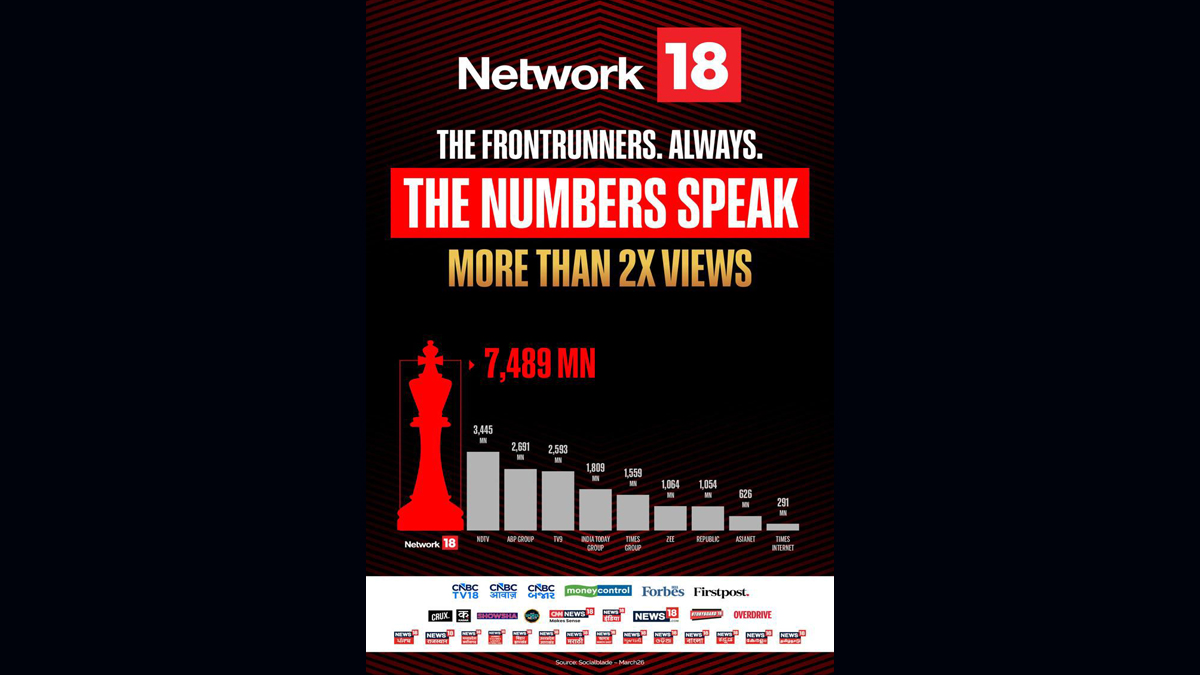
MUMBAI: When the world hit refresh on breaking news, Network18’s channels were already streaming ahead. As geopolitical tensions and war-driven headlines fuelled a surge in global news consumption, the network’s digital playbook delivered big clocking record Youtube viewership across English, Hindi and business news categories in March 2026.
At the forefront was CNN-News18, which emerged as the clear leader in the English news segment with 130 million live and video-on-demand views. The channel edged past competitors such as Times of India (126.5 million), Times Now (101.1 million), India Today (88.2 million) and NDTV (77.5 million), according to Databeings data for March.
In the Hindi news arena, News18 India delivered a commanding performance, racking up a staggering 3,297 million views on YouTube. The channel comfortably outpaced NDTV India, which recorded 3,119 million views, underlining its deep reach and consistent engagement with mass audiences, as per Playboard data.
The network’s dominance wasn’t confined to general news. In the Hindi business segment, CNBC Awaaz topped the charts with 92 million views, narrowly ahead of Zee Business (90 million) and well ahead of ET Now Swadesh (57 million). Meanwhile, its English counterpart CNBC-TV18 posted a strong 58 million views, reinforcing the network’s cross-category strength.
The spike in viewership reflects a broader shift in audience behaviour, with viewers increasingly turning to digital platforms particularly Youtube for real-time updates and in-depth coverage during high-intensity news cycles. For Network18, the numbers signal more than just scale; they underline the effectiveness of a multi-platform strategy that blends speed, credibility and continuous coverage.
In a month where the news never paused, it seems viewers chose to stay tuned where the stream never stopped.






