News Broadcasting
News Nation Budget Conclave: grids of reforms for new India’s $5-trillion economy

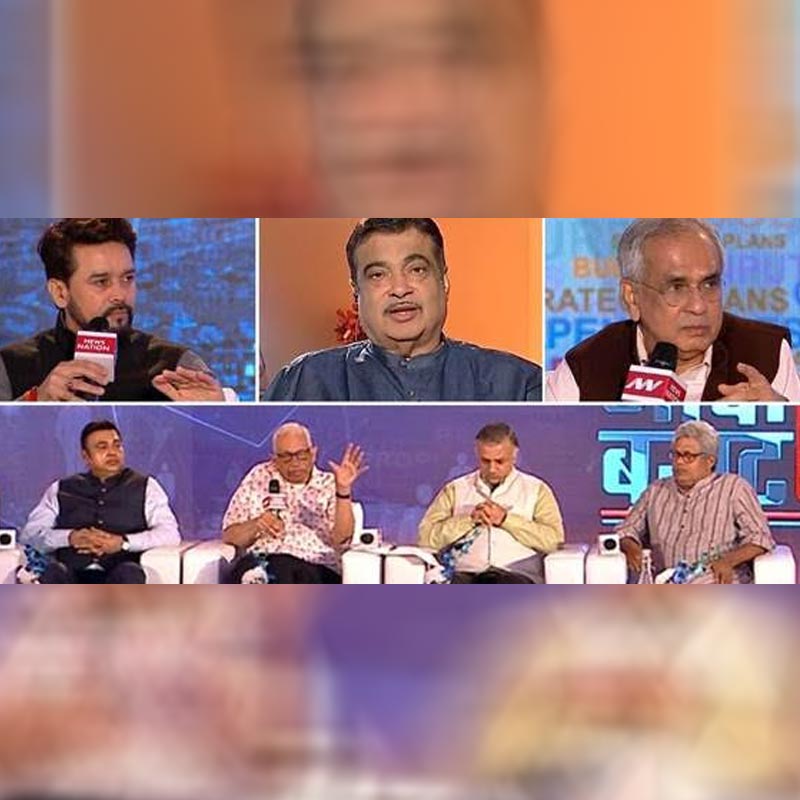
MUMBAI: News Nation hosted a mega event decoding how the Modi Sarkar will achieve the Herculean task of $5-trillion economic growth.
Spread over four sessions, eminent speakers such as Union Minister Nitin Gadkari, Niti Aayog Vice-Chairman Rajiv Kumar and veteran journalist Gautam Chikarmane dissected the finer points of the most important event in India’s fiscal calendar.
Day after Union Finance Minister Nirmala Sitharaman presented her maiden Union Budget for the second term of the Narendra Modi government, News Nation on Saturday hosted a mega event decoding how the Modi Sarkar will achieve the Herculean task of $5-trillion economic growth. Spread over four sessions, eminent speakers such as Union Minister Nitin Gadkari, Niti Aayog Vice-Chairman Rajiv Kumar and veteran journalist Gautam Chikarmane dissected the finer points of the most important event in India’s fiscal calendar.

In the first session, talking to News Nation’s Deepak Chaurasia, Union Minister Nitin Gadkari said that, “There will be ‘magical’ growth in India in next five years.” Highlighting the national water and road grid framework, Gadkari said that, "The allocation for the Ministry of Road Transport and Highways has been increased to Rs 83,016 crore in the budget as against Rs 71,000 crore in 2018-19 which was revised to Rs 78,625.50 crore".
On promoting electric vehicles, Gadkari said the main objective of phase-II of FAME scheme approved by the Cabinet is to have cost effective vehicle system and curb pollution. “We need to develop a cost effective, pollution free and indigenous transport system,” he said. GST for electric vehicles has been reduced to 5 per cent whether they are three wheelers, four wheelers or two wheelers. This can help us making leader in electric vehicle manufacturing unit.
In second session, MoSfinance Anurag Thakur said that the focus of Modi government is to renew the fight against corruption. He also lauded the Centre’s special initiatives that have lessened the corruption in corporate sector. "Jo brasht hai, usse kasht hoga, " Thakur said. "Government proposed a 100 percent foreign direct investment (FDI) in the insurance intermediaries in the Union Budget 2019. Less than 3.5 crore people used to pay tax earlier. It is only because PM Modi's efforts that the taxpayers have doubled," Thakur added.
The third session of experts discussed about the new ways how India can achieve holistic growth. The experts included MK Venu, Sachin Chaturvedi and NC Saxena.
Chaturvedi said that infrastructure is expanding in the country, this shows governments commitment towards development. BJP's spokesperson Zafar Islam said that the government delivered in the last five years, we will continue the development work. Attacking the Modi government, Saxena said that, “Rate of growth of bottom 50 per cent need to be looked into. There’s a need to increase number of doctors and nurses in rural areas. Agrarian distress needs our immediate attention. Total number of jobs have gone down. Section of society jobless. Women empowerment overlooked this budget,” Saxena added.
In last session, Niti Aayog’s Rajiv Kumar gave an optimistic tune to the exercise, saying there are many sectors in which we can easily achieve double digit growth. The economist said the government's focus is on 8.4 per cent growth and to maintain it further just like China maintained it for nearly 30 years between 1978 and 2005. During the time, China maintained a stable economic growth of 9.6.






News Broadcasting
Network18 channels lead YouTube news viewership in March 2026
CNN-News18, News18 India and CNBC channels top categories with record views
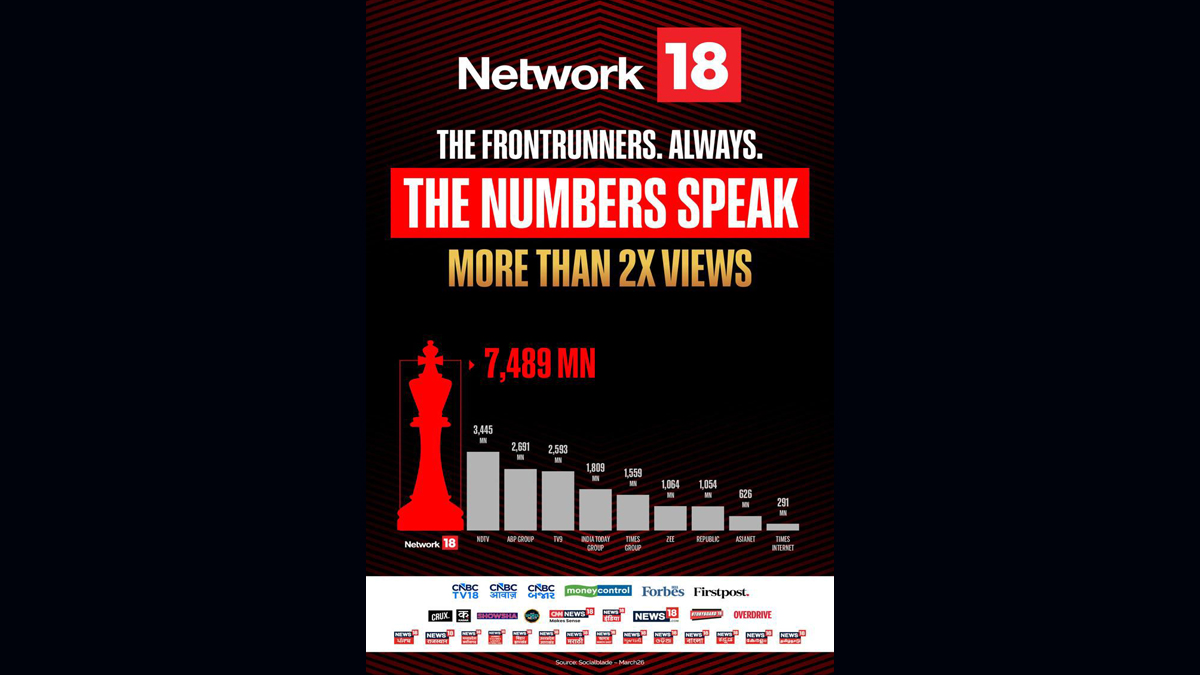
MUMBAI: When the world hit refresh on breaking news, Network18’s channels were already streaming ahead. As geopolitical tensions and war-driven headlines fuelled a surge in global news consumption, the network’s digital playbook delivered big clocking record Youtube viewership across English, Hindi and business news categories in March 2026.
At the forefront was CNN-News18, which emerged as the clear leader in the English news segment with 130 million live and video-on-demand views. The channel edged past competitors such as Times of India (126.5 million), Times Now (101.1 million), India Today (88.2 million) and NDTV (77.5 million), according to Databeings data for March.
In the Hindi news arena, News18 India delivered a commanding performance, racking up a staggering 3,297 million views on YouTube. The channel comfortably outpaced NDTV India, which recorded 3,119 million views, underlining its deep reach and consistent engagement with mass audiences, as per Playboard data.
The network’s dominance wasn’t confined to general news. In the Hindi business segment, CNBC Awaaz topped the charts with 92 million views, narrowly ahead of Zee Business (90 million) and well ahead of ET Now Swadesh (57 million). Meanwhile, its English counterpart CNBC-TV18 posted a strong 58 million views, reinforcing the network’s cross-category strength.
The spike in viewership reflects a broader shift in audience behaviour, with viewers increasingly turning to digital platforms particularly Youtube for real-time updates and in-depth coverage during high-intensity news cycles. For Network18, the numbers signal more than just scale; they underline the effectiveness of a multi-platform strategy that blends speed, credibility and continuous coverage.
In a month where the news never paused, it seems viewers chose to stay tuned where the stream never stopped.






