News Broadcasting
KYOCERA launches new range of color scanners and printers

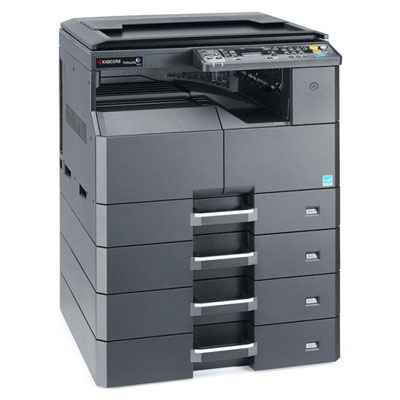
MUMBAI: Kyocera, the leading Japanese document Solutions Company, has announced the launch of four new A3 MFP’s printers and scanners, TASKalfa 1800, TASKalfa 2200, TASKalfa 1801 and TASKalfa 2201 under the brand name Kizuna and is available for Indian market.
As per Kyocera, these new machines are simple to install and work with, and built with superior print and scan elements. Kyocera is renowned to make the most reliable & durable MFP’s, courtesy its patented technology of Amorphous Silicon Drum. Kyocera continues its legacy with the new range of A3 MFP’s which has a Drum life of 1.5 lacs pages(3 times than any other equivalent competition product) & 9-10.5 lac prints of Mainframe/Machine life(Highest in the industry).
Overview of the products:
For the first time, Kyocera has introduced Color Scanning in its Segment 1 machines (20 ppm or below), which ensures flawless digitization of color documents. Each model is equipped with print box feature, a unique application provided with this new range of printers to ensure document security & confidentiality. A user can fire a print and the machine will not execute the Print Command till the User enters a password on the machine. The range comes with a Drum life of 1.5 lacs pages, 3 times than any other equivalent competition product. Being an eco-friendly company, Kyocera has always made a conscious effort to provide the best products with the least environmental impact. The new range of MFP’s, consumes only 385 watts of electricity per hour (printing/copying mode), which is least in the industry for this segment.

Basic Configuration of the machine:
TASKalfa 1800/2200
· 18/22 ppm
· Copy/print/Color Scan
· RAM: 256 MB
· Paper Capacity: 1 x 300 sheets (Standard Tray) + 1 x 100 sheet (Multi purpose Tray)
· Power Consumption: 385/415 watts – Lowest in the Industry
TASKalfa 1801/2201
· 18/22 ppm
· Copy/print/Color Scan
· RAM: 256 MB
· Paper Capacity: 1 x 300 sheets (Standard Tray) +1 x 100 sheet (Multi purpose Tray)
· Power Consumption: 385/415 watts – Lowest in the Industry
· Network Interface (optional)
· Super G3 Fax (Optional)
The TASKalfa 1800, TASKalfa 2200, TASKalfa 1801 and TASKalfa 2201 are available in India from December 2013 with an MRP starting fromRs. 45,000/- to Rs. 1,00,000/- depending on the various enhancements that the customers would be looking for.
Mr. K Swethanarayan, Managing Director, Kyocera Document Solutions India Pvt. Ltd. Said “The new range will help bring balance of suppleness and business sensibility to users in offices and small-medium businesses. We are optimistic of a steady growth this fiscal, and the launch of Kizuna series will help us achieve this.” He further adds, “This new range will enable us to offer unique print solutions equipment to the Indian market that will combine speed and outstanding color into one comprehensive print solution.”


News Broadcasting
Network18 channels lead YouTube news viewership in March 2026
CNN-News18, News18 India and CNBC channels top categories with record views
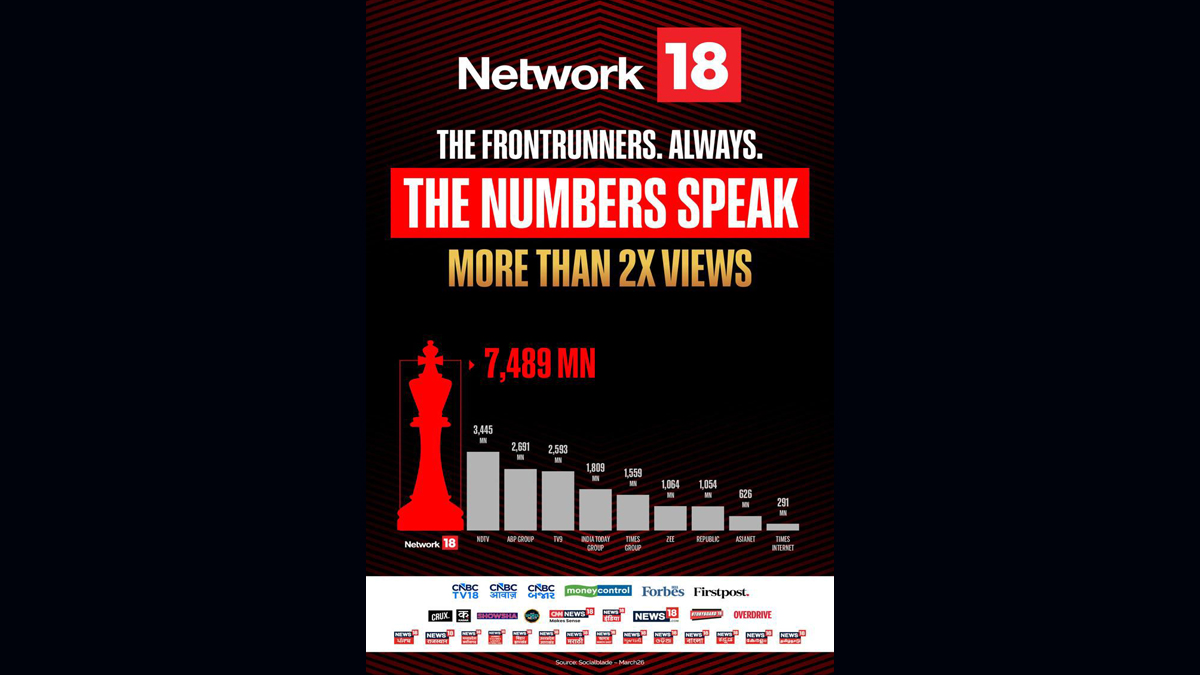
MUMBAI: When the world hit refresh on breaking news, Network18’s channels were already streaming ahead. As geopolitical tensions and war-driven headlines fuelled a surge in global news consumption, the network’s digital playbook delivered big clocking record Youtube viewership across English, Hindi and business news categories in March 2026.
At the forefront was CNN-News18, which emerged as the clear leader in the English news segment with 130 million live and video-on-demand views. The channel edged past competitors such as Times of India (126.5 million), Times Now (101.1 million), India Today (88.2 million) and NDTV (77.5 million), according to Databeings data for March.
In the Hindi news arena, News18 India delivered a commanding performance, racking up a staggering 3,297 million views on YouTube. The channel comfortably outpaced NDTV India, which recorded 3,119 million views, underlining its deep reach and consistent engagement with mass audiences, as per Playboard data.
The network’s dominance wasn’t confined to general news. In the Hindi business segment, CNBC Awaaz topped the charts with 92 million views, narrowly ahead of Zee Business (90 million) and well ahead of ET Now Swadesh (57 million). Meanwhile, its English counterpart CNBC-TV18 posted a strong 58 million views, reinforcing the network’s cross-category strength.
The spike in viewership reflects a broader shift in audience behaviour, with viewers increasingly turning to digital platforms particularly Youtube for real-time updates and in-depth coverage during high-intensity news cycles. For Network18, the numbers signal more than just scale; they underline the effectiveness of a multi-platform strategy that blends speed, credibility and continuous coverage.
In a month where the news never paused, it seems viewers chose to stay tuned where the stream never stopped.






