News Broadcasting
India TV Bihar Conclave set to host the biggest power gathering before state elections

MUMBAI: Riding on a spectacular response, both in terms of numbers & critical acclaim to its special initiatives over the last 2 elections, India TV’s announces the launch of Chunav Manch. This will be a full-day long Mega-Conclave focused on Bihar elections.
The channel that has gained a huge reputation for its top-notch on-ground initiatives over last few years, hold many promises for the avid political watchers & analysts through this initiative. As it is a norm with all India TV events, even this Conclave will be studded with the biggest political names those have direct stakes in these elections.

What makes these elections highly anticipated & a top news event is that many are viewing them as a some sort of a report card to ruling BJP/NDA regime in the centre and others are keen to see how a slightly desperate looking tie-up of various parties ‘with different ideologies’ be able to fare in the litmus test.
While top politicians will discuss & debate their own visions & beliefs and question others’ views for the state, there will be a determined battery of top journalists and top state influencers grilling each of them on issues of genuine importance.
The participants who have so far consented to attend the summit include Bihar CM Nitish Kumar, Former CMs Lalu Prasad Yadav & Jitan Ram Manjhi, BJP President Amit Shah, JD(U) President Sharad Yadav, Union Minister Ravi Shankar Prasad, LJP President Ram Vilas Paswan, Former Deputy CM Sushil Modi, Actor & BJP Leader Shatrughan Sinha, Actor & BJP MP Manoj Tiwari amongst others.
The Conclave, which is set to be the biggest power gathering before Bihar Elections, is slated for tomorrow, 22nd September 2015. The proceedings shall telecast live & exclusive on India TV from Patna’s Hotel Maurya.






News Broadcasting
UDF poised to return to power in Kerala, says Manorama-CVoter survey
Massive opinion poll projects shift in Kerala politics ahead of 2026 Assembly elections.
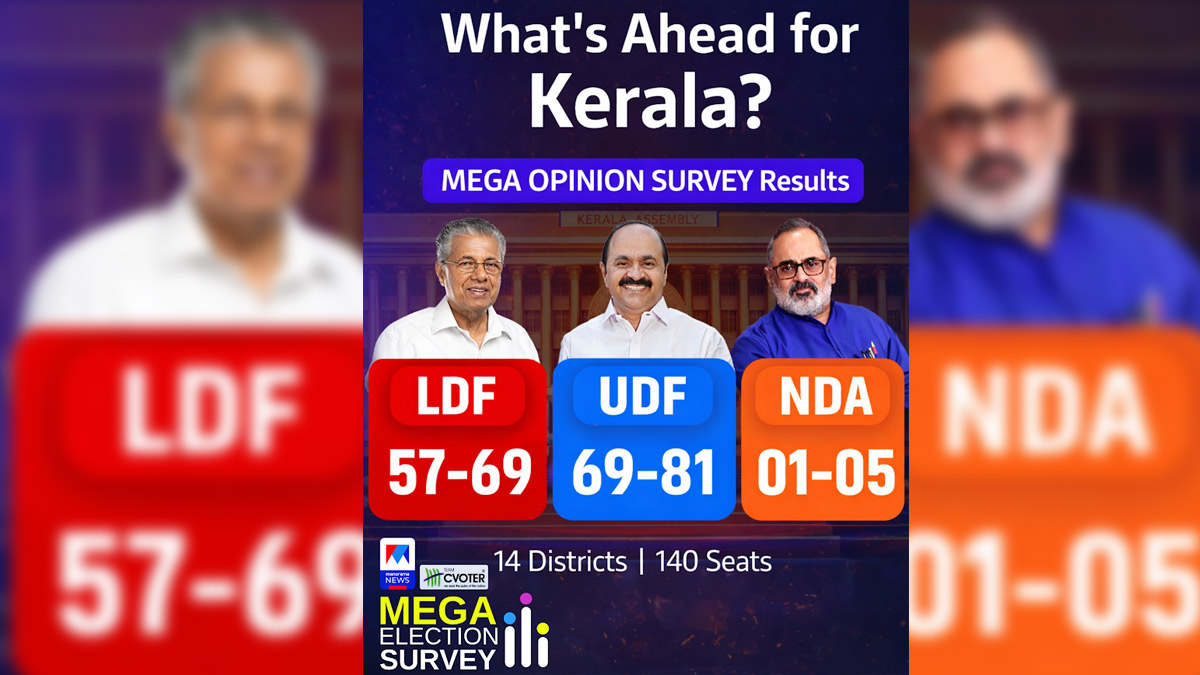
MUMBAI: The winds of change appear to be blowing through Kerala’s political landscape and this time, they seem to favour the United Democratic Front. A comprehensive mega opinion survey conducted by Manorama News in partnership with CVoter projects a potential comeback for the UDF in the upcoming Kerala Legislative Assembly Elections 2026. The survey, covering all 140 constituencies with a massive sample size of nearly 90,000 respondents, predicts the UDF could win between 69 and 81 seats.
The ruling Left Democratic Front (LDF) is expected to secure 57 to 69 seats, a significant drop from the 99 seats it won in the 2021 elections. This would mean the LDF losing 30 to 42 of its sitting seats. Meanwhile, the National Democratic Alliance (NDA), which drew a blank in 2021, is projected to open its account with 1 to 5 seats.
Region-wise, the UDF is expected to make strong gains in Malabar, winning 25 to 34 out of 48 seats, and in Central Kerala, where it could bag 29 to 33 out of 53 seats. In South Kerala, the LDF is likely to retain an edge with 21 to 25 seats, while the UDF may improve to 12 to 16 seats. The NDA could pick up 1 to 3 seats in the southern region.
The survey was conducted between 14 and 26 March 2026, with additional tracker and snap polls carried out from December 2025 to March 2026. A total of 89,693 respondents participated, ensuring representation across all demographics and social segments.
Manorama News has a strong track record of accuracy, with its previous projections closely matching the actual results of the 2019 and 2024 Lok Sabha elections as well as the 2021 Kerala Assembly polls.
In Kerala’s famously fierce political battles, this survey suggests the pendulum may be swinging back. Whether the final verdict matches these numbers or throws up another surprise, one thing is clear, the 2026 Assembly elections are shaping up to be one of the most keenly watched contests in the state’s history.






