News Broadcasting
India Today forecast — bang on, as always!


NEW DELHI – Elections can be unpredictable for political parties. Their results aren't for the India Today Group.
As every other media outlet faltered in its forecast of Haryana and Maharashtra elections, the India Today-Axis-My-India exit poll delivered the most accurate picture of around 11 crore voters in the two states.
HARYANA

Almost all other pollsters and TV stations were unanimous in predicting a sweep by the BJP in Haryana, led by Chief Minister Manohar Lal Khattar.
But it was the India Today-Axis-My-India exit poll that hit the bull's-eye, forecasting anywhere between 32 and 44 for the ruling party. Based on face-to-face interviews with voters across 90 constituencies, with a sample size of 23,118, the India Today-Axis-My-India Today survey foresaw the Congress ranks swelling in the range of 30-42 seats, up from 15 five years ago.
It gave the Dushyant Chautala-led Jannayak Janta Party (JJP), a breakaway faction of the Indian National Lok Dal (INLD), between and six and ten seats.
By Thursday evening, at time of writing, actual results were much the same as India Today's predictions — the BJP led successfully in 40, the Congress in 30 and the JJP in 10 constituencies.
Other pollsters, however, weren't really able to capture the voter pulse in Haryana accurately. In its exit poll, Republic-Jan Ki Baat had given the BJP 52-63 and the Congress between 15 and 19 seats. According to News18-IPSOS, the ruling party was poised to secure 75 and the Congress 10. ABP-CVoter charts indicated 72 for the BJP and eight for the Congress. Times Now predicted 71 for Khattar's party and 11 for the Congress led by Bhupinder Singh Hooda, the Leader of Opposition,
MAHARASHTRA
In Maharashtra, the actual outcome came closest to the India Today-Axis-My-India's predictions for the BJP-Shiv Sena alliance unlike several other pollsters forecasting a landslide for the ruling coalition.
According to the India Today-Axis-My-India survey, the BJP-Sena alliance was projected to secure between 166 and 194 seats and the NCP-Congress combine from 72 to 90.
By Thursday evening, election results at time of writing showed the ruling coalition leading successfully in 159 of the state's 288 constituencies and the NCP-Congress combine in 105.
Contrast this with exit polls executed by other players.
Times Now had predicted 230 seats for the BJP-Shiv Sena and 48 for the NCP-Congress together. Republic-Jan Ki Baat had forecast 216-230 for the governing alliance and 52-59 for the opposition. The News18-IPSOS gave as high as 243 to the BJP-Shiv Sena and as less as 41 seats to the NCP-Congress alliance in Maharashtra.
According to ABP-CVoter, the BJP-Sena were projected to win 204 and the opposition combine 69.
"I think getting the exit poll right again, especially against popular belief, separates news channels from propaganda channels," said Kalli Purie, Vice Chairperson, India Today Group. "It's our approach on ground reporting and non-alignment that we were able to read data with a level of understanding. And doing it in Haryana elections, where the margin on so many seats was so slim, is a validation of the scientific and thorough approach of Axis," the Vice Chairperson said.
INCREDIBLE TRACK RECORD
Of all the elections that took place in India between 2013 and 2019, India Today-Axis My India post-poll surveys have given the most accurate predictions in 95 per cent of the cases.
Since 2013, Axis My India has conducted 38 post-poll surveys, of which 36 have been spot on.
Conducting the largest exit poll for the world's largest democracy the 2019 general elections, the India Today-Axis My India exit poll, for instance, predicted 339-365 seats for the BJP-led NDA and 77-108 seats for the UPA in the new Lok Sabha. The actual results weren't different — the NDA got 352 and the UPA 92 seats in the lower house of parliament.
Axis-My-India chief Pradeep Gupta attributed his successful predictions to team work and scientific monitoring of voter behaviour. "We follow international best practices. Our methodology is highly refined that helps us eliminate margins of error," he explained. "Our sampling is the most demographically representative in any given election. We closely, and continuously, monitor voter mood and intent."







News Broadcasting
UDF poised to return to power in Kerala, says Manorama-CVoter survey
Massive opinion poll projects shift in Kerala politics ahead of 2026 Assembly elections.
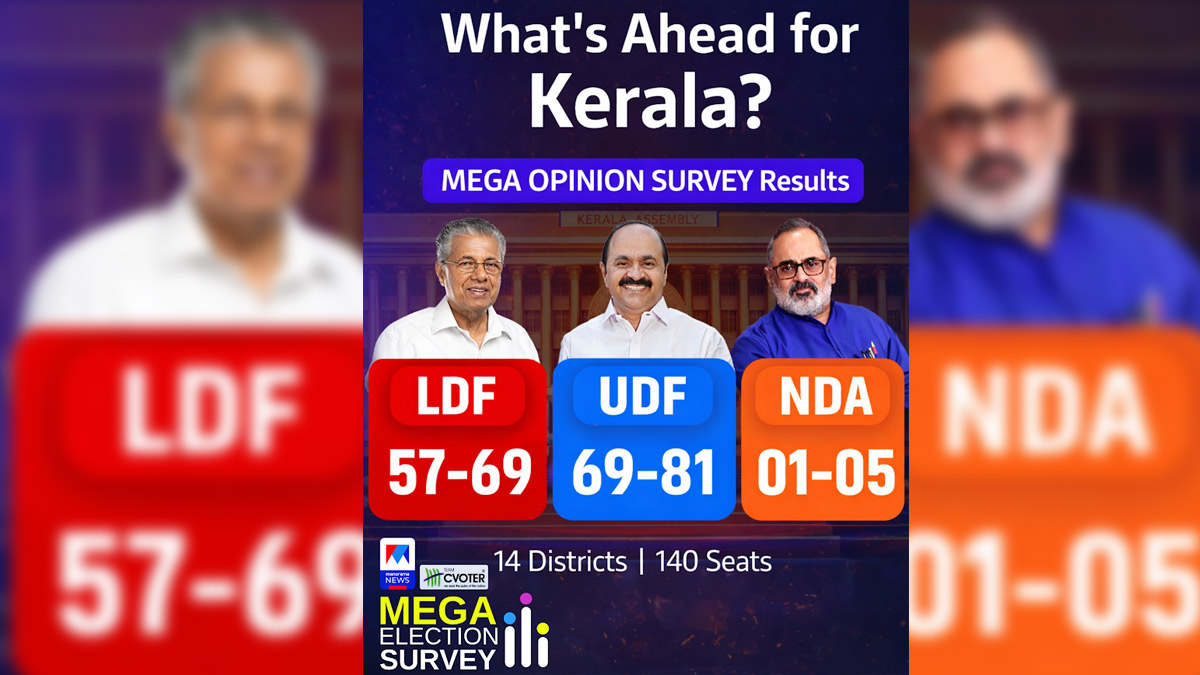
MUMBAI: The winds of change appear to be blowing through Kerala’s political landscape and this time, they seem to favour the United Democratic Front. A comprehensive mega opinion survey conducted by Manorama News in partnership with CVoter projects a potential comeback for the UDF in the upcoming Kerala Legislative Assembly Elections 2026. The survey, covering all 140 constituencies with a massive sample size of nearly 90,000 respondents, predicts the UDF could win between 69 and 81 seats.
The ruling Left Democratic Front (LDF) is expected to secure 57 to 69 seats, a significant drop from the 99 seats it won in the 2021 elections. This would mean the LDF losing 30 to 42 of its sitting seats. Meanwhile, the National Democratic Alliance (NDA), which drew a blank in 2021, is projected to open its account with 1 to 5 seats.
Region-wise, the UDF is expected to make strong gains in Malabar, winning 25 to 34 out of 48 seats, and in Central Kerala, where it could bag 29 to 33 out of 53 seats. In South Kerala, the LDF is likely to retain an edge with 21 to 25 seats, while the UDF may improve to 12 to 16 seats. The NDA could pick up 1 to 3 seats in the southern region.
The survey was conducted between 14 and 26 March 2026, with additional tracker and snap polls carried out from December 2025 to March 2026. A total of 89,693 respondents participated, ensuring representation across all demographics and social segments.
Manorama News has a strong track record of accuracy, with its previous projections closely matching the actual results of the 2019 and 2024 Lok Sabha elections as well as the 2021 Kerala Assembly polls.
In Kerala’s famously fierce political battles, this survey suggests the pendulum may be swinging back. Whether the final verdict matches these numbers or throws up another surprise, one thing is clear, the 2026 Assembly elections are shaping up to be one of the most keenly watched contests in the state’s history.






