News Broadcasting
Dainik Bhaskars eco-friendly initiative Mitti Ke Ganesh receives overwhelming response across India

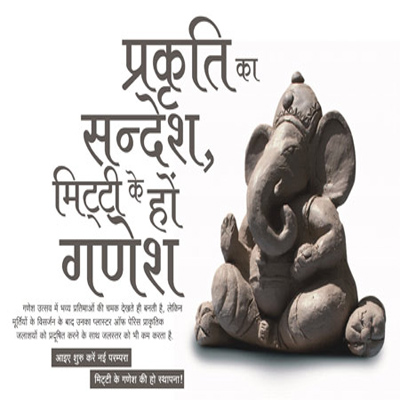
Dainik Bhaskar’s new eco-friendly initiative ‘Mitti Ke Ganesh’ has received an overwhelming response from its readers across the country.
During the just concluded Ganesh Utsav, through this environment friendly campaign readers were appealed to bring home Lord Ganesha’s idols made only of clay. This activity was intended to motivate people to not bring idols made of plaster of paris, which after immersion contaminates our water resources. Dainik Bhaskar readers were also urged to not immerse idols in local natural water bodies. They were encouraged to conduct immersions at their respective homes in a water container, and use this water to water their gardens or flower pots at home.

This was a Pan-India editorial and print campaign, covering 13 states and reaching more than 4.41 crore people.
Commenting on the success of this initiative, Mr. Prashant Kalyani, VP, Brand Marketing (National), Dainik Bhaskar Group said, “The Dainik Bhaskar Group has always taken the lead in social initiatives that contribute towards positive changes in our daily lives. In line with this tradition this year we launched the ‘Mitti Ke Ganesh’ campaign during the immensely popular “Ganesh Utsav” festivities. Religious leaders of various sects also joined this initiative and supported the cause. To further augment this message Dainik Bhaskar through its editions carried thoughts of these religious leaders explaining the merits of ‘Mitti ke Ganesh’.
This initiative not only enabled us to contribute towards protection of our environment, but also ensured that religious sentiments of people are duly respected. We are glad that we were successful in motivating people and the initiative received a overwhelming positive response from all sections of society.”






News Broadcasting
Network18 channels lead YouTube news viewership in March 2026
CNN-News18, News18 India and CNBC channels top categories with record views

MUMBAI: When the world hit refresh on breaking news, Network18’s channels were already streaming ahead. As geopolitical tensions and war-driven headlines fuelled a surge in global news consumption, the network’s digital playbook delivered big clocking record Youtube viewership across English, Hindi and business news categories in March 2026.
At the forefront was CNN-News18, which emerged as the clear leader in the English news segment with 130 million live and video-on-demand views. The channel edged past competitors such as Times of India (126.5 million), Times Now (101.1 million), India Today (88.2 million) and NDTV (77.5 million), according to Databeings data for March.
In the Hindi news arena, News18 India delivered a commanding performance, racking up a staggering 3,297 million views on YouTube. The channel comfortably outpaced NDTV India, which recorded 3,119 million views, underlining its deep reach and consistent engagement with mass audiences, as per Playboard data.
The network’s dominance wasn’t confined to general news. In the Hindi business segment, CNBC Awaaz topped the charts with 92 million views, narrowly ahead of Zee Business (90 million) and well ahead of ET Now Swadesh (57 million). Meanwhile, its English counterpart CNBC-TV18 posted a strong 58 million views, reinforcing the network’s cross-category strength.
The spike in viewership reflects a broader shift in audience behaviour, with viewers increasingly turning to digital platforms particularly Youtube for real-time updates and in-depth coverage during high-intensity news cycles. For Network18, the numbers signal more than just scale; they underline the effectiveness of a multi-platform strategy that blends speed, credibility and continuous coverage.
In a month where the news never paused, it seems viewers chose to stay tuned where the stream never stopped.






