English Entertainment
Comic José Covaco Experiences The First Day First Show Feeling At Home With An Exciting New Line Up of Hollywood Premieres On &flix


Amid the current lockdown with limited out-door entertainment choices, there are certain experiences that we surely reminisce – one such being the First Day First Show feeling. For the ultimate Hollywood buffs, there’s something truly exhilarating about anticipating your favourite blockbusters and witnessing it first, before anyone else! The good news is that not every exciting experience needs to come to a halt in the new normal. In &flix’s latest film shot at home featuring ace stand-up comedian José Covaco, the channel delights viewers with the First Day First Show feeling at home, even before America.
Unveiling this striking campaign shot at home, &flix captures the immersive experience for Hollywood buffs who are missing the cherished First Day First Show feeling at home. The film depicts a series of everyday relatable scenarios with a quirky twist and the absolute ecstasy of witnessing the First Day First Show of the most-awaited Hollywood blockbusters at home. The video opens with José waking up to a neatly pressed outfit by his bedside. As he makes his way to his kitchen, he opens the microwave to find a ready bowl brimming with popcorn. “Something special is happening or what?” exclaims José as he receives a premiere ticket by &flix for an exclusive First Day First Show. The video culminates into José settling for the cinematic extravaganza as he gears up for the Flix First Premiere on &flix.
With its marquee property #FlixFirstBeforeAmerica, &flix truly empowers its viewers to experience Hollywood like never before with back-to-back premieres of the biggest blockbusters such as Spider-Man: Far From Home, MIB: International and Once Upon A Time In… Hollywood among others. Through this disruptive offering, the channel reduces the wait for Hollywood’s top-rated movies to premiere on television by almost half, bringing fans closer to their favourite Hollywood heroes on television, even before America! With back-to-back premieres of Jumanji: The Next Level, Bad Boys For Life and Fantasy Island slated to air between June to August, the channel truly takes the First Day First Show experience to the next level with viewers witnessing Hollywood’s biggest heroes in action, in the language of their choice.

Commenting on the same, Kartik Mahadev, Business Head, Premium Cluster, ZEEL said, “The long wait for Hollywood movies from their theatrical release to premiere on television stood out as a consumer challenge in the English movies genre that we wanted to address. It brings us great joy to have crunched the waiting period for movie premieres on TV by nearly half, thus ensuring movie enthusiasts witness the biggest Hollywood premieres within months from release. This new campaign brings an exciting line up of premieres as an extension to the #FlixFirstBeforeAmerica campaign that was launched with the World Television Premiere of MIB: International. We are thrilled for the movie fans to be able to watch these movies in current times where we haven’t seen a big movie release in a few months.
Today, with limited out-of-home entertainment avenues, people are truly craving a big adventure movie experience. This became the central idea in this fun new campaign film, to bring to life the anticipation and excitement of a First Day First Show from the comfort of your home. It was fantastic collaborating with José Covaco on this campaign, as he so effortlessly took on the task of shooting the film himself at his home.”
Speaking about the film, Aaditya Vazé, Content Director, Flux @ The Glitch said, “Our collective current circumstances made us question whether we would be able to pull it off and do justice in our endeavour to bring smiles on the faces of viewers. But when a bunch of heads sit together and are really driven and united to make something happen, such challenges become mere puzzles that we absolutely love solving. From writing brainstorms to tech recces, every piece of the puzzle evolved along the way, with technology becoming our framework.
Shout out to José for adding the laughers both on and off screen, without which this would not have been such a memorable feat. He not only kept the idea alive but also lent his own unique lens to this tricky self-shot asset.
This film is particularly special because it touches upon the feeling of missing out these experiences during the current lockdown, while reminding us that some things will always be a constant.”
The campaign is running across TV and digital.

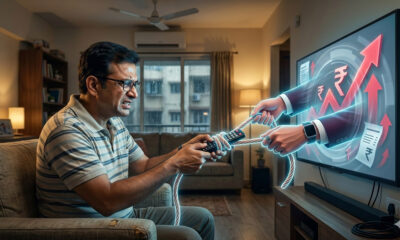




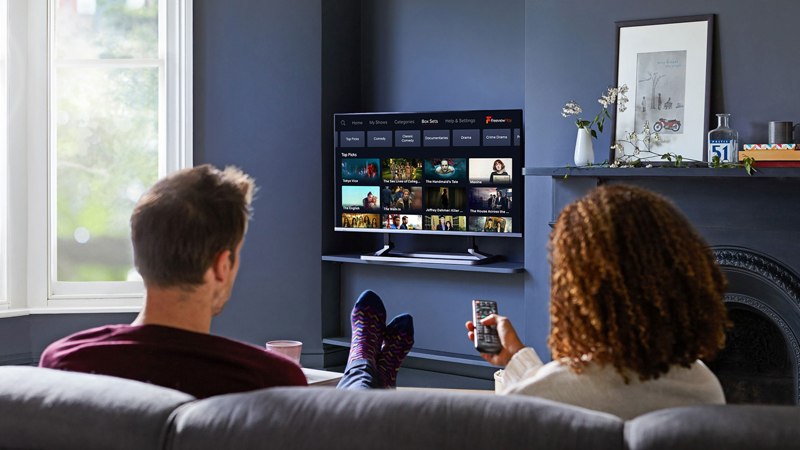
UK: The aerial is losing its grip. As broadband becomes the default way Britons watch television, the UK is edging towards a decisive, and divisive, question: should Freeview be switched off by 2034? The issue, highlighted in reporting by The Guardian, has exposed deep fault lines over access, affordability and the future of public service broadcasting.
For nearly 25 years, Freeview has delivered free-to-air television from the BBC, ITV, Channel 4 and Channel 5 to almost every corner of the country. Even now, it remains the UK’s largest TV platform, used in more than 16m homes and on around 10m main household sets. Yet the same broadcasters that built it are now pressing for its closure within eight years.
Their case rests on a structural shift in viewing. Smart TVs, superfast broadband and the Netflix-led streaming boom have pulled audiences online. Advertising economics have followed. By 2034, the number of homes using Freeview as their main TV set is forecast to fall from a peak of almost 12m in 2012 to fewer than 2m, making digital terrestrial television, or DTT, increasingly costly to sustain.
But critics say the rush to switch off risks abandoning those least able, or least willing, to move online.
“I don’t want to be choosing apps and making new accounts,” says Lynette, 80, from Kent. “It is time-consuming and irritating trying to work out where I want to be, to remember the sequence of clicks, with hieroglyphics instead of words. If I make a mistake I have to start again.”
Lynette is among nearly 100,000 people who have signed a “save Freeview” petition launched by campaign group Silver Voices. She fears the government is about to “take [Freeview] away from me and others who either don’t like, can’t afford, or can’t use online versions”.
Official figures underline the fault lines. A report commissioned by the Department for Culture, Media and Sport estimates that by 2035, 1.8m homes will still depend on Freeview. Ofcom’s analysis shows those households are more likely to be disabled, older, living alone, female, and based in the north of England, Wales, Scotland and Northern Ireland.
Freeview is owned by the public service broadcasters through Everyone TV, which also operates Freesat and the newer streaming platform Freely. After two years of review, DCMS is expected to set out its position soon, drawing on three options proposed by Ofcom: a costly upgrade of Freeview’s ageing technology; maintaining a bare-bones service with only core PSB channels; or a full switch-off during the 2030s.
The broadcasters have rallied behind the third option. They argue that 2034 is the logical cut-off, when transmission contracts with network operator Arqiva expire. By then, they say, the cost of broadcasting to a dwindling audience will far outweigh the returns from TV advertising.
Ofcom agrees a crunch point is approaching. In July, the regulator warned of a “tipping point” within the next few years, after which it will no longer be commercially viable for broadcasters to carry the costs of DTT.
Others see risks beyond economics. Questions remain over whether internet TV can reliably deliver emergency broadcasts, such as the daily Covid updates, in the way that universally available DTT can. The UK radio industry has also warned that an internet-only future for TV could push up distribution costs and force some radio stations off air if PSBs no longer share Arqiva’s mast network.
“It is a political hot potato,” says Dennis Reed, founder of Silver Voices, who says he has “dissociated” his organisation from the government’s stakeholder forum, which he believes is “heavily biased” towards streaming.
The Future TV Taskforce, representing the PSBs, counters that moving online could “close the digital divide once and for all”. “We want to be able to plan to ensure that no one is left behind,” a spokesperson says, adding that rising DTT costs could otherwise mean cuts to programme budgets.
The numbers show the scale of the challenge. Of the 1.8m Freeview-dependent homes projected for 2035, around 1.1m are expected to have broadband but not use it for TV. The remaining 700,000 are forecast to lack a broadband connection altogether.
Veterans of the analogue switch-off, completed in 2012 after 76 years, recall similar fears of “TV blackout chaos”. Around 6 per cent of households were labelled “digital refuseniks”, yet a targeted help scheme and a national campaign, fronted by a robot called Digit Al voiced by Matt Lucas, delivered a largely smooth transition.
This time, the BBC is less keen to foot the bill. Tim Davie, the outgoing director general, has said the corporation should not fund a comparable support programme for a Freeview switch-off.
Research for Sky by Oliver & Ohlbaum suggests that with early awareness campaigns and digital inclusion measures, only about 330,000 households would ultimately need hands-on help ahead of a 2034 shutdown.
Meanwhile, viewing habits continue to fragment. Audience body Barb says 7 per cent of UK households no longer own a TV set, choosing to watch on other devices. In December, YouTube overtook the BBC’s combined channels in total UK viewing across TVs, smartphones and tablets, albeit measured at a minimum of three minutes.
That shift may accelerate. YouTube has recently blocked Barb and its partner Kantar from accessing viewing session data, limiting transparency just as online platforms consolidate power.
“When the government chose British Satellite Broadcasting as the ‘winner’ in satellite TV it was Rupert Murdoch’s Sky instead that came out on top,” says a senior TV executive quoted by The Guardian. “There already is such an outsider ready to be the winner in the transition to internet TV; it is YouTube.”
Freeview’s future now hangs on a familiar British dilemma: modernise fast and risk exclusion, or protect universality and pay the price. Either way, the aerial’s days as king of the living room look numbered.