News Broadcasting
Come and meet Ganeshas friend glittering with LED lights


MUMBAI: It is that time of year when the atmosphere is reverberated with the chants of ‘Bappa Moraya’ and praise of Lord Ganesha. Ganesh Utsav, a 10 day long festival begins with Ganesh Chaturthi, the birthday of the Hindu Lord of prosperity and good fortune. Devotees leave no stone unturned to create unique and eye-catching puja pandals every year. Continuing with its tradition of innovative lighting for the Pandals, Philips Electronics India Limited, the country’s leading provider of lighting solutions, creates a 9ft high and 6 ? ft wide unique and energy efficient statue of ‘Mushak’ by using 1100 LED lights.
Mr. Sumit Joshi, Sr. Director, Marketing, Philips Lighting India, said, “The LalbaugchaRaja Mandal being one of the most popular puja pandals during the Ganesh Utsav, it is visited by approximately 80 lakhs devotees who need to stand in a long queue for Darshan. With the ‘Mushak’ being lighted up with LED lights, devotees can have the immediate Darshan of the Mushak who is also known as the friend of Lord Ganesha.”

The Mushak created with 1100 LED bulbs, will be 96% more energy efficient when compared to the normal incandescent bulbs and CFLs which are normally used in pandaals / mandals during festive occasions. Ganesh Utsav which started on 9th September will culminate on 18th September 2013.




News Broadcasting
Network18 channels lead YouTube news viewership in March 2026
CNN-News18, News18 India and CNBC channels top categories with record views
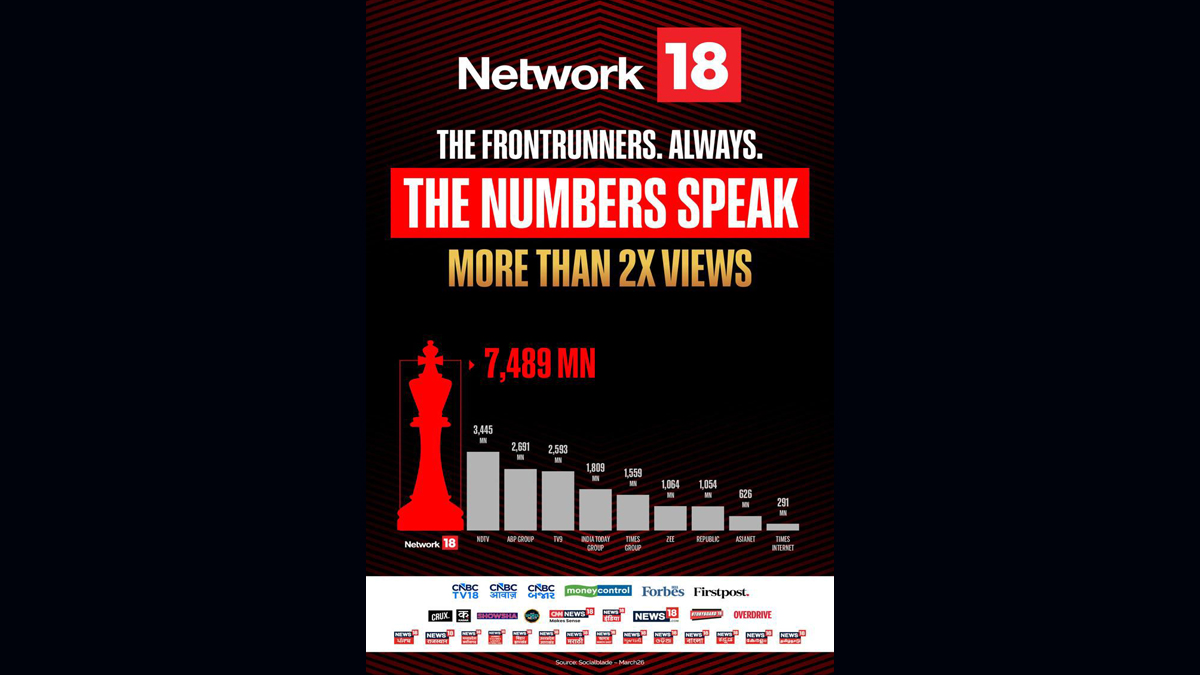
MUMBAI: When the world hit refresh on breaking news, Network18’s channels were already streaming ahead. As geopolitical tensions and war-driven headlines fuelled a surge in global news consumption, the network’s digital playbook delivered big clocking record Youtube viewership across English, Hindi and business news categories in March 2026.
At the forefront was CNN-News18, which emerged as the clear leader in the English news segment with 130 million live and video-on-demand views. The channel edged past competitors such as Times of India (126.5 million), Times Now (101.1 million), India Today (88.2 million) and NDTV (77.5 million), according to Databeings data for March.
In the Hindi news arena, News18 India delivered a commanding performance, racking up a staggering 3,297 million views on YouTube. The channel comfortably outpaced NDTV India, which recorded 3,119 million views, underlining its deep reach and consistent engagement with mass audiences, as per Playboard data.
The network’s dominance wasn’t confined to general news. In the Hindi business segment, CNBC Awaaz topped the charts with 92 million views, narrowly ahead of Zee Business (90 million) and well ahead of ET Now Swadesh (57 million). Meanwhile, its English counterpart CNBC-TV18 posted a strong 58 million views, reinforcing the network’s cross-category strength.
The spike in viewership reflects a broader shift in audience behaviour, with viewers increasingly turning to digital platforms particularly Youtube for real-time updates and in-depth coverage during high-intensity news cycles. For Network18, the numbers signal more than just scale; they underline the effectiveness of a multi-platform strategy that blends speed, credibility and continuous coverage.
In a month where the news never paused, it seems viewers chose to stay tuned where the stream never stopped.






