English Entertainment
COLORS INFINITY bolsters local productions with OPPO presents TOP MODEL INDIA powered by RENAULT CAPTUR

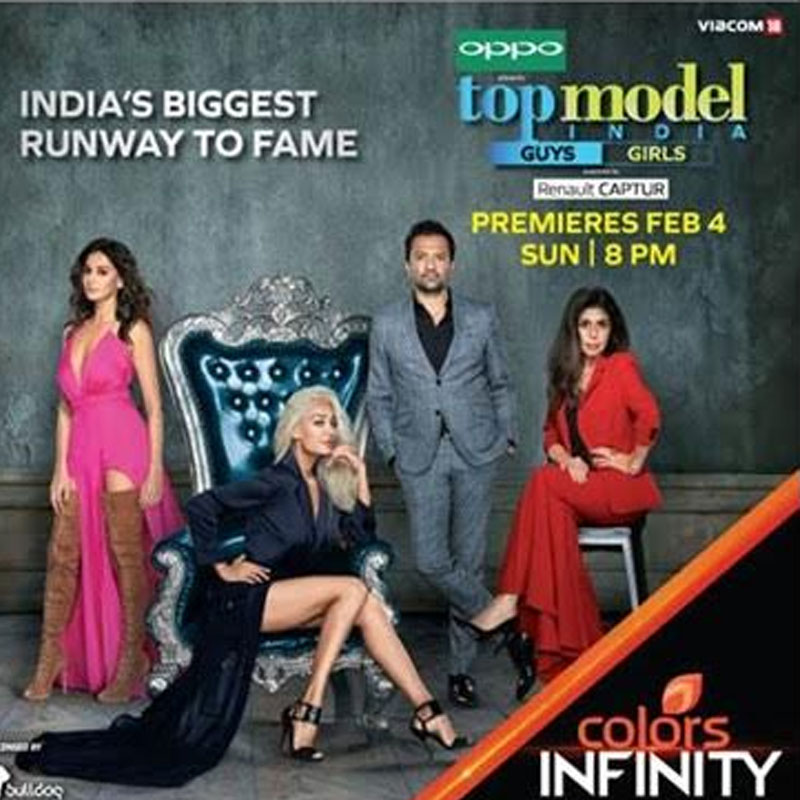
COLORS INFINITY, creator of some of the most beloved and successful homegrown English entertainment content in India is all set to foray into the world of Fashion and Lifestyle entertainment with TOP MODEL INDIA. OPPO presents TOP MODEL INDIA powered by Renault CAPTUR is all set to present a plush ramp, to showcase talent and break all the stereotypes starting this Sunday 4th February 2018 at 8 pm only on COLORS INFINITY. The show is poised to be a unique platform that will take viewers through the transformation of 12 aspiring models into supermodels under the expert guidance of judges Lisa Haydon, Atul Kasbekar, Anaita Shroff Adajania and mentor Shibani Dandekar.
The stakes will be high, as the country’s most influential fashion icons will choose the winner of TOP MODEL INDIA from amongst 12 ambitious models. While the ravishing supermodel Lisa Haydon will shed light on modeling techniques and walking the thin line between art and fashion, ace photographer Atul Kasbekar will explain the nuances required to grace the cover of a fashion magazine. Styling empress Anaita Shroff Adajania will helm the show with her impeccable fashion counsel. The gorgeous Shibani Dandekar will tie it all in, as she mentors the contestants on their emotionally charged journey down the most difficult runway. The crème de la crème of the fashion industry like Mickey Boardman, Manish Malhotra, Kunal Rawal and many more, will also grace the show to impart their styling and grooming wisdom.
Breaking barriers in the fashion industry, the show will witness male and female contestants battling it out amongst each other to grab the most coveted title, as the ultimate winner prepares to take over the world’s fashion runway. The winner will be bestowed with a contract with the prestigious Bling! Entertainment Solutions that has a rich legacy of working with some of the top celebrities in the Indian entertainment industry like Deepika Padukone, Vidya Balan, Jacqueline Fernandez, Shahid Kapoor, Sonam Kapoor and many more. In addition to launching their career, the contestants will also have a chance to shoot with the world-class fashion photographer Atul Kasbekar.

Elaborating on the show, Viacom18, Head – Youth, Music and English Entertainment, Ferzad Palia said “COLORS INFINITY has always been the thought-leader in creating content that viewers would enjoy, ranging from original productions to international programming. This platform will not only showcase the latest international fashion trends but also recognize Indian talent. Gauging the warm response from our sponsors and the wider fraternity, we are confident that TOP MODEL INDIA will be well received by our viewers too.”
“We are proud to be presenting sponsors for TOP MODEL INDIA. As a brand, OPPO has always been focusing on the youth, offering them unique experiences and being a part of their lives. Thus, TOP MODEL INDIA is the perfect platform for OPPO to connect with the youth, take them closer to their dreams and help them create memories via technologically advanced and innovative camera phones”, said Will Yang, Brand Director, OPPO India.
Renault India, Head Marketing, Virat Khullar added “We are extremely glad to associate with COLORS INFINITY for the premiere season of TOP MODEL INDIA. Renault CAPTUR and TOP MODEL INDIA’s synergies match perfectly as they are both focused on encouraging incredible style and great capability. Renault CAPTUR is a new age SUV with Global success. This collaboration has been an enriching experience and we look forward for an exuberant response from the audience.”
CBS Studios International has licensed the India format rights for the reality competition series AMERICA’S NEXT TOP MODEL to Mumbai-based Bulldog Media & Entertainment. The English language version of the franchise promises the same excitement and anticipation as the international format that continues to be a worldwide success.
“AMERICA’S NEXT TOP MODEL” has taken the world by storm, with the original show now in its 24th season and under license in over 100 markets and 20 international versions in production.
International Formats | CBS Studios International, Vice President, Roxanne Pompa said, “We are thrilled to be working with Bulldog and Colors Infinity to launch the first season of the English version of TOP MODEL INDIA. With the Hindi version of Top Model being so successful on MTV, producing this new English version is a natural extension of Top Model brand in India.”
Bulldog Media & Entertainment, Co-Founder & Executive Producer, Akash Sharma said, “I’m moved and inspired by the intensity of the ‘INTM’ fan base whose passion for the show triggered the launch of TOP MODEL INDIA for an international audience. The ‘America’s Next Top Model’ format continues to entertain audiences all around the world and we are excited to have the opportunity to see the English language version make its debut in India. It is a show that is all about transformation & competition with the customary ‘Top Model’ style, glamour, and entertainment for viewers to enjoy.”
To amplify the debut of this one-of-its-kind platform, COLORS INFINITY has mounted a multi-pronged pan-India campaign. Besides high-decibel traditional and digital media, the campaign boasts of disruptive partnerships with pioneering brands and fashion authorities. The channel has also partnered with JW Marriott Sahar as the venue partner and PETA to support their effort in preventing cruelty against animals in fashion.
Strut and Swish as OPPO presents TOP MODEL INDIA powered by Renault CAPTUR is all set to dazzle you on COLORS INFINITY on Sunday, 4th February 2018 at 8 PM.




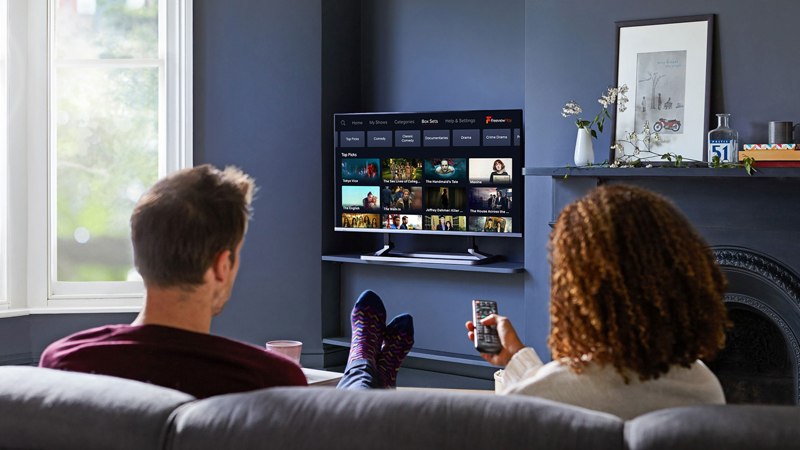
UK: The aerial is losing its grip. As broadband becomes the default way Britons watch television, the UK is edging towards a decisive, and divisive, question: should Freeview be switched off by 2034? The issue, highlighted in reporting by The Guardian, has exposed deep fault lines over access, affordability and the future of public service broadcasting.
For nearly 25 years, Freeview has delivered free-to-air television from the BBC, ITV, Channel 4 and Channel 5 to almost every corner of the country. Even now, it remains the UK’s largest TV platform, used in more than 16m homes and on around 10m main household sets. Yet the same broadcasters that built it are now pressing for its closure within eight years.
Their case rests on a structural shift in viewing. Smart TVs, superfast broadband and the Netflix-led streaming boom have pulled audiences online. Advertising economics have followed. By 2034, the number of homes using Freeview as their main TV set is forecast to fall from a peak of almost 12m in 2012 to fewer than 2m, making digital terrestrial television, or DTT, increasingly costly to sustain.
But critics say the rush to switch off risks abandoning those least able, or least willing, to move online.
“I don’t want to be choosing apps and making new accounts,” says Lynette, 80, from Kent. “It is time-consuming and irritating trying to work out where I want to be, to remember the sequence of clicks, with hieroglyphics instead of words. If I make a mistake I have to start again.”
Lynette is among nearly 100,000 people who have signed a “save Freeview” petition launched by campaign group Silver Voices. She fears the government is about to “take [Freeview] away from me and others who either don’t like, can’t afford, or can’t use online versions”.
Official figures underline the fault lines. A report commissioned by the Department for Culture, Media and Sport estimates that by 2035, 1.8m homes will still depend on Freeview. Ofcom’s analysis shows those households are more likely to be disabled, older, living alone, female, and based in the north of England, Wales, Scotland and Northern Ireland.
Freeview is owned by the public service broadcasters through Everyone TV, which also operates Freesat and the newer streaming platform Freely. After two years of review, DCMS is expected to set out its position soon, drawing on three options proposed by Ofcom: a costly upgrade of Freeview’s ageing technology; maintaining a bare-bones service with only core PSB channels; or a full switch-off during the 2030s.
The broadcasters have rallied behind the third option. They argue that 2034 is the logical cut-off, when transmission contracts with network operator Arqiva expire. By then, they say, the cost of broadcasting to a dwindling audience will far outweigh the returns from TV advertising.
Ofcom agrees a crunch point is approaching. In July, the regulator warned of a “tipping point” within the next few years, after which it will no longer be commercially viable for broadcasters to carry the costs of DTT.
Others see risks beyond economics. Questions remain over whether internet TV can reliably deliver emergency broadcasts, such as the daily Covid updates, in the way that universally available DTT can. The UK radio industry has also warned that an internet-only future for TV could push up distribution costs and force some radio stations off air if PSBs no longer share Arqiva’s mast network.
“It is a political hot potato,” says Dennis Reed, founder of Silver Voices, who says he has “dissociated” his organisation from the government’s stakeholder forum, which he believes is “heavily biased” towards streaming.
The Future TV Taskforce, representing the PSBs, counters that moving online could “close the digital divide once and for all”. “We want to be able to plan to ensure that no one is left behind,” a spokesperson says, adding that rising DTT costs could otherwise mean cuts to programme budgets.
The numbers show the scale of the challenge. Of the 1.8m Freeview-dependent homes projected for 2035, around 1.1m are expected to have broadband but not use it for TV. The remaining 700,000 are forecast to lack a broadband connection altogether.
Veterans of the analogue switch-off, completed in 2012 after 76 years, recall similar fears of “TV blackout chaos”. Around 6 per cent of households were labelled “digital refuseniks”, yet a targeted help scheme and a national campaign, fronted by a robot called Digit Al voiced by Matt Lucas, delivered a largely smooth transition.
This time, the BBC is less keen to foot the bill. Tim Davie, the outgoing director general, has said the corporation should not fund a comparable support programme for a Freeview switch-off.
Research for Sky by Oliver & Ohlbaum suggests that with early awareness campaigns and digital inclusion measures, only about 330,000 households would ultimately need hands-on help ahead of a 2034 shutdown.
Meanwhile, viewing habits continue to fragment. Audience body Barb says 7 per cent of UK households no longer own a TV set, choosing to watch on other devices. In December, YouTube overtook the BBC’s combined channels in total UK viewing across TVs, smartphones and tablets, albeit measured at a minimum of three minutes.
That shift may accelerate. YouTube has recently blocked Barb and its partner Kantar from accessing viewing session data, limiting transparency just as online platforms consolidate power.
“When the government chose British Satellite Broadcasting as the ‘winner’ in satellite TV it was Rupert Murdoch’s Sky instead that came out on top,” says a senior TV executive quoted by The Guardian. “There already is such an outsider ready to be the winner in the transition to internet TV; it is YouTube.”
Freeview’s future now hangs on a familiar British dilemma: modernise fast and risk exclusion, or protect universality and pay the price. Either way, the aerial’s days as king of the living room look numbered.






