News Broadcasting
ABP News-CSDS surveys castes’ intent: Pro-incumbency sentiment prevails in Gujarat

MUMBAI: It’s going to take no less than a gargantuan effort on the part of the Congress party to defeat the Bharatiya Janata Party in the Gujarat Assembly elections due to take place at the end of the year. An opinion poll conducted in the state by Lokniti-CSDS for ABP News, finds the ruling BJP, which has been in power in Gujarat for the last two decades, to be way ahead of the Congress.
BJP seems to gain over last assembly elections held in 2012 under the leadership of then Chief Minister Narendra Modi. Like in other parts of India, Congress in losing out base in Gujarat as well. According to the opinion poll BJP is expected to get close to 150 seats in 182 member assembly.
As things stand right now, the upcoming election of Gujarat appears like a ‘no-contest’ with the BJP leading its arch-rival by over 30 percentage points in terms of people’s voting intention. Close to three in every five (59 per cent) randomly sampled voters said that they would vote for the BJP if state elections were to take place now. Only about one in three (29 per cent) were found to be rooting for the Congress. This means that the BJP has thus far managed to retain the level of support it received in the 2014 Lok Sabha election and the Congress slid.

According to the poll, BJP’s sweep is witnessed all over Gujarat and in all regions of the state. Best performance is in Saurashtra and Kutch regions where BJP is expected to get 65 percent votes against Congress’s 26 percent votes. *Source: Lokniti-CSDS Gujarat Pre-election Tracker Survey 2017, Round 1.
In fact, at the moment, there seems to be no major challenger to Vijay Rupani for the position of the chief minister within or outside the BJP. In response to an open-ended question on chief ministerial preference, 24 percent of the voters said they would like to see Rupani back at the helm whereas most of the voters took no name.
The survey found a sentiment of pro-incumbency to be prevailing in Gujarat. In Kutch and Saurashtra about 54 per cent feel the present BJP government should continue.
Contrary to popular analysis, the recent agitation by some Patel leaders demanding OBC status does not seem to have dented the BJP’s popularity among its voters, the Patels. With nearly three in every four voters belonging to the dominant community, they are still supporting the party. Other than holding on to its core voters, the BJP seems to have also made some serious inroads among the old voting bloc of the Congress – Kshatriyas, Dalits, Tribals and Muslims – politically known as KHAM.
Voting intentions of castes and communities: BJP consolidates base and makes gains.

About 70 percent of the voters said they were satisfied with the performance of the State BJP government during the last five years. Though as the survey suggests, the percentage of satisfied respondents is high although it has dropped from 77 percent to 69 percent somewhat since last survey in May.
According to the survey, the prime minister Narendra Modi’s already high popularity in the state has grown further over the last four years. In the state he ruled for three terms, he is the most liked leader at 82 per cent, followed by with ruling CM Rupani at 73 per cent. While the star of Patidar Andolan, Hardik Patel happens to be the most disliked at 46 per cent.
As per the survey, one in every five Congress voters sympathizes with Vaghela and nearly half refused to take a position on the Vaghela issue. Around 20 per cent Congress voters believe he rightly moved out of the party which disrespected him. Whereas 34 per cent voters of Congress feel that he betrayed the party just before the polls.
According to the survey, most voters were found to be highly supportive of both demonetization (55 percent) and the introduction of the Goods and Services Tax (GST – 38 percent), and also quite satisfied with the way they were implemented.

This analysis is based on the first round of the pre-election tracker survey conducted in Gujarat by Lokniti, Centre for the Study of Developing Societies (CSDS), Delhi, for ABP News. The survey was conducted from 9 August through 16 August, 2017 among 4090 voters in 200 locations (polling stations) spread across 50 assembly constituencies (the State has a total of 182 assembly constituencies).





News Broadcasting
Network18 channels lead YouTube news viewership in March 2026
CNN-News18, News18 India and CNBC channels top categories with record views
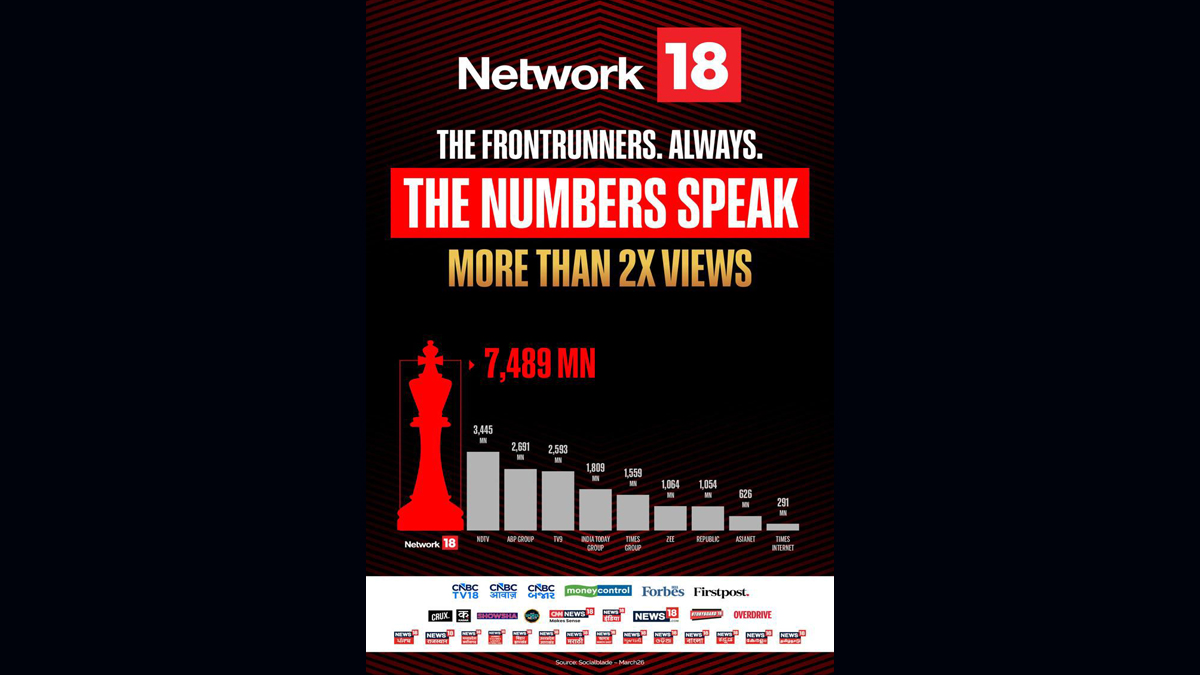
MUMBAI: When the world hit refresh on breaking news, Network18’s channels were already streaming ahead. As geopolitical tensions and war-driven headlines fuelled a surge in global news consumption, the network’s digital playbook delivered big clocking record Youtube viewership across English, Hindi and business news categories in March 2026.
At the forefront was CNN-News18, which emerged as the clear leader in the English news segment with 130 million live and video-on-demand views. The channel edged past competitors such as Times of India (126.5 million), Times Now (101.1 million), India Today (88.2 million) and NDTV (77.5 million), according to Databeings data for March.
In the Hindi news arena, News18 India delivered a commanding performance, racking up a staggering 3,297 million views on YouTube. The channel comfortably outpaced NDTV India, which recorded 3,119 million views, underlining its deep reach and consistent engagement with mass audiences, as per Playboard data.
The network’s dominance wasn’t confined to general news. In the Hindi business segment, CNBC Awaaz topped the charts with 92 million views, narrowly ahead of Zee Business (90 million) and well ahead of ET Now Swadesh (57 million). Meanwhile, its English counterpart CNBC-TV18 posted a strong 58 million views, reinforcing the network’s cross-category strength.
The spike in viewership reflects a broader shift in audience behaviour, with viewers increasingly turning to digital platforms particularly Youtube for real-time updates and in-depth coverage during high-intensity news cycles. For Network18, the numbers signal more than just scale; they underline the effectiveness of a multi-platform strategy that blends speed, credibility and continuous coverage.
In a month where the news never paused, it seems viewers chose to stay tuned where the stream never stopped.






