News Broadcasting
ZMCL reports more than quadruple profit for second quarter


BENGALURU: The Essel group’s television news broadcasting arm Zee Media Corporation Ltd (ZMCL) reported a 355.1 per cent growth (more than four-fold) in consolidated profit after tax (PAT) for the period ended 30 September 2018 (Q2 2019, quarter or period under review) as compared (year-on-year comparison, y-o-y) to the corresponding year ago quarter (Q2 2018, year ago quarter). PAT in Q2 2019 was Rs 17.25 crore as compared to Rs 3.79 crore in Q2 2018. ZMCL reported operating EBITDA at Rs 40.5 crore in Q2 2019, which was 355.1 per cent more than the Rs 3.79 crore in Q2 2018.
The company’s consolidated operating revenue increased 35.5 per cent y-o-y in Q2 2019 at Rs 168.66 crore as compared to Rs 124.51 crore in the year ago quarter. Total income increased 34.7 per cent y-o-y in Q2 2019 to Rs 170.66 crore from Rs 126.71 crore in Q2 2018.
In its earnings release ZMCL reported 34.5 per cent y-o-y growth in advertising revenue for Q 2019 at Rs 149.43 crore from Rs 111.10 crore. Subscription revenue increased 11.8 per cent y-o-y to Rs 13.1 crore in Q2 2019 from Rs 10.73 crore. Other sales and services also almost quadrupled (increased by 3.6 times) in Q2 2019 to Rs 6.11 crore from Rs 1.68 core in the corresponding year ago quarter.

Let us look at the other numbers reported by ZMCL
ZMCL’s total expenditure in Q2 2019 increased 31.2 per cent y-o-y to Rs 144.78 crore from Rs 110.37 crore. Employee benefits expense in the quarter under review increased 20.3 per cent y-o-y to Rs 37.36 crore from Rs 31.06 crore in Q2 2018. The company’s marketing promotion and distribution expenses in Q2 2019 increased 47.7 per cent to Rs 23.03 crore from Rs 15.59 crore in the corresponding year ago quarter.
Operating costs in Q2 2019 increased 25.9 per cent to Rs 24.49 crore from Rs 19.45 crore. Other expenses in Q2 2019 increased 35.5 per cent to Rs 42.91 crore from Rs 31.66 crore in Q2 2018.
It may be noted that ZMCL has sold its entire equity stake in Ez-Mall Online to a related party at an aggregate consideration of Rs 8.60 crore. Accordingly, Ez-Mall Online ceased to be a subsidiary of ZMCL with effect from 30 June 2018 and gain on disposal of investments of approximately Rs 41.21 crore has been recognised during the previous quarter and shown as exceptional items. Also, during the previous quarter, ZMCL completed acquisition of balance 40 per cent equity stake in its subsidiary Zee Akaash News Private Ltd (ZANPL). Accordingly, ZANPL became a wholly owned subsidiary of the company with effect from 1 June, 2018 and figures for the current quarter are not comparable with previous periods presented in the consolidated financial results says the company.







News Broadcasting
Network18 channels lead YouTube news viewership in March 2026
CNN-News18, News18 India and CNBC channels top categories with record views
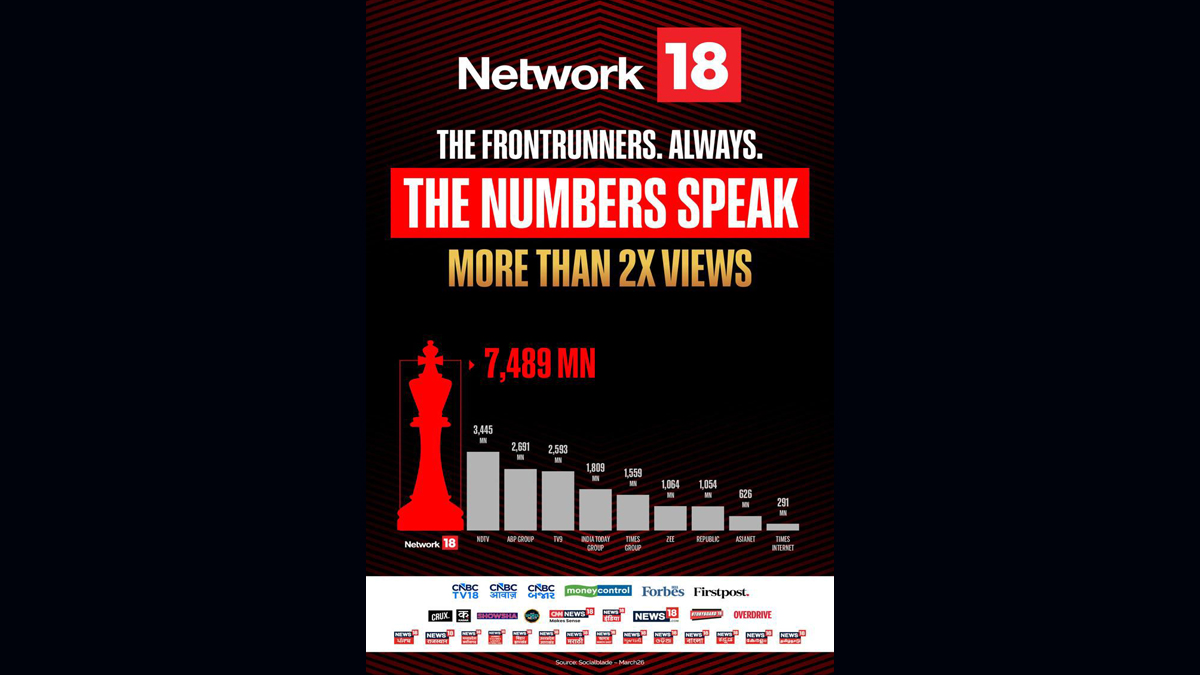
MUMBAI: When the world hit refresh on breaking news, Network18’s channels were already streaming ahead. As geopolitical tensions and war-driven headlines fuelled a surge in global news consumption, the network’s digital playbook delivered big clocking record Youtube viewership across English, Hindi and business news categories in March 2026.
At the forefront was CNN-News18, which emerged as the clear leader in the English news segment with 130 million live and video-on-demand views. The channel edged past competitors such as Times of India (126.5 million), Times Now (101.1 million), India Today (88.2 million) and NDTV (77.5 million), according to Databeings data for March.
In the Hindi news arena, News18 India delivered a commanding performance, racking up a staggering 3,297 million views on YouTube. The channel comfortably outpaced NDTV India, which recorded 3,119 million views, underlining its deep reach and consistent engagement with mass audiences, as per Playboard data.
The network’s dominance wasn’t confined to general news. In the Hindi business segment, CNBC Awaaz topped the charts with 92 million views, narrowly ahead of Zee Business (90 million) and well ahead of ET Now Swadesh (57 million). Meanwhile, its English counterpart CNBC-TV18 posted a strong 58 million views, reinforcing the network’s cross-category strength.
The spike in viewership reflects a broader shift in audience behaviour, with viewers increasingly turning to digital platforms particularly Youtube for real-time updates and in-depth coverage during high-intensity news cycles. For Network18, the numbers signal more than just scale; they underline the effectiveness of a multi-platform strategy that blends speed, credibility and continuous coverage.
In a month where the news never paused, it seems viewers chose to stay tuned where the stream never stopped.






