English Entertainment
ZEEL’s Kartik Mahadev on Zee Café strategy, BBC First block, post-NTO campaigns


MUMBAI: English entertainment channels were feared to face the most challenging time in the NTO phase. ZEEL English Cluster Business Head Kartik Mahadev informs that initially there was a period of flux at ground level but increasing awareness of the MRP regime through campaigns has helped the subscription numbers to grow steadily. #WhereIsMyChannel campaign during transition period of NTO has resulted in an increase of subscription number for the Zee english cluster HD channels, with &flixHD reaching amongst the top two English movies HD channels.
Mahadev spoke to Indiantelevision.com on strategies, campaigns, NTO impact, challenges faced by English entertainment channels and upcoming programmes on Zee Café.
Can you tell us about Zee Café’s TV-First strategy and how does it work?

Our viewers have a keen eye for content that is new. They follow the latest trends and seek the same when it comes to their content consumption preferences. With Zee Café, it has been our constant endeavour to provide the newest and the best shows to our viewers. With over 70% of our content being available on TV first even before the digital platforms, our discerning audience gets to witness the most-recent shows that are making a mark across the globe. Unlike other broadcasters, this TV-First approach of Zee Café has truly enabled us to serve as disruptors in the category. Shows such as American Idol, Battlebots, Seal Team, FBI, A Million Little Things, Charmed, are success stories of this approach, which have been extremely well-received by our viewers. This season, with BBC First too, we brought six shows to India for the first time only on television screens first. This is a format that truly works well with our loyal audience.
It has been three years since the channel launched BBC First in association with BBC Studios, how has your association been so far? How has the programming block BBC First grown over the years?
In a category homogenised by American content, we took a differentiated approach by launching British dramas in 2017. This was widely appreciated by our viewers. In the week of its launch for both seasons, the TSV of the 10 pm time band doubled. The slot viewership in the 2018 season increased by 50%. We generated a total of 50 million impressions on digital with our respective hashtags trending in the last two seasons, along with increasing the channel reach by over 100%. Over the last two years, the block has been immensely appreciated by our viewers who consider it an evolved choice of consumption. British dramas gratified the voracious appetite of our audience and garnered a positive response across mediums. With the highest brand resonance for our viewers, BBC First has truly become the flagship property for the channel. The third season upheld this legacy and met with immense positive reception with a 5X increase in viewership as compared to four weeks before the launch for the 10 pm time slot.
Brief us on #ShakenAndStirred campaign.
Our viewers are evolved, motivated and have a global outlook. They are on the constant look-out for what is new and different along with meaningful engagements. With an abundance of content at their disposal now, it becomes more important than ever to communicate in a way that they feel this is for them. This year’s BBC First block provides our audience a point of deep connection with stories that are powerful and visceral through the shows which are a part of the block. Keeping this is mind, Zee Café took a differentiated approach and launched the campaign #ShakenAndStirred. Through the campaign for BBC First we wanted to bring alive the compelling drama and strong characters that leave a lasting impression on the viewer. The quintessential British phrase, shaken and stirred, emerged as the creative thought as it best describes the impact that the unpredictable British dramas would leave on our viewers.
The idea was to bring out the uniqueness of each of these contemporary dramas, making it relevant to the Indian viewer. So, we collaborated with an authority in drama – Nawazuddin Siddiqui. Bringing in a local connect with his quintessential demeanour, an excited Nawazuddin, sharing his anticipation for British dramas that promise to leave you not just shaken but also stirred. Collaborating with Nawazuddin Siddiqui helped us build engaging and conversational communication, building a strong point of view for the brand. This truly reflects in the way the campaign was received across platforms with immense positive feedback from readers who appreciated the creative effort.
Which mediums were used for #ShakenAndStirred campaign?
We launched the #ShakenAndStirred campaign across on-air and digital platforms and amplified the same through media communication. The aim was to build conversations around British dramas and the unique promo featuring Nawazuddin Siddiqui enabled us to amplify the announcement. Further, as part of the launch, we also engaged with the fans through an exclusive preview clip of Brexit: The Uncivil War which was shared on Zee Café’s social handle, one hour before the on-air telecast. Together, all the activities paved the way for a high-decibel launch of the third season of BBC First.
How has the responses from advertisers been, on this property?
While the block has resonated well with our loyal audience, we’ve always managed to partner with some of the most reputable brands who’ve equally appreciated our endeavour. Over the three seasons, we have had brands such as Prestige, Dominos, Hershey’s, L’Oreal, Phillips, and Vicks with most as recurring sponsors on the BBC First block.
How do you see the growth of English Entertainment channels in Indian market, post NTO?
The English category on television has been growing steadily over a period of time. In last three years (pre-NTO), the viewership on English GEC genre has grown almost 2.5 times, while the English movie genre has witnessed a 26% growth in viewership and 28% growth in reach, as per BARC India data. Any big change is ought to have teething problems and NTO was no different, as it initially brought a period of flux at ground-level with consumers and distributors being confused about the regime. Largely, channel packs were being picked more on the basis of DPO suggestions. Six months on, we have observed that with increasing awareness of the MRP regime, the subscription numbers are steadily growing.
What was the impact of NTO on Zee Café?
One of our recent consumer research studies has reinstated that ‘TV Content is playing a strong role in bringing families together.’ For a lot of urban English consumers, TV is the Go To destination for discovery and effortless viewing. Our studies have suggested that consumers today look for curated content. They don’t want to invest time in trying to decide what best meets their interests. That’s where Zee Café as a channel comes into play. Through the channel's offerings we consistently ensure that all our programming blocks are curated based on audience tastes whether it be a block like BBC First or even Hollywood On Café. For instance, our viewers increasingly look for the latest shows and with our programming block ‘Along With The US’ they get to witness the newest international series that are trending globally and watch it live on Zee Café, before anywhere else. So, the takeaway from this is that the best curators today shall win the game. As per BARC, July 19, AB households, Indian Urban; Zee Café has the highest reach in the category and we are certain that, with growing awareness of the NTO regime, the coming quarter looks promising.
During the transition period of NTO, ZEEL had launched #WhereIsMyChannel campaign for its English Channel cluster. How well did that campaign work?
#WhereIsMyChannel has been successful in driving salience and consideration for the English channels amongst the target audience. Within two weeks, we delivered over 25 million sharp targeted video views with strong engagement rates. The campaign has reached to about 58 million viewers on digital and 41.53 million viewers on TV, for the two ad films. In a competitive category with several brands, the campaign has delivered over 70% ad cut-throughs which is quite strong. The ad campaign is being promoted across Zee Network’s social handles and the TV channels on air. The digital video with RJ Balaji, Mallika Dua and Varun Thakur are also a success indicator for the original films which have become a reference point for other unbranded original renditions to be created.
Overall, it has helped drive subscription for the channel where viewers are now actively involved in the decision-making process. The campaign as also resulted in increased subscription for the Zee English Cluster HD channels, with &flixHD reaching amongst the top two English Movie HD Channels. With increasing awareness of the MRP regime, the subscription numbers are steadily growing.
What are the challenges faced by English Entertainment channels?
One of the biggest challenges in the ecosystem undoubtedly has been the NTO. While the English audience is highly involved in their content choices, they were not used to making the purchase decision and typically, the more affluent households would buy subscription annually. Today, there is ~90% awareness about the change, however there was a need to help consumers through the decision funnel, helping them make an active and informed choice. Hence, we launched the #WhereIsMyChannel campaign encouraging consumers towards becoming more active in making a purchase decision for International entertainment on television. Post NTO, we have observed that viewers are now adding premium packs and upgrading to HD channels. This has bolstered English Entertainment as our HD channels have seen a steady growth in subscription.
Advertisers have spent their major chunk on Sports channels and News channels in the first half of 2019. How do you see the second half of the year especially for niche channels?
English category caters to a unique set of influential and aspirational audiences, through its high- quality content. At Zee English Cluster, over the years, we have garnered a unique loyal audience base that consistently supports our channels which truly reflects in our movie channels &flixHD and &Privé HD having ranked number 2 and 1 respectively in their category. Premium brands across automobile, telecom, BFSI and FMCG, amongst many other categories, have over the years found a great fit with this category.
Especially since most of the English content available on OTT has the paywall limitation, brands who want to exclusively target English category, majorly look to associate with this content, come on TV. To reach out to our affluent viewers, they have partnered with us on impact campaigns to drive perception and recall. Moreover, during peak in sports tournaments, television itself witnesses an overall growth in viewers which in turn elevates the viewership of entertainment channels as well. This year &flix launched a campaign #FlixMovieLeague to support the spirit of the sporting events in the country. So, it goes without saying that English category will continue to serve as the best platform for advertisers to reach out to the relevant audience.
What are the new programming launches on Zee Café?
With the festive fervour, we are bringing two of our flagship properties on Zee Café namely – Along With The US and Hollywood On Café as part of our festive offering to viewers. Last year, in its 2018 edition, Along With The US grew the 7PM – 10PM slot viewership by 52% (as per BARC, NCCS AB 15-40-Megacities). This year, with present the latest seasons of both popular favourites like Grey’s Anatomy and Supergirl, and new shows such as Carol’s Second Act and The Unicorn we are extremely thrilled to take it a notch up. Moreover, we are truly proud of a property like Hollywood On Café that brings the scale and grandeur of Hollywood on television. As part of the block last year, shows such as The Sinner and The Night Manager witnessed an increase in slot viewership by 55% and 75% respectively. This year, with a collection of shows such as LA’s Finest and The Son we have truly raised the bar and are certain that the festive line-up with resonate well with our discerning audience.




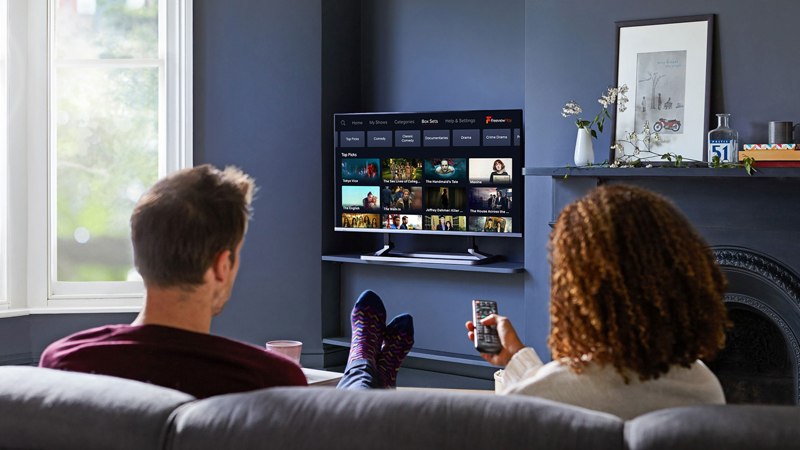
UK: The aerial is losing its grip. As broadband becomes the default way Britons watch television, the UK is edging towards a decisive, and divisive, question: should Freeview be switched off by 2034? The issue, highlighted in reporting by The Guardian, has exposed deep fault lines over access, affordability and the future of public service broadcasting.
For nearly 25 years, Freeview has delivered free-to-air television from the BBC, ITV, Channel 4 and Channel 5 to almost every corner of the country. Even now, it remains the UK’s largest TV platform, used in more than 16m homes and on around 10m main household sets. Yet the same broadcasters that built it are now pressing for its closure within eight years.
Their case rests on a structural shift in viewing. Smart TVs, superfast broadband and the Netflix-led streaming boom have pulled audiences online. Advertising economics have followed. By 2034, the number of homes using Freeview as their main TV set is forecast to fall from a peak of almost 12m in 2012 to fewer than 2m, making digital terrestrial television, or DTT, increasingly costly to sustain.
But critics say the rush to switch off risks abandoning those least able, or least willing, to move online.
“I don’t want to be choosing apps and making new accounts,” says Lynette, 80, from Kent. “It is time-consuming and irritating trying to work out where I want to be, to remember the sequence of clicks, with hieroglyphics instead of words. If I make a mistake I have to start again.”
Lynette is among nearly 100,000 people who have signed a “save Freeview” petition launched by campaign group Silver Voices. She fears the government is about to “take [Freeview] away from me and others who either don’t like, can’t afford, or can’t use online versions”.
Official figures underline the fault lines. A report commissioned by the Department for Culture, Media and Sport estimates that by 2035, 1.8m homes will still depend on Freeview. Ofcom’s analysis shows those households are more likely to be disabled, older, living alone, female, and based in the north of England, Wales, Scotland and Northern Ireland.
Freeview is owned by the public service broadcasters through Everyone TV, which also operates Freesat and the newer streaming platform Freely. After two years of review, DCMS is expected to set out its position soon, drawing on three options proposed by Ofcom: a costly upgrade of Freeview’s ageing technology; maintaining a bare-bones service with only core PSB channels; or a full switch-off during the 2030s.
The broadcasters have rallied behind the third option. They argue that 2034 is the logical cut-off, when transmission contracts with network operator Arqiva expire. By then, they say, the cost of broadcasting to a dwindling audience will far outweigh the returns from TV advertising.
Ofcom agrees a crunch point is approaching. In July, the regulator warned of a “tipping point” within the next few years, after which it will no longer be commercially viable for broadcasters to carry the costs of DTT.
Others see risks beyond economics. Questions remain over whether internet TV can reliably deliver emergency broadcasts, such as the daily Covid updates, in the way that universally available DTT can. The UK radio industry has also warned that an internet-only future for TV could push up distribution costs and force some radio stations off air if PSBs no longer share Arqiva’s mast network.
“It is a political hot potato,” says Dennis Reed, founder of Silver Voices, who says he has “dissociated” his organisation from the government’s stakeholder forum, which he believes is “heavily biased” towards streaming.
The Future TV Taskforce, representing the PSBs, counters that moving online could “close the digital divide once and for all”. “We want to be able to plan to ensure that no one is left behind,” a spokesperson says, adding that rising DTT costs could otherwise mean cuts to programme budgets.
The numbers show the scale of the challenge. Of the 1.8m Freeview-dependent homes projected for 2035, around 1.1m are expected to have broadband but not use it for TV. The remaining 700,000 are forecast to lack a broadband connection altogether.
Veterans of the analogue switch-off, completed in 2012 after 76 years, recall similar fears of “TV blackout chaos”. Around 6 per cent of households were labelled “digital refuseniks”, yet a targeted help scheme and a national campaign, fronted by a robot called Digit Al voiced by Matt Lucas, delivered a largely smooth transition.
This time, the BBC is less keen to foot the bill. Tim Davie, the outgoing director general, has said the corporation should not fund a comparable support programme for a Freeview switch-off.
Research for Sky by Oliver & Ohlbaum suggests that with early awareness campaigns and digital inclusion measures, only about 330,000 households would ultimately need hands-on help ahead of a 2034 shutdown.
Meanwhile, viewing habits continue to fragment. Audience body Barb says 7 per cent of UK households no longer own a TV set, choosing to watch on other devices. In December, YouTube overtook the BBC’s combined channels in total UK viewing across TVs, smartphones and tablets, albeit measured at a minimum of three minutes.
That shift may accelerate. YouTube has recently blocked Barb and its partner Kantar from accessing viewing session data, limiting transparency just as online platforms consolidate power.
“When the government chose British Satellite Broadcasting as the ‘winner’ in satellite TV it was Rupert Murdoch’s Sky instead that came out on top,” says a senior TV executive quoted by The Guardian. “There already is such an outsider ready to be the winner in the transition to internet TV; it is YouTube.”
Freeview’s future now hangs on a familiar British dilemma: modernise fast and risk exclusion, or protect universality and pay the price. Either way, the aerial’s days as king of the living room look numbered.