News Broadcasting
ZEEL expands to Indonesia, launches Zee Bioskop


MUMBAI: Of late, Zee Entertainment Enterprises Limited (ZEEL) has been making headlines for its expansion plans the world over. It isn’t just taking the existing channels from India to the international market but is also coming up with new channels to cater to the local people of the countries they want to reach out to. In the present case, they have done just that.
In order to expand in the south East Asia market, it has launched a movie channel in Indonesia, aptly titled Zee Bioskop (Bioskop means cinema in Bahasa, the local language of the country). The last time Zee introduced a channel in this region was five years ago – Zee Variasi in Malaysia, again a local Bollywood movie channel.

Zee Bioskop, which has been launched today, is currently available only on Aora TV as a pay channel and is beaming off satellite Measat 3a. With the tagline – ‘Bollywood Banget’, which means ‘bollywood excessively’, the channel will showcase the best of Bollywood movies dubbed in Bahasa Indonesian.
An official announcement about the launch will be made in January in Jakarta, the capital, where the office of Zee Bioskop is located. As of now, the officials are working on increasing the distribution of the channel.
Since Indonesia is the world’s fourth most populous country with not too many movie theatres showing Bollywood movies, the company is trying to cash in on the situation. “Our focused study group showed that Indonesians wanted to watch Bollywood movies and with Bioskop we are targeting the local audience and not the Indians in Indonesia,” says a highly placed source from Zee.
Bioskop will air comedy, action, thriller, drama and romantic movies. Activities on Facebook and Twitter have already started to promote the channel. “This initiative is going to make not just Zee but also Bollywood movies popular in the Indonesian market,” says the source.
Movies like Delhi 6, Shaitan, Aa Dekhen Zara, Oh My God, Vivaah, Love Story 2050 etc are in the current line-up. The channel will come under the APac area and will be headed by Asia-Pacific business head Sushruta Samanta. There are other Zee channels already present in the region since many years.






News Broadcasting
Network18 channels lead YouTube news viewership in March 2026
CNN-News18, News18 India and CNBC channels top categories with record views
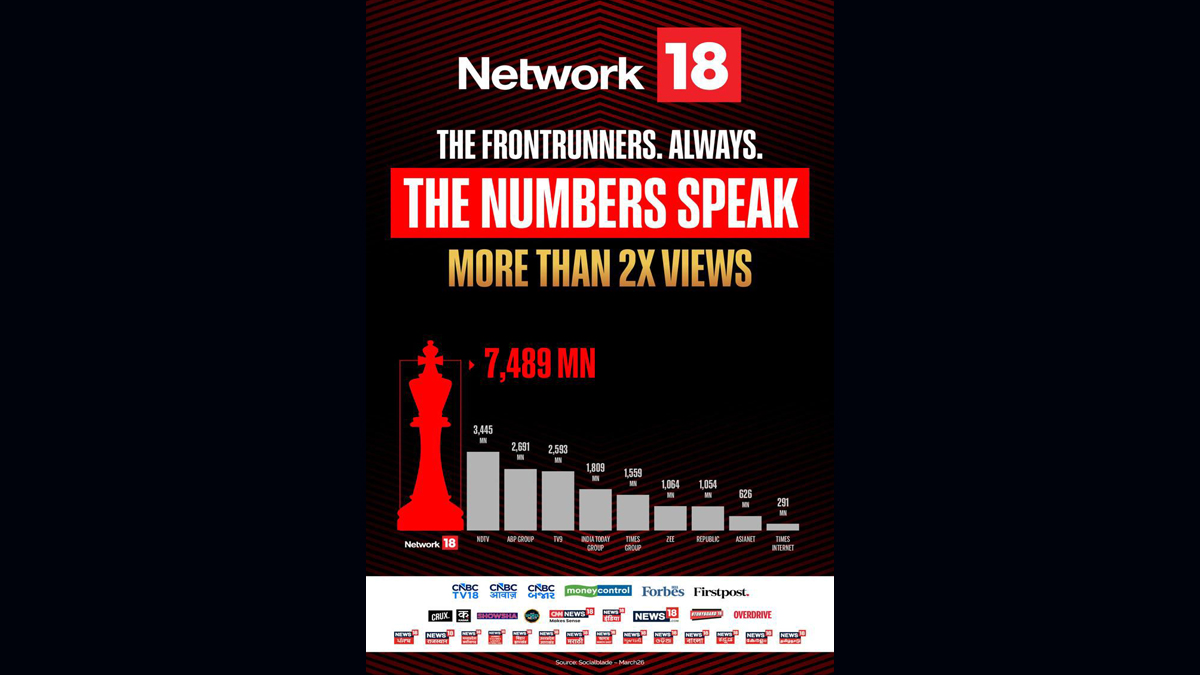
MUMBAI: When the world hit refresh on breaking news, Network18’s channels were already streaming ahead. As geopolitical tensions and war-driven headlines fuelled a surge in global news consumption, the network’s digital playbook delivered big clocking record Youtube viewership across English, Hindi and business news categories in March 2026.
At the forefront was CNN-News18, which emerged as the clear leader in the English news segment with 130 million live and video-on-demand views. The channel edged past competitors such as Times of India (126.5 million), Times Now (101.1 million), India Today (88.2 million) and NDTV (77.5 million), according to Databeings data for March.
In the Hindi news arena, News18 India delivered a commanding performance, racking up a staggering 3,297 million views on YouTube. The channel comfortably outpaced NDTV India, which recorded 3,119 million views, underlining its deep reach and consistent engagement with mass audiences, as per Playboard data.
The network’s dominance wasn’t confined to general news. In the Hindi business segment, CNBC Awaaz topped the charts with 92 million views, narrowly ahead of Zee Business (90 million) and well ahead of ET Now Swadesh (57 million). Meanwhile, its English counterpart CNBC-TV18 posted a strong 58 million views, reinforcing the network’s cross-category strength.
The spike in viewership reflects a broader shift in audience behaviour, with viewers increasingly turning to digital platforms particularly Youtube for real-time updates and in-depth coverage during high-intensity news cycles. For Network18, the numbers signal more than just scale; they underline the effectiveness of a multi-platform strategy that blends speed, credibility and continuous coverage.
In a month where the news never paused, it seems viewers chose to stay tuned where the stream never stopped.






