News Broadcasting
Zee Turner, Tata Sky spat reaches court


NEW DELHI: It has come a full circle for the Zee group. DTH service provider Tata Sky has dragged distribution company Zee Turner to court for acting pricey on giving its channels to the new entrant in the Indian DTH arena.
The case filed some days back in a Delhi court by Tata Sky states that Zee Turner is setting “unreasonable” terms for negotiations for its bouquet of channels, which amounts to a breach of various directives issued by the sector regulator.
The case is slated for a hearing today. However, court sources indicated that its unlikely arguments will take place in the first hearing.

Tata Sky, which began its commercial operations few weeks back, is presently offering consumers 55-odd TV channels at a price that is more than the Subhash Chandra-promoted Dish TV, which is country’s first pay TV platform.
Zee Turner is a 74:26 distribution joint venture between the Chandra-controlled Zee Telefilms and Time Warner company Turner International India.
The genesis of the present face-off is lack of consensus on pricing of Zee Turner channels and Tata Sky’s insistence on select TV channels from the bouquet of 32 channels.
While India’s second pay digital platform Tata Sky wants select Zee Turner channels for a reported sum of below Rs. 40 per subscriber, the latter is insisting all its 32 channels should be taken.
As reported by Indiantelevision.com earlier, sources close to the negotiations said Zee Turner has conveyed that it’s ready to give all its channels to Tata Sky’s DTH platform for Rs. 74 per subscriber per month, which is 50 per cent of the price that cable operators pay for the Zee Turner bouquet.
Bouquet 1 of Zee Turner comprises Zee TV, Zee Cinema, Zee News, Zee Studio, Zee Bengali, Zee Gujarati, Zee Marathi, Zee Punjabi, Cartoon Network, Reality TV, CNBC, CNN, Zee Café, Zee Trendz, ETC, ETC Punjabi, Zee Jagran, Zee Smile, Zee Telgu and Zee Music.
The second bouquet includes HBO, Pogo, Awaaz, VH1 and Zee Business. Zee Turner is soft bundling Zee Sports at a price benefit.
The third bouquet, called Breakfree, consists of Zee Action, Zee Premier and Zee Classic, which air movies of different genre and are primarily available on Dish TV DTH platform.
Zee Turner had earlier reasoned that its demand is based on a recent ruling of a disputes tribunal in Dish TV vs. Star case wherein Star was asked to make available its channel to Dish at Rs. 27 per subscriber, which is 50 per cent less than the price cable ops pay.
Dish TV had to wait for over 18 months since launch to finally manage to get Star channels on its DTH platform.
After having got powerful products like Star Plus, Dish TV has announced that it will not charge its consumers for some months anything extra for the Star channels, most of which are in the basic tier of 78-odd channels and can be had for Rs. 185 per month by a subscriber of Dish TV.







News Broadcasting
Network18 channels lead YouTube news viewership in March 2026
CNN-News18, News18 India and CNBC channels top categories with record views
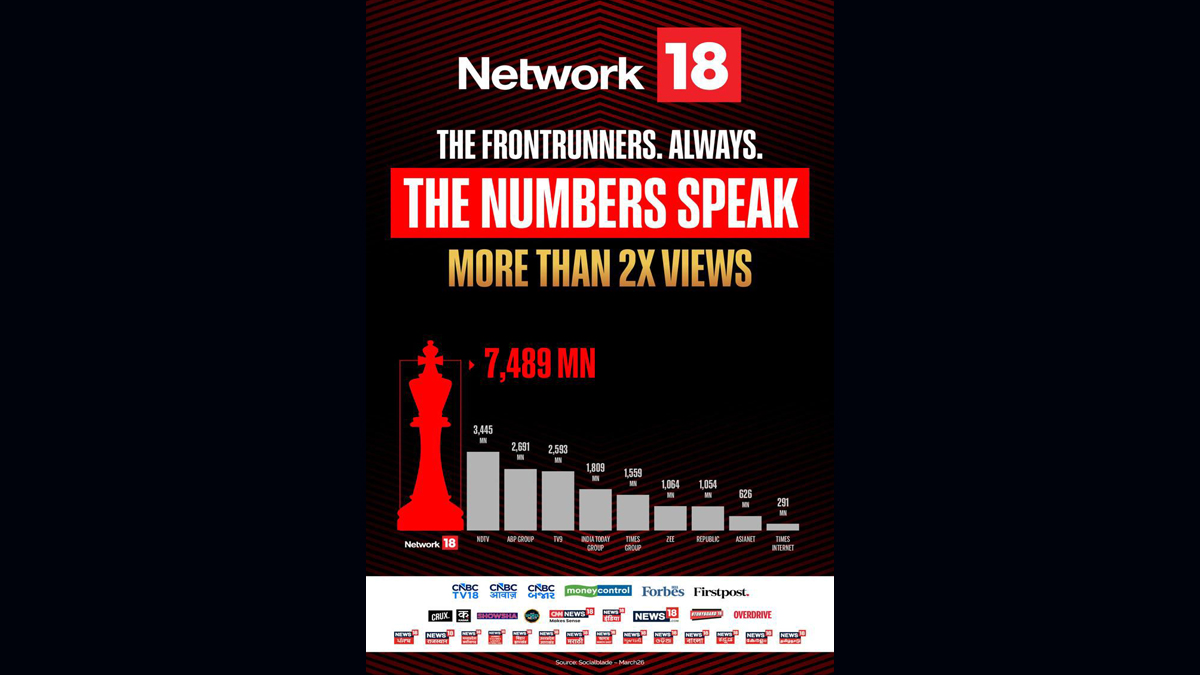
MUMBAI: When the world hit refresh on breaking news, Network18’s channels were already streaming ahead. As geopolitical tensions and war-driven headlines fuelled a surge in global news consumption, the network’s digital playbook delivered big clocking record Youtube viewership across English, Hindi and business news categories in March 2026.
At the forefront was CNN-News18, which emerged as the clear leader in the English news segment with 130 million live and video-on-demand views. The channel edged past competitors such as Times of India (126.5 million), Times Now (101.1 million), India Today (88.2 million) and NDTV (77.5 million), according to Databeings data for March.
In the Hindi news arena, News18 India delivered a commanding performance, racking up a staggering 3,297 million views on YouTube. The channel comfortably outpaced NDTV India, which recorded 3,119 million views, underlining its deep reach and consistent engagement with mass audiences, as per Playboard data.
The network’s dominance wasn’t confined to general news. In the Hindi business segment, CNBC Awaaz topped the charts with 92 million views, narrowly ahead of Zee Business (90 million) and well ahead of ET Now Swadesh (57 million). Meanwhile, its English counterpart CNBC-TV18 posted a strong 58 million views, reinforcing the network’s cross-category strength.
The spike in viewership reflects a broader shift in audience behaviour, with viewers increasingly turning to digital platforms particularly Youtube for real-time updates and in-depth coverage during high-intensity news cycles. For Network18, the numbers signal more than just scale; they underline the effectiveness of a multi-platform strategy that blends speed, credibility and continuous coverage.
In a month where the news never paused, it seems viewers chose to stay tuned where the stream never stopped.






