News Broadcasting
Zee Business races ahead of its competitors in Barc news ratings


Mumbai: Zee Business has grabbed the position of top business channel in India in the critical broadcast segment, according to data provided to the business channel by Broadcast Audience Research Council (Barc).
According to the relative share data released by the association (Business news genre, week 10 of 2022 (avg rolling data) HSM all 22+ male ABC, 0600 – 2400 hrs), Zee Business scored the top place with 59.7 percent relative share, while the rest of the business news channels combined have 40.3 per cent relative share.
“A big thanks to the viewers of Zee Business as we continue to be the top choice and the voice of the consumers,” commented Zee Business managing editor Anil Singhvi. “We will continue to empower our viewers on smart investment decisions that can help them make profits. This feat has now become a habit for the channel. We are the only channel that provides jargon-free information to the viewers in the simplest language possible which helps them make sound investment decisions.”

“I take this opportunity to thank our viewers for their continued confidence in our channel Zee Business and this has helped us to be in the top position,” stated Zee Media Corp Ltd head of marketing Anindya Khare. “Zee Business is always educating and explaining the viewers on the nuances of the stock market. We are always trying to find new ways to help and educate our audiences on various matters related to finance and share our expert views on the channel.”







News Broadcasting
Network18 channels lead YouTube news viewership in March 2026
CNN-News18, News18 India and CNBC channels top categories with record views
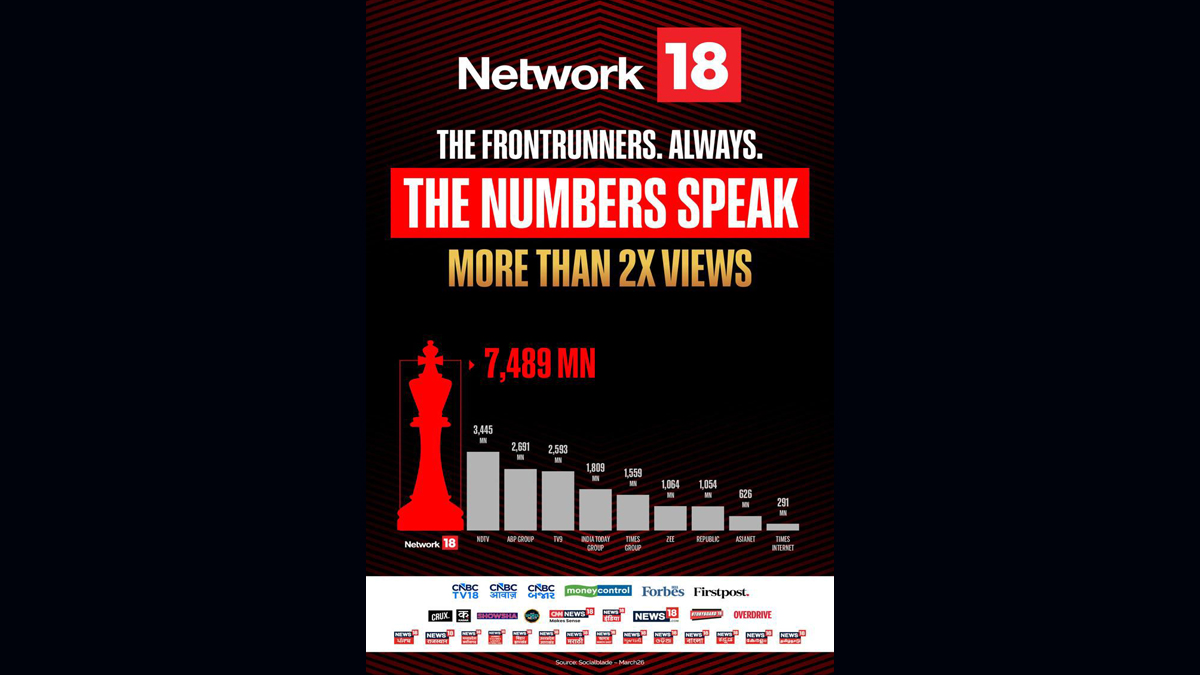
MUMBAI: When the world hit refresh on breaking news, Network18’s channels were already streaming ahead. As geopolitical tensions and war-driven headlines fuelled a surge in global news consumption, the network’s digital playbook delivered big clocking record Youtube viewership across English, Hindi and business news categories in March 2026.
At the forefront was CNN-News18, which emerged as the clear leader in the English news segment with 130 million live and video-on-demand views. The channel edged past competitors such as Times of India (126.5 million), Times Now (101.1 million), India Today (88.2 million) and NDTV (77.5 million), according to Databeings data for March.
In the Hindi news arena, News18 India delivered a commanding performance, racking up a staggering 3,297 million views on YouTube. The channel comfortably outpaced NDTV India, which recorded 3,119 million views, underlining its deep reach and consistent engagement with mass audiences, as per Playboard data.
The network’s dominance wasn’t confined to general news. In the Hindi business segment, CNBC Awaaz topped the charts with 92 million views, narrowly ahead of Zee Business (90 million) and well ahead of ET Now Swadesh (57 million). Meanwhile, its English counterpart CNBC-TV18 posted a strong 58 million views, reinforcing the network’s cross-category strength.
The spike in viewership reflects a broader shift in audience behaviour, with viewers increasingly turning to digital platforms particularly Youtube for real-time updates and in-depth coverage during high-intensity news cycles. For Network18, the numbers signal more than just scale; they underline the effectiveness of a multi-platform strategy that blends speed, credibility and continuous coverage.
In a month where the news never paused, it seems viewers chose to stay tuned where the stream never stopped.






